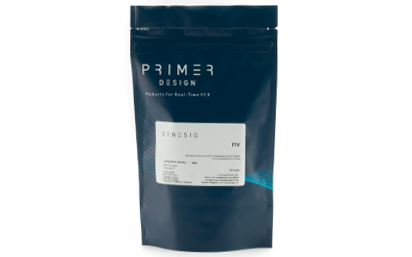
Primer and probe mix (150 reactions) Reverse Transcription, target specific primers (RNA genome viruses only) Copy number standard curve (sufficient for multiple standard curves) Internal extraction control – Read through VIC channel* Endogenous control (150 tests) RNAse/DNAse free water *alternative fluorophores available on request
Nucleic acid testing (NAT) is the method of choice for detection and quantification of a wide range of micro organisms. Primerdesign manufactures and supplies high quality quantitative real-time PCR kits for the detection and simultaneous quantification of numerous significant pathogens . A copy number standard curve is provided for quantification and an the internal extraction template (DNA or RNA), controls for the quality of the nucleic acid extraction and eliminates false negative results.
The kit is designed with the broadest possible detection profile to ensure that all clinically relevant strains and subtypes are detected. Target sequences are selected by working with data from key opinion leaders in the field. Multiple sequence alignments and unprecedented real-time PCR expertise in design and validation ensure the best possible kit. Details of the target and priming specificity are included in the individual handbooks above.
Packaged, optimised and ready to use. Expect Better Data.
Blood samples contain rich DNA, including mitochondrial DNA, genomic DNA, circulating DNA (mostly released into blood after tumor cell apoptosis) in white blood cells, as well as parasitic viral or microbial DNA. These DNA are important parameters in clinical testing or diagnosis, which are also valuable materials for medical research. There are three main issues with extracting DNA from blood samples:
1. The sample is highly infectious, posing great harm to operators and the environment.
2. The source of DNA is complex and aportion of the nucleic acid, such as viral DNA or free DNA, may be lost during the operation, leading to downstream detection failure;
3. Blood sample contains a large amount of impurities and inhibitory factors.
Currently there are many methods available for extracting DNA from whole blood samples, such as phenol chloroform extraction, salting out method, etc. However, these methods require pre-treatment of blood sample, which removes red blood cells and isolate white blood cells in the first step. Due to the requirement that it cannot inactivate or kill pathogens during the process of removing red blood cells, the waste liquid (red blood cell lysate) and consumables may be contaminated by pathogens and become infectious, posing a danger to the entire laboratory environment and operators. In addition, during the process of removing red blood cells, useful nucleic acid information such as viruses, microorganisms, or circulating DNA is also lost, leading to experiment or detection failures.
The HiPure Blood DNA Kits series provided by Magen Company uses silica gel column purification technology, which can directly lyse whole blood samples without the need for white blood cell separation. Whole blood samples are directly mixed with lysates and proteases, resulting in the inactivation of pathogens, greatly reducing the infectivity, environmental pollution, and the chance of operators being infected. Due to the direct lysis and digestion of samples, except lymphocyte DNA, other circulating DNA as well as DNA from viruses and microorganisms, can also be recovered.
This product provides fast and easy methods for purification of total DNA for reliable PCR and Southern blotting. Total DNA (e.g., genomic, viral, mitochondrial) can be purified from whole blood, tissue and culture cells.
Details
Specifications
Features
Specifications
Main Functions
Isolation total DNA from 10ml blood and 1g tissue using Maxi column
Applications
PCR, southern bolt and virus detection, etc
Purification method
Maxi spin column
Purification technology
Silica technology
Process method
Manual (centrifugation or vacuum)
Sample type
Tissue, cell, blood, saliva, swab, blood spot, semen and other clinical samples
Sample amount
3-10ml
Elution volume
≥700μl
Time per run
≤90 minutes
Liquid carrying volume per column
4ml
Binding yield of column
5mg
Principle
This product is based on silica column purification. The sample is lysed and digested with lysate and protease, DNA is released into the lysate. Transfer to an adsorption column. Nucleic acid is adsorbed on the membrane, while protein is not adsorbed and is removed with filtration. After washing proteins and other impurities, Nucleic acid was finally eluted with low-salt buffer (10mm Tris, pH9.0, 0.5mm EDTA).
Advantages
High quality DNA – meet a variety of downstream applications, including PCR, qPCR, enzyme digestion, hybridization, etc.
Fast – without separation of leukocytes, organic extraction or ethanol precipitation
Simple – all nucleic acids can be obtained by direct digestion
Pertinence – specially designed for isolating DNA from 3-10ml blood and related body fluids
Wide applicability – handle a variety of liquid samples
Proteinase K, RNase A should be stored at 2-8°C upon arrival. However, short-term storage (up to 12 weeks) at room temperature (15-25°C) does not affect their performance. The remaining kit components can be stored at room temperature (15-25°C) and are stable for at least 18 months under these conditions.
*Note:Leukocyte protocol can be used when large volume whole blood samples need to be processed. Whole blood was treated with red blood cell lysate, and white blood cells were obtained by centrifugation before extraction
Document
Blood samples contain rich DNA, including mitochondrial DNA, genomic DNA, circulating DNA (mostly released into blood after tumor cell apoptosis) in white blood cells, as well as parasitic viral or microbial DNA. These DNA are important parameters in clinical testing or diagnosis, which are also valuable materials for medical research. There are three main issues with extracting DNA from blood samples:
Apply to drying in laboratories such as cosmetics, fermentation broth, soil, materials, etc.
product description:
9kg-12kgs water capture capacity, which can meet the needs of laboratories with large freeze-drying requirements for water capture capacity
-70°C/-90°C ultra-low temperature cold trap, which can capture lower temperature organic solvents
Unique refrigeration technology, the cooling time of the cold trap from the start of the low-temperature refrigeration system to the target value is ≤3 minutes
Hemispherical cold trap bottom surface is more conducive to the discharge of condensed water
The cold trap and condenser coil are all Teflon anti-corrosion treatment, which can freeze-dry a large amount of ultra-low temperature organic solvents
One-click hot gas defrost, with defrost compressor protection program.
Large flat flange silicone seal, permanently no need to apply any auxiliary sealing silicone grease
High-precision ultra-wide width detection, vacuum sensor with full-range automatic temperature compensation, making vacuum display more accurate
The cavity vacuum can be read and controlled accurately, and the vacuum control accuracy is ≤0.1mbar
Removable sample shelf with dedicated holes for centrifuge tube placement, making placement and height adjustment easier
Configuration of various types of chambers and T-frames can fully satisfy users’ sample placement
Optional configuration of eutectic point detection system and data export system.
The vacuum pump and sample placement chamber can be combined at will according to user needs, making the configuration more flexible and convenient
Techinical parameter
9-12L Floor tabletop and floor standing one for lab usage
Tabletop
BD1-9
BD2-9
BD1-12
BD2-12
Floor standing
BH1-9
BH2-9
BH1-12
BH2-12
Water Capture capacity
9L
12L
Cold trap temperature
-70 C
-90℃
-70C°
-90℃
Cold trap volume
15L
20L
Freeze dried chamber
High permeability organic glass/multi manifold external valve/stainless steel chamber