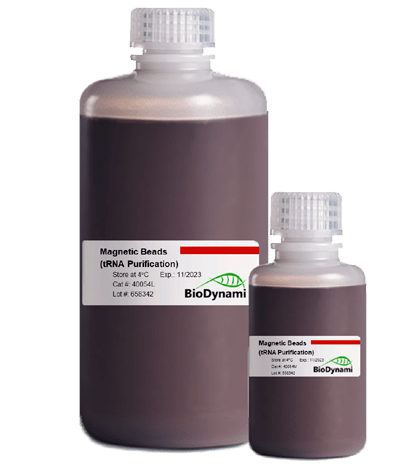
Solid Phase Reversible Immobilization magnetic beads has been used for nucleic acids purification because they are effective, simple, and fast. The carboxyl groups coated beads are paramagnetic particles that reversibly bind to nucleic acid. However, there is a drawback for magnetic beads that it can only purify DNA/RNA that are 100 base pairs or longer. tRNA and other DNA/RNA fragments shorter than 100 base pairs are not effectively recovered. We have developed Magnetic Beads (tRNA Purification) to overcome the hurdle.
Detail
Magnetic Beads (tRNA Purification)
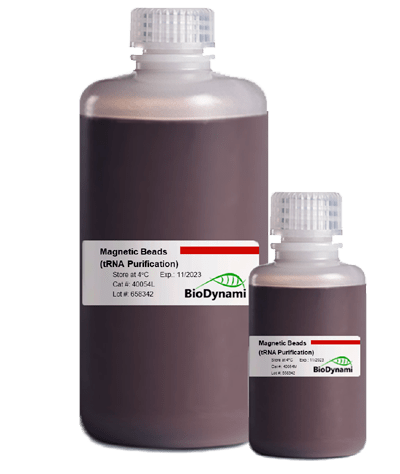
Solid Phase Reversible Immobilization magnetic beads has been used for nucleic acids purification because they are effective, simple, and fast. The carboxyl groups coated beads are paramagnetic particles that reversibly bind to nucleic acid. However, there is a drawback for magnetic beads that it can only purify DNA/RNA that are 100 base pairs or longer. tRNA and other DNA/RNA fragments shorter than 100 base pairs are not effectively recovered. We have developed Magnetic Beads(tRNA Purification) to overcome the hurdle.
The Magnetic Beads(tRNA Purification) solves the tRNA and short DNA/RNA purification problem. The beads with our proprietary technology purify tRNA effectively by removing impurities and unwanted components such as dNTPs, detergents, salts, proteins, and other contaminants. The magnetic bead reagents can be used for oligo (>70 nt) applications.
Workflow without large RNA/DNA contamination
In the case of samples contaminated with RNA/DNA such as rRNA and DNA, our magnetic beads can effectively remove RNA/DNA that are 180 nt and larger. Purified tRNA are ideal for applications requiring high quality, as the fragments are free of impurities and contaminants.
Workflow with large RNA/DNA contamination
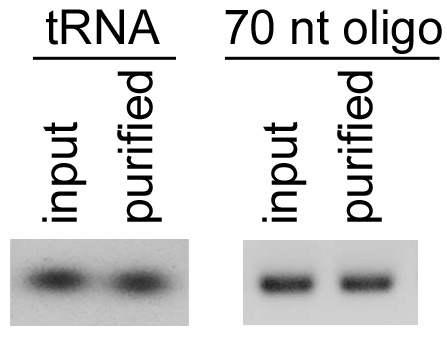
Comparison of tRNA and 70 nt oligos recovery. BioDynami beads (tRNA purification) successfully recovered DNA fragments both yeast tRNA and 70 nt oligos.
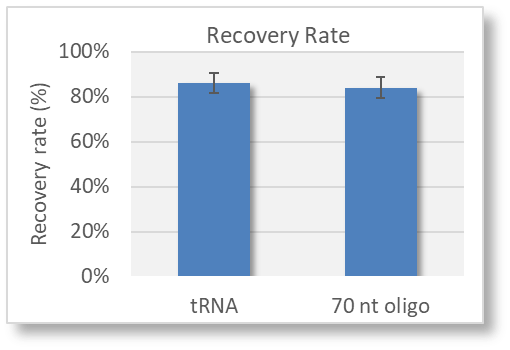
Recovery of tRNA and 70 nt oligos with BioDynami magnetic Beads (tRNA Purification). Yeast tRNA and 70 nt oligos were used as input. Input and recovered oligos were quantified with ssDNA Quantification kit (BioDynami Cat. # 40043) and RNA Quantification kit (BioDynami Cat. # 40044).
Depletion of larger RNAs. Left panel: depletion of 28S rRNA and 18S rRNA. Right panel: depletion of RNA of 180 nt and larger.
Features
Removal of unwanted components and other impurities
Purification of tRNA and oligos (>70 nt)
tRNA
RNA fragments 70 nt or longer
DNA/RNA hybrid fragments 70 nt or longer
Oligo and chimeric oligo 70 nt or longer
dsDNA fragments 70 bp or longer
ssDNA fragments 70 nt or longer
Removal of larger RNA/DNA contamination:
18S rRNA
28S rRNA
RNA/DNA> 180 nt
Other Products
Low Abundance RNA Quantification Kit
Product Info
Document
Product Info
Overview
Quantify RNA of a wide spectrum of concentrations, including the lower ng per µL and pg per µL range
Compatible with any Real-Time PCR system
RNA is accurately quantified using a standard curve constructed from the provided RNA standard
Norgen’s Low Abundance RNA Quantification Kit offers a PCR-based detection procedure to quantify RNA of a wide spectrum of concentrations, including the lower ng per µL and pg per µL range. The kit has two main enzymatic components – reverse transcription using Norgen’s microScript Reverse Transcription system and PCR Master Mix used in conjunction with a specially formulized primer mixture, to amplify human RNA from different types of inputs (such as various liquid biopsies). The kit is compatible with any Real-Time PCR system with the addition of fluorescent nucleic acid stains such as SYBR Green. The unknown RNA is accurately quantified by using a standard curve constructed from the provided RNA Standard.
Storage Conditions Upon receipt, store Norgen’s Low Abundance RNA Quantification Kit at -20°C or lower. Avoid multiple freeze-thaw cycles. If needed, prepare smaller working aliquots and store at -20°C or lower.
This test discovers beer germs in a timely and precise manner
Method/Platform
PCR
Range/Assay Sensivity
10^4 – 10^5 cfu/mL
Test Principle
The technological basis for the GenLine tests is the polymerase chain reaction (PCR) combined with lateral flow tests.
Labelled specific primers are used to amplify specific DNA fragments. In addition to the target gene, a control gene, which is also present in the PCR mixes, is amplified in order to make sure that the PCR process works properly.
The resulting PCR products carry the labels of the incorporated primers.
In a second part of the test, the created PCR products are detected by a lateral flow Test Strip. A “molecular sandwich” is formed and becomes visible as a line on the test Strip.
Document
Brief Instructions The PCR reagents and the samples are prepared. After the addition of the sample to the PCR reagents, the PCR is started. The resulting PCR products are detected by a simple lateral flow test
Livestock Disease Kit with African swine fever virus Test Kit for Nucleic Acid Detection
Product parameters:
Kit composition(WLRE8208KIT 48T/Pack)
Composition
Content
E buffer
1 mL×2 Tubes
B buffer
150 μL×1Tube
Positive control template
100 μL×1Tube
Reagents
48T
Product features and advantages:
Product features and advantages
Features
Advantages
High sensitivity
1 copies/ml
Strong specificity
Specificity is superior to PCR
Short reaction time
20min
Polymorphic reagent
Liquid, freeze-dried powder, freeze-dried ball
Easy to operate
Few steps of liquid dispensing; It is even possible to add only samples and amplify to get the resultsDesign of primers and probe is simple
Easy to store and transport
It is best preserved at -20℃, and can be stored at room temperature for up to 30 days in a cool place away from light.The freeze-dried form has a long storage time and is convenient for transportation
Low requirements on equipment
Applicable to Applied Biosystems 7500, QuantStudio 3/5, QuantStudio 6/7 Flex fluorescence quantitative PCR instrument;Applicable to our WL-16-III and other isothermal fluorescence detector
Product application:
Application
Ultra-clean laboratory
African Swine Fever Virus Isothermal Detection
Indoor
Operation procedure and process:
Take out the liquid components of the kit in advance, thaw at room temperature, and shake to mix.
Prepare freeze-dried reagents according to the number of samples to be tested, negative and positive controls, and add 37.5 μL E buffer to each freeze-dried reagent.
Select the appropriate nucleic acid extraction method and reagent to extract the sample nucleic acid
Add 10 μL nucleic acid template to the reaction tube (the amount of template can be adjusted to be filled with sterile water; That is, 10 μL nucleic acid template plus sterile water), 10 μL positive control template was added to positive control, and 10 μL sterile water was added to negative control
Add 2.5μL B buffer to each reaction tube and close the tube cap (for multiple reactions, it is recommended to add B buffer to the inside of the tube cap)
Thoroughly mix the reaction tube upside and down for 8-10 times. After mixing, shake (or rapidly centrifuge) the reaction liquid to the bottom of the tube and transfer it to the amplification zone.
Performence Comparison Data:
No.
TT value
Template concentration
Result determination
1
4.2
10-1
Positive
2
5.5
10-2
Positive
3
10.2
10-3
Positive
4
17.0
10-4
Positive
5
12.0
10-5
Positive
6
–
10-6
Negative
7
–
10-7
Negative
8
Negative control
Negative
Support and Services:
Livestock Disease Kit Technical Support and Services
We provide technical support and services for our Livestock Disease Kit. We are committed to helping you get the most out of your product and ensuring your satisfaction with our products and services.
Our technical support staff is available to answer any questions you may have about the product.
We offer online tutorials and user guides to help you understand the product better.
We provide technical assistance to help troubleshoot any issues you may be having with the product.
We offer a warranty on our products.
If you have any questions or need technical support, please do not hesitate to contact us. We are here to help you make the most of your Livestock Disease Kit.
FAQ:
Q: What diseases can Livestock Disease Kit detect? A: Livestock Disease Kit can detect different infectious diseases, such as Foot and Mouth Disease, Bluetongue Disease, Bovine Viral Diarrhea.
Q: How does Livestock Disease Kit work? A: Livestock Disease Kit uses advanced MIRA technology to amplify the target DNA/RNA targent sequences , and detect the disease by analyzing the amplified sequences.
Q: How long does it take to get results from Livestock Disease Kit? A: Livestock Disease Kit can give a result within 5-20 mins.
Q: What type of sample is suitable for Livestock Disease Kit? A: Livestock Disease Kit is suitable for blood, serum, and tissue samples.
Q: Does Livestock Disease Kit require professional equipment? A: No, Livestock Disease Kit does not require any professional equipment,can use with our isothermal equipment or pcr machine
Document
Livestock Disease Kit with African swine fever virus Test Kit for Nucleic Acid Detection