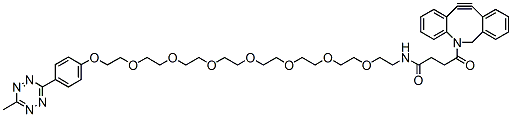
Methyltetrazine-PEG7-DBCO is a PEG linker with a terminal TCO reactive reagent and a DBCO group. DBCO is commonly used for copper-free Click Chemistry reactions. Methyltetrazine can be used to convert azido-containing peptides or proteins into tetrazine-modified peptides or protein without catalyst or axillary reagents. Reagent grade, for research purpose. Please contact us for GMP-grade inquiries.
Detail
Methyltetrazine-PEG7-DBCO is a PEG linker with a terminal TCO reactive reagent and a DBCO group. DBCO is commonly used for copper-free Click Chemistry reactions. Methyltetrazine can be used to convert azido-containing peptides or proteins into tetrazine-modified peptides or protein without catalyst or axillary reagents. Reagent grade, for research purpose. Please contact us for GMP-grade inquiries.
Other Products
Cell Culture Media Exosome Purification and RNA Isolation Kits
Product Info
Document
Product Info
Overview
Purification and enrichment of intact cell culture media exosomes for functional studies
Isolate all sizes of RNA, including microRNA, irrespective of size or GC content, without bias.
Versatile cell culture media input volumes
No phenol extractions, Proteinase K treatment, nor carrier RNA required
No time-consuming ultracentrifugation, filtration nor special syringes required
No precipitation reagents nor overnight incubation required
Pure exosomes are purified and are free from any other RNA-binding proteins
Purification is based on spin column chromatography that uses Norgen’s proprietary resin
The purified RNA is suitable for a variety of downstream applications, including Small RNA Sequencing. Find out more information on Norgen’s NGS services
Norgen’s Cell Culture Media Exosome Purification and RNA Isolation Kits constitute an all-in-one system for the purification of exosomes and the subsequent isolation of exosomal RNA from different cell culture media sample volumes. The purification is based on spin column chromatography that employs Norgen’s proprietary resin. The kit is designed to isolate all sizes of RNA, including microRNA, irrespective of size or GC content, without bias. These kits provide a clear advantage over other available kits in that they do not require any special instrumentation, protein precipitation reagents, extension tubes, phenol/chloroform or protease treatments. Moreover, the kits allow the user to elute into a flexible elution volume ranging from 50 µL to 100 µL. The RNA isolated from the purified exosomes is free from any protein-bound circulating RNA and is of the highest integrity. The purified RNA can be used in a number of downstream applications including real time PCR, reverse transcription PCR, Northern blotting, RNase protection and primer extension, and expression array assays.
Cell Culture Media Exosome Purification and RNA Isolation Mini Kit
For sample input volumes ranging from 5 mL to 10 mL.
Cell Culture Media Exosome Purification and RNA Isolation Midi Kit
For sample input volumes ranging from 10 mL to 20 mL.
Cell Culture Media Exosome Purification and RNA Isolation Maxi Kit
For sample input volumes ranging from 20 mL to 35 mL.
All sizes, including miRNA and small RNA (<200 nt)
Elution Volume
50-100 μL
Time to Complete 10 Purifications
40-45 minutes
Average Yields*
Variable depending on specimen
*Please check page 4 of the product insert for Average Yields and Common RNA Quantification Methods.
Storage Conditions and Product Stability All buffers should be kept tightly sealed and stored at room temperature. This kit is stable for 2 years from the date of shipment. It is recommended to warm Lysis Buffer A for 20 minutes at 60ºC if any salt precipitation is observed.
[CD1020] SMOChem™ Deoxynucleotide (dNTP) Mix, 25 mM each (100 mM total), 500 µl
Product Info
Document
Product Info
Description
The SMOChem™ Deoxynucleotide (dNTP) Mix is an aqueous solution that contains an equimolar solution of ultrapure dATP, dCTP, dGTP and dTTP, each at a concentration of 25 mM at pH 8.5. The dNTP Mix is designed for many different molecular biology applications that involved in DNA synthesis or labeling, such as PCR, real-time PCR, DNA sequencing, reverse transcription, primer extension, and etc. The dNTP Mix is free of exo-deoxyribonuclease and endo-deoxyribonuclease as well as ribonuclease activity. The dNTP Mix offers the possibility to reduce the number of pipetting steps and the risk of reaction set up errors.
Features
Ideal for PCR amplification and cDNA synthesis
Premixed solution
Nuclease and ribonuclease free
Applications
PCR amplification of DNA fragments
DNA fill-in reaction
DNA sequencing
Reverse transcription
One-step RT-PCR
Storage
-20°C for 36 months
Document
The SMOChem™ Deoxynucleotide (dNTP) Mix is an aqueous solution that contains an equimolar solution of ultrapure dATP, dCTP, dGTP and dTTP, each at a concentration of 25 mM at pH 8.5. The dNTP Mix is designed for many different molecular biology applications that involved in DNA synthesis or labeling, such as PCR, real-time PCR, DNA sequencing, reverse transcription, primer extension, and etc. The dNTP Mix is free of exo-deoxyribonuclease and endo-deoxyribonuclease as well as ribonuclease activity. The dNTP Mix offers the possibility to reduce the number of pipetting steps and the risk of reaction set up errors.
Cysticercosis is caused by larval cysts of the tapeworm Taenia solium and is a major cause of adult onset seizures in most developing countries. Diagnosis is based on imaging findings, but in many cases it is not conclusive for the diagnosis. Serological assays has an important place on the final diagnosis of the disease. The ELISA kit hs shown appropriate performances for the serological screening of cysticercosis.
Name of Product
Taenia solium – IgG ELISA
Catalog Number
AF 9700
Short Info
Cysticercosis is caused by larval cysts of the tapeworm Taenia solium and is a major cause of adult onset seizures in most developing countries. Diagnosis is based on imaging findings, but in many cases it is not conclusive for the diagnosis. Serological assays has an important place on the final diagnosis of the disease. The ELISA kit hs shown appropriate performances for the serological screening of cysticercosis.
This product is manufactured by Bordier Affinity Products in Switzerland and distributed in Germany exclusively by Milenia Biotec.
Method/Platform
ELISA in microplate format
Range/Assay Sensivity
98% sensitivity, 98% specificity
Test Principle
The kit provides all the material needed to perform 96 enzyme-linked immunosorbent assays (ELISA) on breakable microtitration wells sensitized with Taenia solium cyst soluble antigens. Specific antibodies in the sample will bind to these antigens and washing will remove unspecific antibodies. The presence of parasite specific antibodies is detected with a Protein A – alkaline phosphatase conjugate. A second washing step will remove unbound conjugate. Revealing bound antibodies is made by the addition of pNPP substrate which turns yellow in the presence of alkaline phosphatase. Color intensity is proportional to the amount of Taenia solium specific antibodies in the sample. Potassium phosphate is added to stop the reaction. Absorbance at 405 nm is read using an ELISA microplate reader. The test can be performed with automatic systems, but this must be validated by the user.
Document
Cysticercosis is caused by larval cysts of the tapeworm Taenia solium and is a major cause of adult onset seizures in most developing countries. Diagnosis is based on imaging findings, but in many cases it is not conclusive for the diagnosis. Serological assays has an important place on the final diagnosis of the disease. The ELISA kit hs shown appropriate performances for the serological screening of cysticercosis.