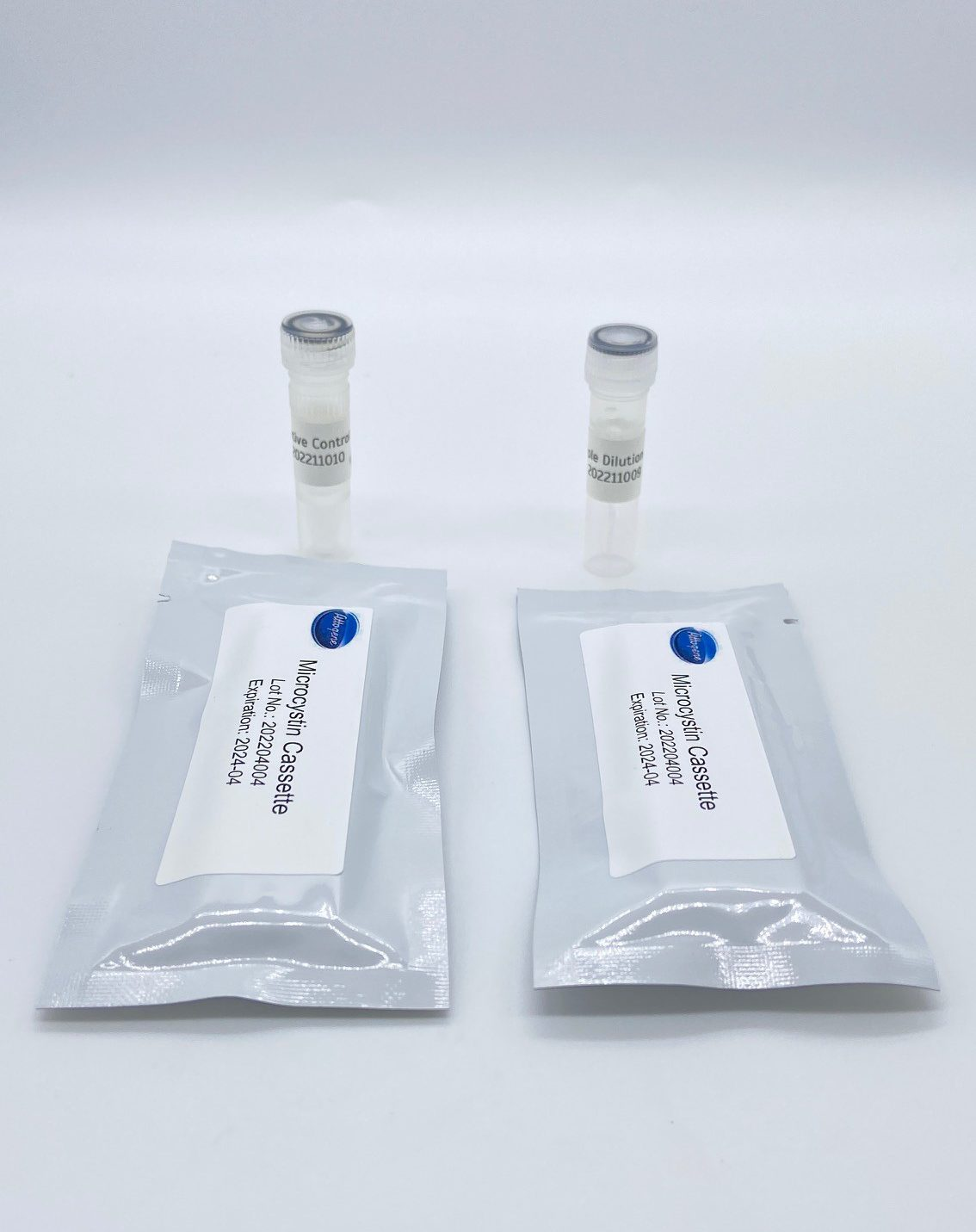
Screening of Microcystins in water samples at 0.1 ppb (drinking water) Format: 10 tests (5 tests/5 controls) Not provided: Water Sample Bottles Run Time: 15 Minutes Finished Drinking Water
Detail
Screening of Microcystins in water samples at 0.1 ppb (drinking water)
Attogene’s Microcystin Test Kit (Rapid – Drinking Water) can be used to detect microcystins in water to as low as 0.1ppb; highly sensitive, rapid, robust screening kit for microcystins and nodularins.
The most frequently reported cyanobacterial toxins are the hepatotoxic microcystins (MCs). MCs are peptides with a molecular weight ranging from 900 to 1,100 Da. They consist of seven amino acids of which the two terminal amino acids of the linear peptide are condensed to form a cyclic compound.
A tiered notification system which takes different actions based on thresholds for microcytin-LR concentrations in drinking waters has been developed. This is guidance that allows states to take various actions.
For the rapid screening of microcystins in drinking water samples at or above 0.1 ppb. Samples requiring regulatory action should be confirmed by ELISA, HPLC, or other conventional methods.
To protect consumers from adverse health effects caused by these toxins, the World Health Organization (WHO) has proposed a provisional upper limit for Microcystin-LR of 1.0 ppb (μg/L) in drinking water.
The U.S. Environmental Protection Agency (EPA) has also established guidelines for Microcystins in drinking water:
-For children below school age, 0.3 μg/L (ppb)
-For all other age groups, 1.6 μg/L (ppb)
Other Products
R4185 HiPure Stool RNA Kit
Product Info
Document
Product Info
Introduction
Hipure Stool RNA Kit is specially designed for stool RNA extraction. This kit is suitable for extracting high-purity microbial or host cell RNA from ≤0.1g stool samples. The kit adopts silica gel column purification technology and original solution system, which can effectively remove humic acid and other inhibitory factors in stool samples. The purified RNA can be directly used in RT-PCR, Northern hybridization and other experiments.
Details
Specifications
Features
Specifications
Main Functions
Isolation total RNA from 100-150mg stool sample
Applications
RT-PCR, Northern hybridization and other experiments
Purification method
Mini spin column
Purification technology
Silica technology
Process method
Manual (centrifugation or vacuum)
Sample type
Stool
Sample amount
100-150 mg
Elution volume
≥30μl
Time per run
≤50 minutes
Liquid carrying volume per column
100µg
Binding yield of column
800µl
Principle
The HiPure silica gel column uses a high binding ability glass fiber filter membrane as the substrate. Under the condition of high concentration of ionizing agent (such as Guanidinium chloride or guanidine isothiocyanate), the filter membrane can adsorb nucleic acid through hydrogen bonding and electrostatic and other physical factors, while protein or other impurities are not adsorbed and removed. The filter membrane that has adsorbed nucleic acids is washed to remove proteins and salts. Finally, low salt buffer solution (such as Buffer TE) or water can be used to wash out the nucleic acids adsorbed on the filter membrane. The obtained nucleic acid has high purity and can be directly used in various downstream experiments.
The stool samples are homogenized in the lysis solution, further lysed in a high-temperature water bath, and RNA is released into the lysis solution. Chloroform extraction removes genomic DNA and impurities, transfer the supernatant to an alcohol free binding solution, purify RNA through a column, and finally elute RNA with RNase Free Water. The purified RNA can be directly used for experiments such as PCR, Southern hybridization, and enzyme digestion.
Advantages
High purity – unique adsorbent for more efficient removal of inhibitors
High concentration – maximum extraction of total RNA from stool samples
Sensitive – RNA can be purified at the level of PG
Kit Contents
Contents
R418502
R418503
Purification Times
50 Preps
250 Preps
HiPure RNA Mini Columns
50
250
2ml Collection Tubes
50
250
Glass Beads (0.1~0.6mm)
30 g
150 g
Buffer SPL
30 ml
140 ml
Buffer PHC
30 ml
140 ml
Buffer GRP
60 ml
250 ml
Buffer RW1
50 ml
250 ml
Buffer RW2 *
20 ml
2 x 50 ml
RNase Free Water
15 ml
30 ml
Storage and Stability
The kit components can be stored at room temperature (15–25°C) and are stable for 18 months under these conditions. At low temperatures, Buffer SPL may form precipitates, dissolve it by 55°C water bath. After receiving the product, Buffer PHC should be stored at 2-8°C.
Document
Hipure Stool RNA Kit is specially designed for stool RNA extraction. This kit is suitable for extracting high-purity microbial or host cell RNA from ≤0.1g stool samples. The kit adopts silica gel column purification technology and original solution system, which can effectively remove humic acid and other inhibitory factors in stool samples. The purified RNA can be directly used in RT-PCR, Northern hybridization and other experiments.
Short term stability: 2-8oC, Long term stability: See individual component labels
Stability:
> 2 years under recommended storage conditions
Analyte:
α-Amylase
Assay Format:
Spectrophotometer, Auto-analyser
Detection Method:
Absorbance
Wavelength (nm):
400
Signal Response:
Increase
Limit of Detection:
0.003 U/g
Reproducibility (%):
~ 3%
Total Assay Time:
~ 30 min
Application examples:
Cereal flours, fermentation broths and other materials.
Method recognition:
AACC Method 22-02.01, AOAC Method 2002.01, ICC Standard No. 303, RACI Standard Method and CCFRA (Flour Testing Working Group Method 0018)
The Ceralpha Method: α-Amylase test kit is suitable for the specific measurement and analysis of α-amylase in cereal grains and fermentation broths (fungal and bacterial).
All reagents stable for > 2 years after preparation
Very specific
Simple format
Mega-Calc™ software tool is available from our website for hassle-free raw data processing
Standard included
Validation of Methods
Document
The Ceralpha Method: α-Amylase test kit is suitable for the specific measurement and analysis of α-amylase in cereal grains and fermentation broths (fungal and bacterial).
DBCO-NHS Ester is a very popular amine-reactive click chemistry reagent. It can be used to modify an amine-containing molecule in organic solvents (limited solubility in aqueous media). It reacts with primary amines such as the side chain of lysine residues or aminosilane-coated surfaces at neutral or slightly basic pH to form covalent bonds. The low mass weight will add minimal spacer to modified molecules. DBCO is commonly used for copper-free Click Chemistry reactions. Reagent grade, for research purpose. Please contact us for GMP-grade inquiries.
Document
DBCO-NHS Ester is a very popular amine-reactive click chemistry reagent. It can be used to modify an amine-containing molecule in organic solvents (limited solubility in aqueous media). It reacts with primary amines such as the side chain of lysine residues or aminosilane-coated surfaces at neutral or slightly basic pH to form covalent bonds. The low mass weight will add minimal spacer to modified molecules. DBCO is commonly used for copper-free Click Chemistry reactions. Reagent grade, for research purpose. Please contact us for GMP-grade inquiries.