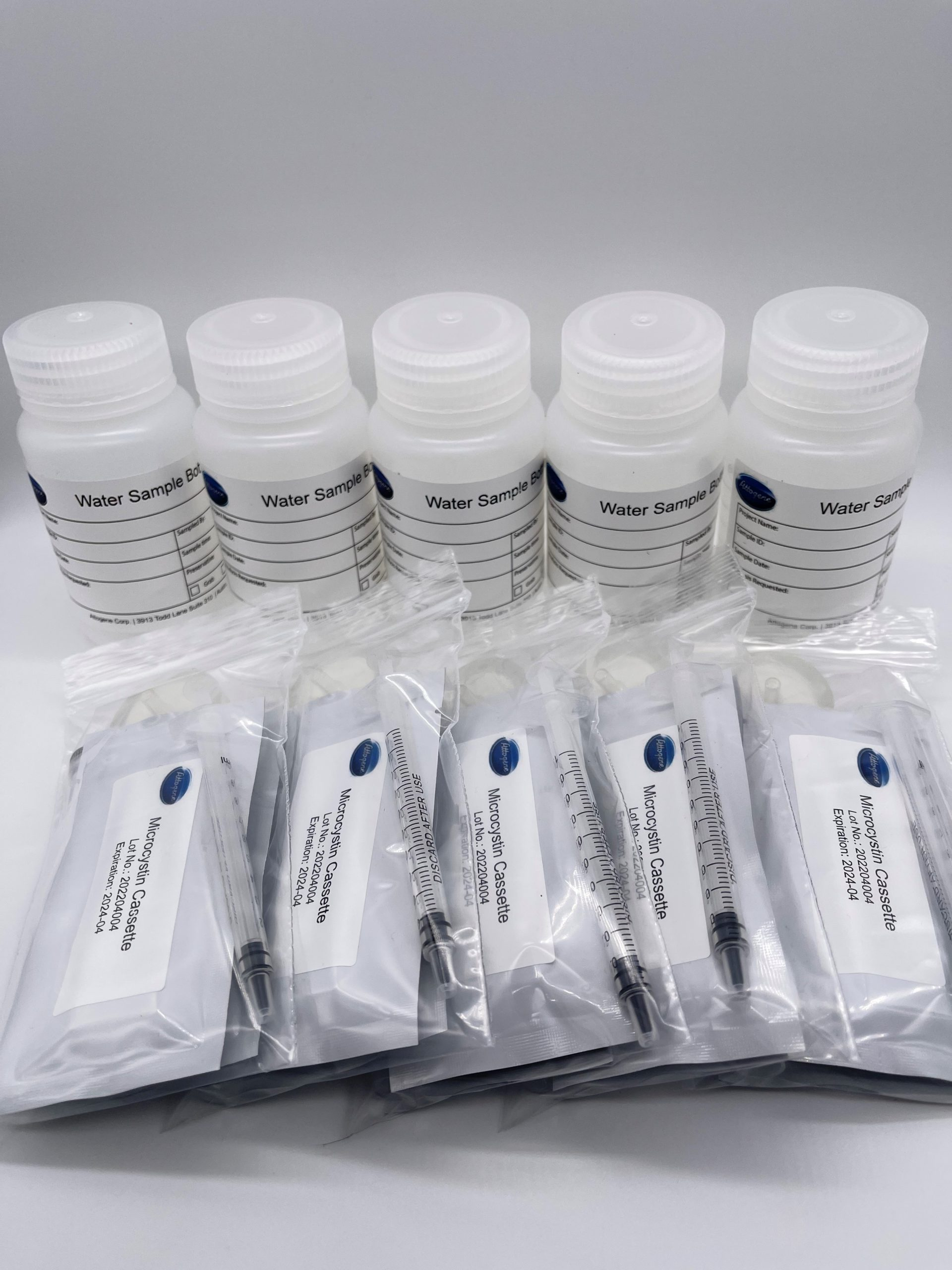
Screening of Microcystins in water samples at 6 ppb or lower Format: 10 tests (5 tests/5 control) Water Sample Bottles Negative Control 1mL Syringe Sample Dilution Buffer also sold separately Sample Filters
Detail
Screening of Microcystins in water samples at 6 ppb or lower
Attogene’s Microcystin Test Kit (Rapid – Recreational Water) can be used to detect microcystins in liquid samples; highly sensitive, rapid, robust screening kit for algae toxins microcystins and nodularins.
The most frequently reported cyanobacterial toxins are the hepatotoxic microcystins (MCs). MCs are peptides with a molecular weight ranging from 900 to 1,100 Da. They consist of seven amino acids of which the two terminal amino acids of the linear peptide are condensed to form a cyclic compound.
A tiered notification system which takes different actions based on different numeric thresholds for microcytin-LR concentrations in recreational waters has been developed. This is guidance that allows states to take various actions—such as posting information about harmful algal blooms (HABs), issuing a recreational public health advisory, or temporarily closing recreational waters through a no contact advisory—depending on the severity of the bloom event.
Microcystin-LR
Informational sign postings about HABs at recreational waters: < 6 μg/L Recreational public health advisory: 6 μg/L Elevated recreational public health advisory (e.g. no contact): 20 μg/L
X396 Combo 384-well/96-Well Magnetic Plate with Integrated Cushion Base
Product Info
Document
Product Info
Ideal magnet for all of your low volume needs. From Low elution 96-well PCR applications to 384-well, the X396 has you covered. No need to purchase two separate plates anymore. 96-well volumes as low as 5 µL are achieved from 96-well, PCR plates on the inside of the magnet, while the outside of each magnet will pull beads to well sides in 384-well plates.
ANSI/ SBS Footprint (127.75mm x 85.50mm) to fit into any automated liquid handling robot on bottom. ANSI/SBS footprint on top to accept all common microplates.
Integrated Cushion base for maximum recovery. Helps aid in set-up, robot positioning inconsistencies, and labware consumable inconsistencies
Features include solid aluminum alloy construction and hard coat anodized finish for years of trouble-free use, and compatible with any magnetic beads
Ideal magnet for all of your low volume needs. From Low elution 96-well PCR applications to 384-well, the X396 has you covered. No need to purchase two separate plates anymore. 96-well volumes as low as 5 µL are achieved from 96-well, PCR plates on the inside of the magnet, while the outside of each magnet will pull beads to well sides in 384-well plates.
Attogene’s Carbon Dioxide Enzymatic Assay Kit is a simple, direct method for measuring Carbon Dioxide levels in the environment. The assay uses a coupled enzyme assay to detect CO2 (as HCO3-) as follows. In the first step, the bicarbonate condenses with phosphoenol pyruvate to form oxalate (and phosphoric acid); this reaction is catalyzed by the enzyme Phosphoenolpyruvate Decarboxylase, PEPC. The oxalate is then enzymatically reduced by the enzyme Malate Dehydrogenase (using an NADH cofactor) to form malate and NAD+.
Purification and enrichment of intact urinary exosomes for functional studies
Isolate all sizes of RNA, including microRNA, irrespective of size or GC content, without bias.
Versatile urine input volumes
No phenol extractions, Proteinase K treatment, nor carrier RNA required
No time-consuming ultracentrifugation, filtration nor special syringes are required
No precipitation reagents nor overnight incubation required
Compatible with urine from most species
Pure exosomes are purified and are free from any other RNA-binding proteins
Purification is based on spin column chromatography that uses Norgen’s proprietary resin
The purified RNA is suitable for a variety of downstream applications, including Small RNA Sequencing. Find out more information on Norgen’s NGS services
Norgen’s Exosome Purification and RNA Isolation Kits constitute all-in-one systems for the purification of exosomes and the subsequent isolation of exosomal RNA from different urine sample volumes. The purification is based on spin column chromatography that employs Norgen’s proprietary resin. These kits are designed to isolate all sizes of RNA, including microRNA, irrespective of size or GC content, without bias. These kits provide a clear advantage over other available kits in that they do not require any special instrumentation, protein precipitation reagents, extension tubes, phenol/chloroform or protease treatments. Moreover, the kit allows the user to elute into a flexible elution volume ranging from 50 µL to 100 µL. The purified RNA is free from any protein-bound circulating RNA and of the highest integrity. The purified RNA can be used in a number of downstream applications including real time PCR, reverse transcription PCR, Northern blotting, RNase protection and primer extension, and expression array assays.
Urine Exosome Purification and RNA Isolation Mini Kit
For sample volumes ranging from 250 µL to 1 mL.
Urine Exosome Purification and RNA Isolation Midi Kit
For sample volumes ranging from 2 mL to 10 mL.
Urine Exosome Purification and RNA Isolation Maxi Kit
All sizes, including miRNA and small RNA (< 200 nt)
Elution Volume
50-100 μL
Time to Complete 10 Purifications
35 – 40 minutes
Average Yields*
Variable depending on specimen
*Please check page 4 of the product insert for the average yields and the common RNA quantification methods.
Storage Conditions and Product Stability All buffers should be kept tightly sealed and stored at room temperature. This kit is stable for 2 years after the date of shipment. It is recommended to warm Lysis Buffer A for 20 minutes at 60°C if any salt precipitation is observed.
Important Note Urine samples stored at -70°C, -20°C or at 4°C will develop some precipitation due to the aggregation of some of the highly abundant proteins in urine. Eliminating these precipitates using centrifugation or filtration may cause the loss of exosomes. Furthermore, these precipitates may affect the quality of the purified nucleic acid. We recommend the use of Norgen’s Urine Preservative when collecting urine samples, which is designed for the preservation of nucleic acids and proteins in fresh urine samples at ambient temperatures. The components of the Urine Preservative allow samples to be stored for over 2 years at room temperature with no detected degradation of urine DNA, RNA or proteins. Norgen’s Urine Preservative is available as a liquid format in Norgen’s Urine Preservative Single Dose Ampules, as well as in a dried format in Norgen’s Urine Collection and Preservation Tubes.