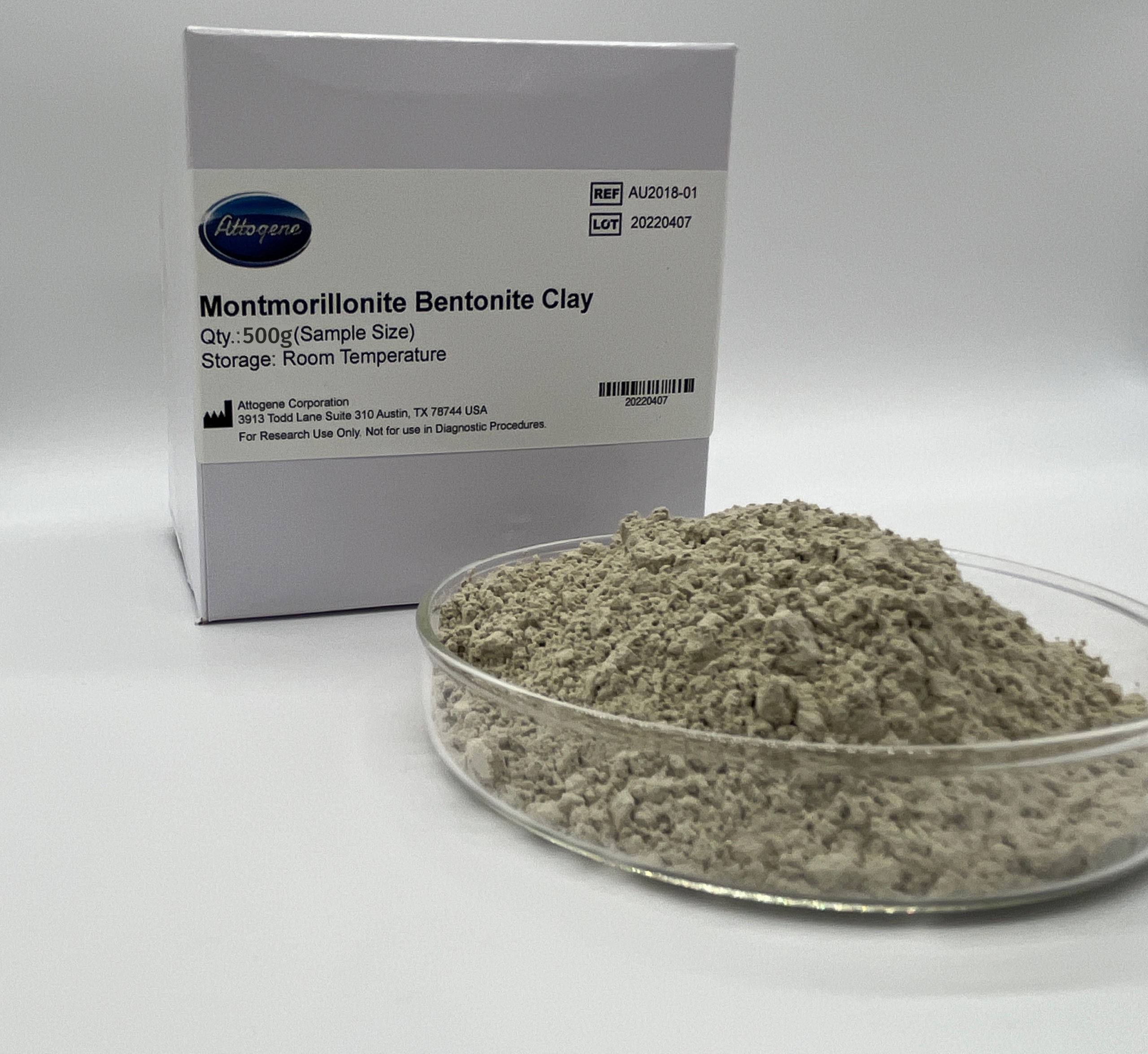
Promotes flocculation of cyanobacteria cell debris, binds residual phosphate compounds and promotes gradual settling of the cyanobacterial biomass on the sediment.
Attogene’s Montmorillonite Bentonite Clay binds toxins with high affinity and high capacity. Montmorillonite has been shown to be the active ingredient in bentonites. The proposed mechanism of action of Attogene’s Montmorillonite Bentonite Clay is through the adsorption of toxins (mainly onto the interlayer spaces of montmorillonite). Attogene’s Montmorillonite Bentonite Clay is a common anti-caking agent in animal feeds to adsorb aflatoxins and diminish their bioavailability. Its composite for application in drug system can be formed through the utilization of anionic, cationic, and nonionic surfactants.
Bentonite is a promising rock of clay which is found in nature. It is a major source of montmorillonite in nature. It is a rock produced of highly colloidal and plastic clays mainly comprised of montmorillonite. In addition to montmorillonite, bentonite may compose of some amount of crystalline quarz, cristobalite, and feldspar. Montmorillonite nanoclay is used as a drug carrier system and as an additive. Its composite for application in drug system can be formed through the utilization of anionic, cationic, and nonionic surfactants. These are used to improve basal spacing resulting in organo clay to be utilised in drug loading and drug release.
Other Products
027340 PYG Broth Base
Product Info
Document
Product Info
Introduction
Usages: For cultivation of bifidobacteria and lactic acid metabolites test.
Principle: Peptone, yeast extract provide nitrogen, vitamins, and growth factors; glucose as fermentable sugars; cysteine – HCl, vitamin K1, hemin, magnesium sulfate, calcium chloride, sodium chloride, sodium bicarbonate training offers various bifidobacteria growth factor; dipotassium hydrogenphosphate, potassium dihydrogenphosphate buffer.
endo-BCN-PEG2-acid is a PEG linker containing a BCN group and a terminal carboxylic acid. The BCN group can react with azide-tagged biomolecules. The terminal carboxylic acid can react with primary amine groups in the presence of activators (e.g. EDC, or HATU) to form a stable amide bond. Reagent grade, for research purpose. Please contact us for GMP-grade inquiries.
Document
endo-BCN-PEG2-acid is a PEG linker containing a BCN group and a terminal carboxylic acid. The BCN group can react with azide-tagged biomolecules. The terminal carboxylic acid can react with primary amine groups in the presence of activators (e.g. EDC, or HATU) to form a stable amide bond. Reagent grade, for research purpose. Please contact us for GMP-grade inquiries.
This product is suitable for extracting total RNA from 50-150mg conventional plantor fungal samples as well as samples rich in polyphenolic and polysaccharides. This kit is based on silica gel column purification technology, and the extraction process does not require the use of toxic phenol chloroform extraction. The entire extraction process only takes 20-30 minutes. This kit adopts DNA filtration technology, which can efficiently filter and remove DNA. The obtained RNA can be directly used for experiments such as RT-PCR, Northern Blot, poly A+ purification, nucleic acid protection, and in vitro translation.
Details
Kit Contents
Contents
R415002
D415003
Purification Times
50 Preps
250 Preps
HiPure RNA Mini Columns
50
250
gDNA Filter Columns
50
250
2ml Collection Tubes
100
500
TCEP (1M)
0.29 g
5 x 0.29 g
Buffer EP
1.0 ml
5.0 ml
Buffer PSL
50 ml
250 ml
Buffer RW1
50 ml
250 ml
Buffer RW2*
20 ml
2 x 50 ml
RNase Free Water
10 ml
30 ml
Storage and Stability
Except TCEP, the kit components can be stored dry at room temperature (15–25°C) and are stable for at least 18 months under these conditions. After receiving the product, it is recommended to store TCEP (dry powder) at -20-8°C. At low temperatures, Buffer PSL may form precipitates, dissolve it completely by 55°C water bath.
Purchase Guide
1. When dealing with woody or uncommon samples, R4150 is recommended first. R4150 contains two polysaccharide/polyphenol lysis buffer, which is the most universal product.
2. R4151 is recommended for handling common economic crop samples for the first time. Strong lysis solution can be used to process easy-extraction samples. The amount of corn or rice leaves samples can reach up to 300mg.
3. R4165 adopts CTAB/chloroform method, which can also handle a large number of difficult-to-extraction plants, but requires contact with chloroform substitutes, which is less safe than other kits. This kit uses DNase Ⅰ to remove DNA, which is also a good choice for extracting polysaccharide/polyphenol-rich plant samples.
4. R4014 is recommended for fruit/starch plant samples, which uses improved trizol pre-treatment, single column operation and is more economical.
Document
This product is suitable for extracting total RNA from 50-150mg conventional plantor fungal samples as well as samples rich in polyphenolic and polysaccharides. This kit is based on silica gel column purification technology, and the extraction process does not require the use of toxic phenol chloroform extraction. The entire extraction process only takes 20-30 minutes. This kit adopts DNA filtration technology, which can efficiently filter and remove DNA. The obtained RNA can be directly used for experiments such as RT-PCR, Northern Blot, poly A+ purification, nucleic acid protection, and in vitro translation.