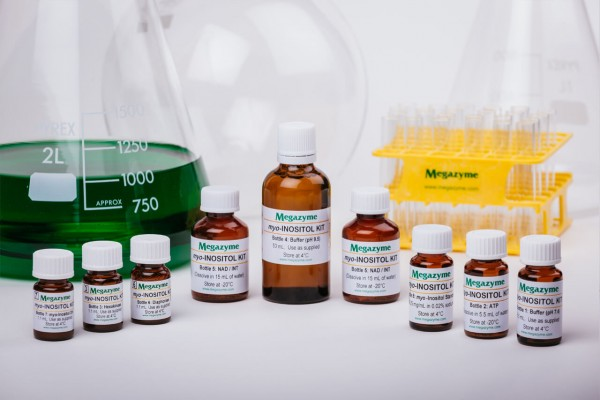
The myo-Inositol Assay Kit is a reliable and accurate enzymatic UV-method for the specific measurement and analysis of myo-inositol in animal feeds, foods and various other materials.
Detail
K-INOSL
SKU: 700004304
50 assays per kit
Content:
50 assays per kit
Shipping Temperature:
Ambient
Storage Temperature:
Short term stability: 2-8oC, Long term stability: See individual component labels
Stability:
> 2 years under recommended storage conditions
Analyte:
myo-Inositol
Assay Format:
Spectrophotometer
Detection Method:
Absorbance
Wavelength (nm):
492
Signal Response:
Increase
Linear Range:
2 to 35 µg of myo-inositol per assay
Limit of Detection:
0.8 mg/L
Reaction Time (min):
~ 30 min
Application examples:
Animal feeds, food and other materials.
Method recognition:
Novel method
The myo-Inositol Assay Kit is a reliable and accurate enzymatic UV-method for the specific measurement and analysis of myo-inositol in animal feeds, foods and various other materials.
Phytic acid content of samples with very low levels of free myo-inositol can also be determined using K-INOSL. This can be achieved by measuring the amount of myo-inositol released after de-phosphorylation of phytic acid with the enzymes phytase and alkaline phosphatase, as used with the Megazyme Phytic Acid/Total Phosphorus Assay Kit (K-PHYT).
Not suitable for the determination of myo-inositol in baby formula.
Note for Content: The number of manual tests per kit can be doubled if all volumes are halved. This can be readily accommodated using the MegaQuantTM Wave Spectrophotometer (D-MQWAVE).
All reagents stable for > 2 years after preparation
Only enzymatic kit available
Rapid reaction
Mega-Calc™ software tool is available from our website for hassle-free raw data processing
Standard included
Other Products
Cell Culture Media Exosome Purification and RNA Isolation Kits
Product Info
Document
Product Info
Overview
Purification and enrichment of intact cell culture media exosomes for functional studies
Isolate all sizes of RNA, including microRNA, irrespective of size or GC content, without bias.
Versatile cell culture media input volumes
No phenol extractions, Proteinase K treatment, nor carrier RNA required
No time-consuming ultracentrifugation, filtration nor special syringes required
No precipitation reagents nor overnight incubation required
Pure exosomes are purified and are free from any other RNA-binding proteins
Purification is based on spin column chromatography that uses Norgen’s proprietary resin
The purified RNA is suitable for a variety of downstream applications, including Small RNA Sequencing. Find out more information on Norgen’s NGS services
Norgen’s Cell Culture Media Exosome Purification and RNA Isolation Kits constitute an all-in-one system for the purification of exosomes and the subsequent isolation of exosomal RNA from different cell culture media sample volumes. The purification is based on spin column chromatography that employs Norgen’s proprietary resin. The kit is designed to isolate all sizes of RNA, including microRNA, irrespective of size or GC content, without bias. These kits provide a clear advantage over other available kits in that they do not require any special instrumentation, protein precipitation reagents, extension tubes, phenol/chloroform or protease treatments. Moreover, the kits allow the user to elute into a flexible elution volume ranging from 50 µL to 100 µL. The RNA isolated from the purified exosomes is free from any protein-bound circulating RNA and is of the highest integrity. The purified RNA can be used in a number of downstream applications including real time PCR, reverse transcription PCR, Northern blotting, RNase protection and primer extension, and expression array assays.
Cell Culture Media Exosome Purification and RNA Isolation Mini Kit
For sample input volumes ranging from 5 mL to 10 mL.
Cell Culture Media Exosome Purification and RNA Isolation Midi Kit
For sample input volumes ranging from 10 mL to 20 mL.
Cell Culture Media Exosome Purification and RNA Isolation Maxi Kit
For sample input volumes ranging from 20 mL to 35 mL.
All sizes, including miRNA and small RNA (<200 nt)
Elution Volume
50-100 µL
Time to Complete 10 Purifications
35 to 40 minutes
Average Yields*
Variable depending on specimen
* Please check page 4 of the product insert for Average Yields and Common RNA Quantification Methods
Storage Conditions and Product Stability All buffers should be kept tightly sealed and stored at room temperature. This kit is stable for 2 years from the date of shipment. It is recommended to warm Lysis Buffer A for 20 minutes at 60°C if any salt precipitation is observed.
Urine Exosome and Free-Circulating RNA Isolation Kits
Product Info
Document
Product Info
Overview
Isolate all sizes of RNA, including microRNA, irrespective of size or GC content, without bias
Versatile sample input ranges
Isolate all sizes of free-circulating RNA, including microRNA
Bind and elute all RNA irrespective of size or GC content, without bias
The purified exosomal RNA is free from any circulating RNA-binding proteins
No phenol extractions, Proteinase K treatment nor carrier RNA required
No time-consuming ultracentrifugation, filtration nor special syringes are required
No precipitation reagents nor overnight incubation required
Concentrate isolated exosomal RNA and free-circulating RNA into a flexible elution volume ranging from 50 µL to 100 µL
Purification is based on spin column chromatography that uses Norgen’s proprietary resin separation matrix
These kits provide a fast, reliable and convenient method to sequentially isolate and concentrate exosomal RNA as well as Free-Circulating RNA from different urine sample volumes. The purification is based on spin column chromatography that employs Norgen’s proprietary resin. These kits are designed to isolate all sizes of RNA, including microRNA, irrespective of size or GC content, without bias. These kits provide a clear advantage over other available kits since they do not require any special instrumentation, protein precipitation reagents, extension tubes, phenol/chloroform or protease treatments. Moreover, the kits allow the user to elute into a flexible elution volume ranging from 50 µL to 100 µL. The RNA isolated from the purified exosomes is free from any protein-bound circulating RNA and is of the highest integrity. Moreover, the free-circulating, protein-bound, RNA is free from any exosomal RNA. The purified RNA can be used in a number of downstream applications including real time PCR, reverse transcription PCR, Northern blotting, RNase protection and primer extension, and expression array assays.
Urine Exosome and Free-Circulating RNA Isolation Mini Kit
For sample volumes ranging from 250 µL to 1 mL.
Urine Exosome and Free-Circulating RNA Isolation Midi Kit
For sample volumes ranging from 2 mL to 10 mL.
Urine Exosome and Free-Circulating RNA Isolation Maxi Kit
All sizes, including miRNA and small RNA (< 200 nt)
Elution Volume
50 – 100 µL
Time to Complete 10 Purifications
35 – 40 minutes
Average Yields*
Variable depending on the specimen
*Please check page 5 of the product insert for the average yields and the common RNA quantification methods.
Storage Conditions and Product Stability All buffers should be kept tightly sealed and stored at room temperature. This kit is stable for 2 years after the date of shipment. It is recommended to warm Lysis Buffer A for 20 minutes at 60°C if any salt precipitation is observed.
Important Note Urine samples stored at -70°C, -20°C or at 4°C will develop some precipitation due to the aggregation of some of the highly abundant proteins in urine. Eliminating these precipitates using centrifugation or filtration may cause the loss of exosomes. Furthermore, these precipitates may affect the quality of the purified nucleic acid. We recommend the use of Norgen’s Urine Preservative when collecting urine samples, which is designed for the preservation of nucleic acids and proteins in fresh urine samples at ambient temperatures. The components of the Urine Preservative allow samples to be stored for over 2 years at room temperature with no detected degradation of urine DNA, RNA or proteins. Norgen’s Urine Preservative is available as a liquid format in Norgen’s Urine Preservative Single Dose Ampules, as well as in a dried format in Norgen’s Urine Collection and Preservation Tubes.
AAV Purification from any input – cell fraction or media fraction
High AAV recovery, up to 90%
No specialized equipment needed
Purification from a variety of AAV serotypes (including AAV6 and AAV9)
Yields highly active AAV for in vivo and in vitro experiments
Purification is based on spin column chromatography that uses Norgen’s resin separation matrix
Recombinant adeno-associated virus (AAV) vectors are highly promising tools for both in vitro and in vivo gene transfer. Norgen’s AAV Purification Kits provide fast and simple procedures for concentrating and purifying AAV vectors from cell lysate and cell culture media. Purification is based on precipitation onto Norgen Biotek’s proprietary resin. Contaminating cellular debris is largely removed from the sample via a centrifugation step, while contaminating DNA and RNA is reduced using enzymatic digestion. AAV vector purified in this manner is highly active for use in in vitro and in vivo transduction experiments.
AAV Purification Kit
Norgen’s AAV Purification Kit contains sufficient materials for 15 preparations (33.5 mL per prep of supernatant (SN) or a total of 500 mL of supernatant input). Approximately 1 mL of cell pellet can be purified per prep, up to a maximum of 15 mL of cell pellet in total for the entire kit. Up to 33X sample concentration.
AAV Purification Mini Kit
Each spin column is able to concentrate and purify AAV from 0.5-8 mL of cell pellet, cell culture media, or cells and culture media mixed together. Up to 50X sample concentration. AAV vector purified in this manner is highly active for use in in vitro transduction experiments, and is eluted into a small volume (200 µL). Preparation time for 4 samples is 1.5 hours, with 45 minutes of hands-on time.
AAV Purification Midi Kit
Each spin column is able to concentrate and purify AAV from 8 mL up to 45 mL of input consisting of cell pellet, cell culture media, or cells and culture media mixed together. Up to 50X sample concentration. AAV vector purified in this manner is highly active for use in in vitro transduction experiments, and is eluted into a small volume (1 mL). The kit may be used to purify up to 8 x 25 mL or 4 x 45 mL of samples using the included columns. Preparation time for 4 samples is approximately 2 to 2.5 hours, with 1.5 hours of hands on time.
AAV Purification Maxi Kit (Slurry Format)
Each spin column is able to concentrate and purify AAV from 45 mL to 90 mL of input consisting of cell pellet, cell culture media, or cells and culture media mixed together. Up to 200X sample concentration. AAV vector purified in this manner is highly active for use in in vitro transduction experiments, and is eluted into a small volume (1-10 mL) using the optional concentration step. The kit may be used to purify up to 1 x 900 mL samples or 10 x 45-90 mL samples using the included columns. Preparation time for 1 x 900 mL sample is approximately 2.5 to 3.5 hours, with an optional concentration step requiring an additional 30 min.
At least 5 x 10¹⁰ AAV particles as determined by qPCR
AAV Vector Serotype
AAV6, AAV9 and others
Input Type
Cells, media
Input Volume (AAV supernatant)
1 – 33.5 mL SN per prep (500 mL SN in total)
Input Volume (AAV cell pellet)
1 mL cell pellet per prep (15 mL in total)
Time to Complete Purifications
2.5 to 4.5 hours with 1 hour hands on time
In vivo transduction
Yes
Storage Conditions and Product Stability
HL-SAN Nuclease should be stored at -20°C upon arrival. Elution Buffer O should be stored tightly capped at 4°C upon arrival. All other solutions should be kept tightly sealed and stored at room temperature. Once opened, the solutions should be stored at 4°C. This kit is stable for 2 years after the date of shipment.
Component
Cat. 66100 (15 preps)
Cat. 63200 (20 preps)
Cat. 63300 (4-8 preps)
Cat. 63250 (1-10 preps)
Lysis Buffer S
5.5 mL
5.5 mL
5.5 mL
20 mL
DNAse I
–
2 x 25 uL
2 x 25 uL
210 μL
RNAse A
–
60 μL
60 μL
240 μL
HL-SAN Nuclease
102 μL
–
–
–
Binding Buffer A
20 mL
4 mL
4 mL
2 x 8 mL
Purification Solution C
60 mL
–
–
–
Purification Solution D
130 mL
–
–
–
Wash Solution C
2 x 130 mL
60 mL
60 mL
3 x 60 mL
Slurry E
12.5 mL
–
–
2 x 14.5 mL
Elution Buffer O
66 mL
8.5 mL
8.5 mL
66 mL
Protein Neutralizer
4 mL
4 mL
4 mL
4 mL
Spin Columns
–
20
–
–
Mini Spin Columns
–
20
–
–
Midi Spin Columns (grey contents) with Collection Tubes
–
–
8
10
Midi Spin Columns (white contents) with Collection Tubes
–
–
8
–
Maxi Spin Columns (grey contents) with Collection Tubes
–
–
–
10
Maxi Spin Columns (white contents) with Collection Tubes