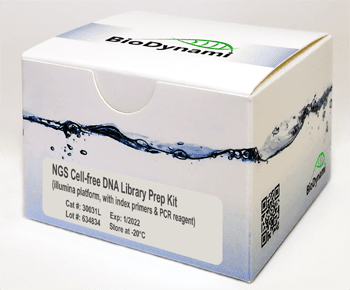
NGS Cell Free DNA Library Prep Kit (illumina and MGI Platforms)
Facebook
X
Pinterest
Email
The NGS Cell Free DNA Library Prep Kit (illumina and MGI Platforms) was developed for the construction of high quality cell-free DNA (cfDNA) libraries using 1 ng to 50 ng of cell-free DNA as input. The kit has a simple work flow and a fast procedure. Multiplexing of the cell free DNA library is possible based on the index type.
Detail
The NGS Cell Free DNA Library Prep Kit (illumina and MGI Platforms) was developed for the construction of high quality cell-free DNA (cfDNA) libraries using 1 ng to 50 ng of cell-free DNA as input. The kit has a simple work flow and a fast procedure. Multiplexing of the cell free DNA library is possible based on the index type.
NGS Cell Free DNA Library Prep Kit Workflow
The main source of cell-free DNA (cfDNA) is derived from apoptotic hematopoietic cells in blood and found in the plasma. The length of the cfDNA is about 150-200 bp in length. Circulating tumor DNA (ctDNA) derived from malignant tumors is a part of cfDNA. Both cfDNA and ctDNA can be used as a noninvasive biomarker since it offers a better approach in comparison to invasive tissue biopsies.
NGS has been used for cfDNA and ctDNA sequencing in the field of liquid biopsy as it provides a whole genome level of molecular profiling. One of the hurdles for cfDNA sequencing is the difficulty of library preparation from the limited amount of cfDNA obtained from plasma. Our cell-free NGS kit makes it easy to get enough libraries from limited input in just 1.5 hours.
Three index types are available for the NGS Cell Free DNA Library Prep Kit of the illumina platform:
Non-index (Cat.# 30029): Libraries do not have index.
Index(Cat.# 30031): Each of our index primers contains a unique 6-base index sequence that can be used for sample identification. Total 48 library multiplexing is possible. Index information can be downloaded here.
Unique dual index (Cat.# 30033): Cell-free DNA library multiplexing up to 96 samples is possible with the unique dual indexes. We have developed a Four-Base Difference Index System. The system have at least 4 bases different from each other in the 8 bases index length. The primers effectively minimize sequencing errors such as mis-assignment, index hopping, index contamination etc. Index information can be downloaded here.
Indexes are available for the MGI platform kits (Cat.# 34031).
Kit advantages:
Fast and simple protocol
Hands-on time is around 10 minutes
The total protocol time is only 1.5 hours
Easy procedure based on:
Ready-to-use master mix for easy setup of reactions
Less reaction components to simplify bench work
Less magnetic beads used for cleanup procedures: This can reduce more than 50% of the beads consumption
Guaranteed high library conversion efficiency
Low input cell-free DNA: From 1 ng to 50 ng
Comparison of library conversion efficiency with different samples under the same condition.
Comparison of library yield with different samples under the same condition.
Other Products
IVD4173 HiPure Viral DNA/RNA Kit
Product Info
Document
Product Info
Introduction
This kit is used for extracting total viral nucleic acid from non-cell/low cell content biological samples such as body fluid, serum, plasma, immersion solution, tissue homogenate supernatant, culture supernatant, etc., the extracted products can be used for clinical in vitro detection.
Details
Specifications
Features
Specifications
Main Functions
Extract viral RNA/DNA from 200μl plasma/serum samples
Applications
RT-PCR,PCR,NGS
Products
Viral total nucleic acid, body cell total nucleic acid, negative bacterial DNA
Purification method
Mini spin column
Purification technology
Silica technology
Process method
Manual (centrifugation or vacuum)
Sample type
Whole blood, plasma, serum, soaking solution and tissue homogenate supernatant
Sample amount
200μl
Yield
2-10μg
Elution volume
≥30μl
Time per run
≤30 minutes
Liquid carrying volume per column
800μl
Binding yield of column
100μg
Principle
Hipure silica gel column is based on glass fiber filter membrane with high binding force. Under the condition of high concentration of ionizing agent (such as guanidine hydrochloride or guanidine isothiocyanate), the filter membrane can adsorb nucleic acid through hydrogen bond and electrostatic, while protein and other impurities are not adsorbed and removed. The filter membrane adsorbed with nucleic acid is washed to remove the residual protein and salt. Finally, the nucleic acid adsorbed on the filter membrane can be washed out with low salt buffer (such as buffer TE) or water. The obtained nucleic acid has high purity and can be directly used in various downstream experiments.
Advantages
Fast – several samples can be extracted in 20 minutes by column method
High quality – high purity total RNA can be directly used in various sensitive downstream applications
Safe – no phenol chloroform extraction required
Sensitive – DNA/RNA can be recovered at the level of PG
High yield – carrier RNA contained in the product maximize the recovery of trace nucleic acid
Kit Contents
Contents
IVD4173
Purification Times
100 Preps
HiPure Viral Mini Column
100
2ml Collection Tubes
200
PK/Carrier RNA
50 mg
Protease Dissolve Buffer
5 ml
Buffer AL
30 ml
Buffer MW1
44 ml
Buffer MW2
50 ml
RNase Free Water
15 ml
Storage and Stability
This kit is shipped and stored at room temperature and is valid for 12 months.
Experiment Data
Document
This kit is used for extracting total viral nucleic acid from non-cell/low cell content biological samples such as body fluid, serum, plasma, immersion solution, tissue homogenate supernatant, culture supernatant, etc., the extracted products can be used for clinical in vitro detection.
Magnetic bead nucleic acid purification technology uses nano or micron superparamagnetic material as the matrix, generally black ferric oxide or yellowish brown ferricoxide as the magnetic material. The surface of bead is coated with appropriate functional groups, which can adsorb nucleic acid. Magnetic beads commonly used for nucleic acids, containing carboxyl groups, hydroxyl groups, or silicon groups. Silicon-based magnetic beads are the most common, and its principle of adsorbing nucleic acid is consistent with the classical glass milk purification technology or glass fiber filter membrane purification method. Magpure particle is a kind of polydisperse fast speed silica magnetic beads. The core is ferricoxide, accounting for 50%, and the surface coating is silica, accounting for 50%. The product can be used for plasmid extraction, gel DNA recovery, product purification, genomic DNA and RNA extraction, and viral nucleic acid extraction.
Details
Specifications
Features
Specifications
Concentration
70 mg/ml
Appearance
Suspension of yellowish brown particles
Surface functional group
Si-OH, Silanol
Dispersibility
Polydisperse Amorphous
Particle size
0.2-2 μm
Preservation conditions
Room Temperature, valid for up to 2 years.It is recommended to store in 2-8°C to prevent microbial growth.
Magnetic response speed
~60 seconds
Settling velocity
>10 minutes
High salt mediated binding
>2M guanidine isothiocyanate, DNA recovery up to 80%
Alcohol mediated binding
2M guanidine hydrochloride / isopropanol (30%), and the recovery of DNA / RNA was as high as 85%
PEG8000 mediated binding
The recovery of DNA/RNA was up to 85%
DNase/RNase
Not detected
DNA residue
<1 ppm
Recommended application
Plasmid extraction, gel DNA recovery, viral nucleic acid isolation
Principle
Highsalt mediated binding: in the solution containing 2-4M guanidine isothiocyanate, Magpure particles can selectively recover DNA molecules, and impurities such as protein polysaccharides are not adsorbed.
Alcohol mediated binding: in the solution containing guanidine salt and alcohol (>25%), Magpure particles can selectively recover DNA/RNA molecules, and proteins and other impurities are not adsorbed.
After biological samples are treated with digestive solution or lysis Buffer, DNA/RNA is released from cells, organelles and protein complexes (ribosomes and nucleosomes) into reagents. After Magpure particles and binding solution are added, DNA/RNA is adsorbed to the surface of Magpure particles to form DNA/RNA bead complex. Under the action of the magnetic field, the magnetic beads are separated and collected, and the impurities such as protein are removed with the waste liquid. After two or three steps of further cleaning, the DNA/RNA magnetic bead complex is resuspended in sterilized water or TE buffer, and the DNA/RNA falls off from the surface of the magnetic beads, so as to achieve the purpose of purification.
gDNA/RNA Isolation from Blood, Tissue, Plant, Swab, Spots, Stool, Soil and etc.Viral DNA/RNA IsolationAgarose Gel DNA Purification
DNA/RNA Isolation from low nucleic acid content samplesPlasmid IsolationDNA/RNA Clean Up
Circulating DNA IsolationViral Nucleic acid IsolationgDNA Isolation FFPE DNA/RNA Isolation
Plasmid extractiongel DNA recoverygenomicDNA/RNA extraction viral nucleic acid extractionCirculating DNA extraction
DNA/RNA Clean Up and concentrationDNA/RNA Isolation from low nucleic acid content samplesResearch immuno assays
The MagPure magnetic-particle technology combines the speed and efficiency of silica-based DNA purification with the convenient handling of magnetic particles. DNA binds to the silica surface of the magnetic particles in the presence of a chaotropic salt. DNA bound to the particles is then efficiently washed, considerably improving the purity of DNA. High-quality DNA is eluted. The automated purification procedure completely removes enzymes, nucleotides, and other contaminants and inhibitors. Purified DNA is suitable for direct use in downstream applications, such as sequencing and microarray analysis.
Document
Magnetic bead nucleic acid purification technology uses nano or micron superparamagnetic material as the matrix, generally black ferric oxide or yellowish brown ferricoxide as the magnetic material. The surface of bead is coated with appropriate functional groups, which can adsorb nucleic acid. Magnetic beads commonly used for nucleic acids, containing carboxyl groups, hydroxyl groups, or silicon groups. Silicon-based magnetic beads are the most common, and its principle of adsorbing nucleic acid is consistent with the classical glass milk purification technology or glass fiber filter membrane purification method. Magpure particle is a kind of polydisperse fast speed silica magnetic beads. The core is ferricoxide, accounting for 50%, and the surface coating is silica, accounting for 50%. The product can be used for plasmid extraction, gel DNA recovery, product purification, genomic DNA and RNA extraction, and viral nucleic acid extraction.