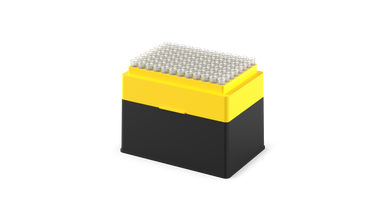
200 µL filtered pipette tips for the Opentrons Flex, provided sterile in racks or blister packs (refills). Tips are clear, non-conducting polypropylene tips, free of human DNA, PCR inhibitors, RNase/DNase, pyrogens, and endotoxins. Opentrons Flex Tips and Racks are autoclavable.
Detail
200 µL filtered pipette tips for the Opentrons Flex, provided sterile in racks or blister packs (refills). Tips are clear, non-conducting polypropylene tips, free of human DNA, PCR inhibitors, RNase/DNase, pyrogens, and endotoxins. Opentrons Flex Tips and Racks are autoclavable.
Other Products
Propargyl-PEG13-acid
Product Info
Document
Product Info
Propargyl-PEG13-acid consists of an alkyne group and a carboxylic acid. The carboxylic acid reacts with amine groups to form amide bonds in the presence of EDC or HATU as an activator. The alkyne group is commonly used in copper catalyzed azide-alkyne Click Chemistry reactions. The hydrophilic PEG units enhance the solubility of the molecule in aqueous media. Reagent grade, for research purpose. Please contact us for GMP-grade inquiries.
Document
Propargyl-PEG13-acid consists of an alkyne group and a carboxylic acid. The carboxylic acid reacts with amine groups to form amide bonds in the presence of EDC or HATU as an activator. The alkyne group is commonly used in copper catalyzed azide-alkyne Click Chemistry reactions. The hydrophilic PEG units enhance the solubility of the molecule in aqueous media. Reagent grade, for research purpose. Please contact us for GMP-grade inquiries.
This product is suitable for extracting RNA from anticoagulant blood, lymphocytes, buffy coat, bone marrow, cultured cells and other samples.
Details
Specifications
Features
Specifications
Main Functions
Isolation total RNA from 1-1.5ml whole blood, 0.5-1ml bone marrow, buffy coat
Applications
RT-PCR, cDNA synthesis, second generation sequencing
Purification method
Polydisperse magnetic beads
Purification technology
Magnetic beads technology
Process method
Manual or automatic
Sample type
anticoagulant blood, lymphocytes, buffy coat, bone marrow, cultured cells
Sample amount
1-1.5ml whole blood, 0.5-1ml bone marrow
Yield
1-30μg
Principle
This product is suitable for extracting RNA from anticoagulant blood, lymphocytes, buffy coat, bone marrow, cultured cells and other samples. This product is based on the purification method of high binding magnetic particles. The sample is lysed and digested by lysis buffer and protease, and RNA/DNA is released into the lysis buffer. Add binding solution and magnetic particles to adsorb RNA/DNA, while proteins are not adsorbed and removed. The particles adsorbed with DNA/RNA are washed with washing buffer to remove proteins and other impurities, then washed with ethanol to remove salt, and finally digested with DNase to remove DNA. RNA is recovered by adding binding solution, and finally the RNA is eluted with low salt buffer. The eluted RNA can be directly used for experiments such as RT-PCR,NGS and virus detection.
Advantages
High purity – OD 260 / 280 :1.9-2.0, OD 260 / 230 :1.5-2.0
Economy – less than 50% of the price of top brands
Automatic – extraction without manual participation, saving time and effort
High yield – nucleic acid recovery up to 95%
General – samples include whole blood, serum, plasma, lymphocyte suspension, bone marrow, cultured cells, etc.
Kit Contents
Contents
R661101
R661102
R661103
Purification Times
48 Preps
96 Preps
480 preps
10 x RBC Lysis Buffer
50 ml
2 x 50 ml
4 x 100 ml
Proteinase K
12 mg
24 mg
120 mg
Protease Dissolve Buffer
1.8 ml
1.8 ml
10 ml
DNase I
600 μl
2 x 600 μl
10 x 600 µl
DNase Buffer
20 ml
30 ml
150 ml
MagPure Particles N
1.2 ml
2.5 ml
11 ml
Buffer RTL
30 ml
60 ml
300 ml
Buffer ALB2
40 ml
60 ml
300 ml
Buffer MW1*
22 ml
44 ml
220 ml
Buffer MW2*
20 ml
50 ml
2 x 100 ml
RNase Free Water
10 ml
20 ml
60 ml
Storage and Stability
DNase I should be shipped with ice pack or dry ice and stored at -20°C upon arrival. MagPure Particles N and Proteinase K should be stored at 2–8°C upon arrival. However, short-term storage(up to 8 weeks) at room temperature (15–25°C) does not affect their performance.The remaining kit components can be store at room temperature and are stable for up to 18 months under these conditions.
Document
This product is suitable for extracting RNA from anticoagulant blood, lymphocytes, buffy coat, bone marrow, cultured cells and other samples.
Microcystin are a class of hepatotoxins produced by blue-green algae such as Microcystis aeruginosa. Microcystin-LR is the most common of the over 50 different congeners. Cyanobacteria can produce microcystin in large quantities during an algae bloom which then pose a major threat.
This kit can be used for Congener-Independent quantitative test of Microcystin in liquid samples such as drinking, ambient and waste water and algal cultures.
Additional Quality Control, Calibration Verification, and Spiking Solution materials can be obtained separately in optional Supplemental Pack for Method 546 (catalog # EL2024-Q).
Microcystin-LR
Informational sign postings about HABs at recreational waters: < 6 μg/L
Recreational public health advisory: 6 μg/L
Elevated recreational public health advisory (e.g. no contact): 20 μg/L
EPA 10-day drinking water health advisories:
Do Not Drink – 0.3 μg/L for bottle fed infants and preschool children, pregnant and nursing woman, elderly immunocompromised and liver conditions.
Do Not Drink – 1.6 μg/L for school-age children to adults.
Do not Use – 20 μg/L
Document
Format: 96-well microtiter plate (12 test strips of 8 wells) Standards: 0 | 0.15 | 0.4 | 1 | 2 | 5 ppb Incubation Time: 75 Minutes Compatible for use with US EPA Method 546