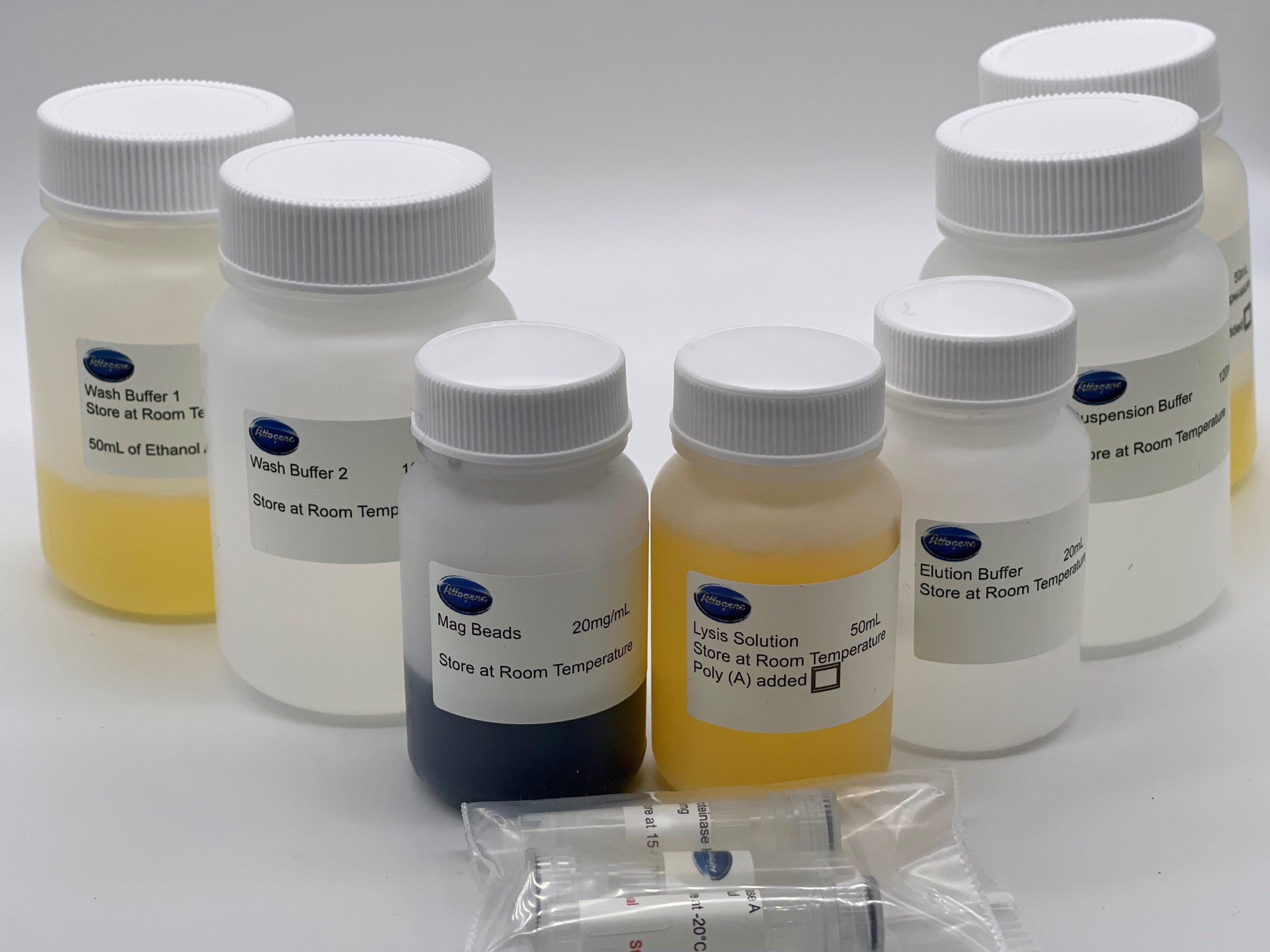
The Plant RNA Kit (NA2014-01) is optimized for purification of total RNA from a wide variety of plant samples which rich in polysaccharides and phenol. It comes with proprietary magnetic beads and a specially optimized buffer. Toxic solvents such as phenol, chloroform are not needed in the process. The eluted RNA is high-quality and is ready for all downstream applications, such as RT-PCR, Northern blotting, differential display. The procedures can be fully automated on the magnetic particle processor instrument and ease of use.
Other Products
Acetic Acid GK Assay Kit (Analyser Format)
Product Info
Document
Product Info
K-ACETGK
SKU: 700004257
110 mL of prepared reagent (e.g. 500 assays of 0.22 mL)
Content:
110 mL of prepared reagent (e.g. 500 assays of 0.22 mL)
Shipping Temperature:
Ambient
Storage Temperature:
Short term stability: 2-8oC, Long term stability: See individual component labels
Stability:
> 2 years under recommended storage conditions
Analyte:
Acetic Acid
Assay Format:
Auto-analyser
Detection Method:
Absorbance
Wavelength (nm):
340
Signal Response:
Increase
Linear Range:
up to 1.8 g/L of acetic acid per assay
Limit of Detection:
~ 10 mg/L
Reaction Time (min):
8 min at 25oC or 5 min at 37oC
Application examples:
Wine, beer, fruit and fruit juices, soft drinks, vinegar, vegetables, pickles, dairy products (e.g. cheese), meat, fish, bread, bakery products (and baking agents), ketchup, soy sauce, mayonnaise, dressings, paper (and cardboard), tea, pharmaceuticals (e.g. infusion solutions), feed and other materials (e.g. biological cultures, samples, etc.).
Method recognition:
Improved method
The Acetic Acid GK format test kit is for use with auto-analysers and is suitable for the specific measurement and analysis of acetic acid (acetate) especially in wines, fruit juices, beverages and food products.
As part of Megazyme’s overall commitment to providing the highest quality products, we have developed this acetic acid kit that provides a specific and rapid assay for use with auto-analysers. The kit assay is based on the conversion of NAD+ to NADH and therefore provides a positive reaction (increase in absorbance) which offers a more robust assay.
The reagents, as supplied, are stable for a minimum of 2 years and the prepared reagents are stable for a minimum of 1 week (on-board stability). In addition, the prepared reagents can be stored frozen for longer term stability (see K-ACETGK Booklet for more details).
View more of our acetic acid and organic acid assay kits.
Advantages
Excellent reagent stability
> 7 days at 4oC or > 2 years below -10oC when prepared for auto-analyser applications
> 2 years as supplied
Very rapid reaction (~ 5 min at 37oC)
Linear calibration (R2 ~ 0.997 up to 1.8 g/L sample)
Document
The Acetic Acid GK format test kit is for use with auto-analysers and is suitable for the specific measurement and analysis of acetic acid (acetate) especially in wines, fruit juices, beverages and food products.
t-Boc-N-Amido-PEG9-propargyl is an alkyne linker that can be used in Click Chemistry reactions with azides to yield a stable triazole linkage; copper is required for catalyzation. Under mild acidic conditions, the Boc group can be removed to form a free amine. Reagent grade, for research purpose. Please contact us for GMP-grade inquiries.
Document
t-Boc-N-Amido-PEG9-propargyl is an alkyne linker that can be used in Click Chemistry reactions with azides to yield a stable triazole linkage; copper is required for catalyzation. Under mild acidic conditions, the Boc group can be removed to form a free amine. Reagent grade, for research purpose. Please contact us for GMP-grade inquiries.
1. Brushless frequency motor, in great torque, free maintenance, no power pollution, quick in speed up and down.
2. 7” LCD Touch screen display which indicates the program, rotor No, speed, time, RCF and temperature.
3. CFC-free refrigerant, pre-cooling function ,double cycle cooling, cold and hot alternating easily, free environment pollution and precise in temperature control.
4. Microprocessor control , 100 programs in store, 10 kinds of acceleration and deceleration for your choice.
5. Over speed and imbalance protection.
6. Speed, RCF, time, temperature can be edited during running.
7. High quality steel centrifuge body , stainless steel chamber, built-in stainless steel explosion-proof protect sleeve, 3 tiers protection, safe and reliable.
8. Automatic door open & close, as well as anti-pinch function (Optional).
CDL7M Technical Parameter:
Max. Speed
7000rpm
Max. RCF
11650×g
Max. Capacity
6×2400ml (12*500ml blood bag)
Time Range
1~99h59min59s
RPM/RCF Convert
Yes
Noise (dB)
≤ 65
Temperature
-20 ~ 40℃
Acc/Dec
10 Kinds
Speed Accuracy
±20r/min
Temperature Accuracy
±1℃
Voltage(V/Hz)
AC 220V/380V 50HZ/60HZ
Size (W x D x Hmm)
940×890×1000mm
Net Weight(Kg)
570KG
Certificates
CE,ISO & Calibration report are available
Special rotor for blood bag separation
Order No.
Rotor No.
Max Speed (rpm)
Max Volume(ml)
Max. RCF(×g)
05202
Swing Rotor
4000
6×2x1000ml
5210
Document
CDL7M touch screen with special programs for blood bag separation, can get good performance for platelet, red cell, all parts separation of blood. 6x2x1000ml bucket suitable for blood bag separation. Also with automatical lid lock open and close function, also wind shield can open along with door open. Model: CDL7M