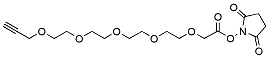
Propargyl-PEG5-CH2CO2-NHS is an amine reactive linker with an alkyne moeity which can react with azide-bearing biomolecules in copper catalyzed Click Chemistry reactions. The PEG units enhance the solubility of the linker in aqueous media. Reagent grade, for research purpose. Please contact us for GMP-grade inquiries.
Detail
Propargyl-PEG5-CH2CO2-NHS is an amine reactive linker with an alkyne moeity which can react with azide-bearing biomolecules in copper catalyzed Click Chemistry reactions. The PEG units enhance the solubility of the linker in aqueous media. Reagent grade, for research purpose. Please contact us for GMP-grade inquiries.
Other Products
DBCO-PEG8-PFP ester
Product Info
Document
Product Info
DBCO-PEG8-PFP ester is a PEG reagent comprising a DBCO group which can react with azides for copper-free Click Chemistry reactions. The PFP ester is an active ester which can be used to react with amine groups. PFP esters have been are stable compounds and are less susceptible to undergo hydrolysis. PEG8 linker increases the water solubility of a compound in aqueous media. Reagent grade, for research purpose. Please contact us for GMP-grade inquiries.
Document
DBCO-PEG8-PFP ester is a PEG reagent comprising a DBCO group which can react with azides for copper-free Click Chemistry reactions. The PFP ester is an active ester which can be used to react with amine groups. PFP esters have been are stable compounds and are less susceptible to undergo hydrolysis. PEG8 linker increases the water solubility of a compound in aqueous media. Reagent grade, for research purpose. Please contact us for GMP-grade inquiries.
N-(Propargyl-PEG4-carbonyl)-N-bis(PEG1-acid) is a crosslinker that can react with azide compounds or biomolecules via copper catalyzed Click Chemistry to form a stable triazole linkage. The terminal carboxylic acids can react with primary amino groups in the presence of activators (e.g. HATU) to form a stable amide bond.
Document
N-(Propargyl-PEG4-carbonyl)-N-bis(PEG1-acid) is a crosslinker that can react with azide compounds or biomolecules via copper catalyzed Click Chemistry to form a stable triazole linkage. The terminal carboxylic acids can react with primary amino groups in the presence of activators (e.g. HATU) to form a stable amide bond.
Extract total RNA (including microRNA) from FFPE samples
No phenol extraction step
Includes DNase for optional on-column DNA removal
Isolated RNA is of the highest quality and integrity
Isolate a diversity of RNA species
Purified RNA is suitable for a variety of downstream applications, including Small RNA Sequencing. Find out more information on Norgen’s NGS services
Purification is based on spin column chromatography that uses Norgen’s proprietary resin separation matrix
Norgen’s FFPE RNA Purification Kits provide a rapid method for the isolation and purification of total RNA (including microRNA) from formalin-fixed paraffin-embedded (FFPE) tissue samples in as little as 1 hour. Using formalin to fix tissues leads to crosslinking of the RNA and proteins, and the process of embedding the tissue samples can also lead to fragmentation of the RNA over time. Norgen’s FFPE RNA Purification Kits provide conditions that allow for the partial reversing of the formalin modifications, resulting in a high quality and yield of RNA. These kits are able to purify all sizes of RNA, from large mRNA and ribosomal RNA down to microRNA (miRNA) and small interfering RNA (siRNA), depending on the age of the FFPE tissue as fragmentation of the RNA is known to occur over time. The RNA is preferentially purified from other cellular components without the use of phenol or chloroform.
FFPE RNA Purification Kit (Spin Column)
Maximum loading volume of 650 μL per column, and a maximum binding capacity of 50 μg per column.
Purification is based on 96-well column chromatography using Norgen’s proprietary resin as the separation matrix. Purification can be performed using either a vacuum manifold or centrifugation. Maximum loading volume of 400 μL per well, and a maximum binding capacity of 50 μg per well.
5 slices of < 20 µm thick paraffin slices 25 mg of unsectioned block
Average Yield
Variable due to age of paraffin blocks ~2-3 µg of Total RNA per 1 mg of fresh FFPE hamster kidney
* Time required for purification varies by length of Proteinase K incubation and formalin crosslink-reversal
Storage Conditions and Product Stability All solutions should be kept tightly sealed and stored at room temperature. The DNAse I and Proteinase K should be stored at -20°C upon arrival. This kit is stable for 1 year from the date of shipment.