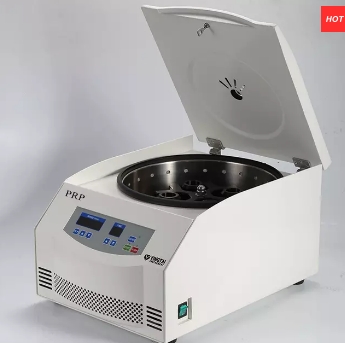
PRP Centrifuge widly used for Aesthetic & Plastic,Orthopedic & Pain-treatment, Dentistry, Ophthalmology,Veterinary and etc..Our company has been cooperated with Korean and Chinese PRP kit manufacturer to making the PRP centrifuge to our customers
Detail
PRP centrifuge/Platelet rich plasma centrifuge
PRP Application:
Aesthetic & Plastic,Orthopedic & Pain-treatment, Dentistry, Ophthalmology,Veterinary and etc..Our company has been cooperated with Korean and Chinese PRP kit manufacturer to making the PRP centrifuge to our customers.Detail information, please send email to us, [email protected]
Features:
1.Widely used in hospital, modern beauty salon and micro plastic hospitals.
DC inverter motor with simpler construction, more reliable performance, longer life and quietly running
2.Smooth in operation, low noise and small vibration.
3.Micro computer control system, digital display the RCF, time and speed. 4.Automatic electric lid, compact design, super speed and imbalance protection.
5.The centrifuge body is made of high-quality steel, safe and reliable.
TD4N Technical Parameters:
Max speed
4000rpm
Max RCF
2600xg
Max volume
4x20ml
Noise
≤55dBA
Timer
0~99min
Net weight
28KG
Dimension(HxDxW)
528×370×280mm
Power supply
AC 220V 50HZ 2A
Speed accuracy
±20rpm
Package
Carton box
Other Products
Urine DNA Isolation Kits
Product Info
Document
Product Info
Overview
Rapid isolation of both small and large species of DNA from urine
Convenient spin column format
Effective removal of PCR inhibitors
Purified DNA is highly suited to sensitive downstream applications
Allows for the purification of viral DNA from urine
Both high molecular weight DNA (greater than 1 kb in size; mostly cell associated) and the smaller DNA (150 – 250 bp; derived from the circulation) is effectively isolated and purified using a rapid and convenient spin column protocol. This kit can be used to isolate DNA from a broad range of viruses in urine as well. Salts, metabolic wastes, proteins and other contaminants are removed to yield inhibitor-free DNA for use in sensitive applications. The DNA is of excellent quality for various downstream applications such as PCR, qPCR and DNA fingerprinting, methylation studies and more.
This kit provides a fast, reliable and simple procedure for isolating DNA from urine volumes ranging from 50 μL to 1.75 mL of urine. Multiple samples can be processed in 30 minutes.
Urine DNA Isolation Kit (Slurry Format)
This kit provides a fast, reliable and simple procedure for isolating DNA from urine volumes ranging from 3 mL to 25 mL. Multiple samples can be processed in 30 minutes. Multiple samples can be processed in 45 minutes.
Urine DNA Isolation Maxi Kit (Slurry Format)
This kit provides a fast, reliable and simple procedure for isolating DNA from urine volumes ranging from 25 mL of urine up to 80 mL. Multiple samples can be processed in 45 minutes.
Background
DNA found in urine can be divided into 2 basic categories. The larger species, genomic-DNA (gDNA), is generally greater than 1 kb in size, and appears to be derived mainly from exfoliated cells. The second species is smaller, generally between 150 and 250 bp (apoptotic-DNA), and derives, at least in part, from the circulation. The second species is also considered as an RNA/DNA hybrid as reported by Halicka et al. (2000). Both types of DNA can be isolated reliably using this kit.
Storage Conditions and Product Stability All buffers should be kept tightly sealed and stored at room temperature. This kit is stable for 2 years after the date of shipment. It is recommended to warm up Slurry B1 and Lysis Buffer A for 20 minutes at 60°C if any salt precipitation is observed. Slurry B1 contains a grey resin that will not dissolve when warmed.
Bis-propargyl-PEG18 has two propargyl groups at both ends. These propargyl groups reacts with azide compounds or biomolecules to form stable triazole linkages under the catalyzation of copper. The hydrophilic PEG units enhance the solubility of the molecule in aqueous environment. Reagent grade, for research purpose. Please contact us for GMP-grade inquiries.
Document
Bis-propargyl-PEG18 has two propargyl groups at both ends. These propargyl groups reacts with azide compounds or biomolecules to form stable triazole linkages under the catalyzation of copper. The hydrophilic PEG units enhance the solubility of the molecule in aqueous environment. Reagent grade, for research purpose. Please contact us for GMP-grade inquiries.
Attogene’ s Cylindrospermopsin Lateral Flow Kit can be used to detect Cylindrospermopsin in source water samples.
Format: Rapid-Water – Run Time: 30 Minutes, enough to run two samples (undiluted and a 10 fold dilution) and negative control.
Cylindrospermopsin (CYN) is a potent cyanotoxin synthesized by select species of cyanobacteria, prominently including Cylindrospermopsin raciborskii. It belongs to the tricyclic alkaloid class, exhibiting a molecular weight of approximately 415 Da. Structurally, cylindrospermopsin features an uracil ring fused with a hydantoin moiety, alongside a guanidino group, attributes that render it highly soluble and polar in aqueous environments.
Cylindrospermopsin is notorious for its profound toxicity towards aquatic organisms and its potential threat to human health through exposure via contaminated water and food sources. Consequently, rigorous monitoring protocols are essential in regions prone to cyanobacterial blooms, where cylindrospermopsin can accumulate in freshwater reservoirs and other aquatic habitats. In recognition of these risks, regulatory bodies such as the United States Environmental Protection Agency (EPA) have implemented an action level guideline. As of 2019, EPA 10-day drinking water health advisory for cylindrospermopsin recommended a threshold of 0.7 parts per billion (ppb), or 700 parts per trillion (ppt) for children under the age of six, and 3 parts per billion, 3000 parts per trillion for anyone older, to effectively manage cylindrospermopsin levels. This precautionary measure aims to uphold both environmental sustainability and public health integrity by minimizing exposure risks. The EPA has also drafted a human health recreational water quality criterion to protect human health at 8,000ppt.