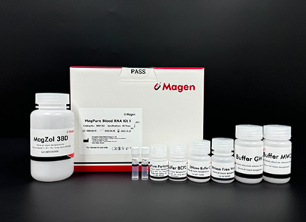
This product is suitable for extracting RNA from 1ml anticoagulant blood (fresh or frozen blood/cryopreservation blood), lymphocytes, buffy coat, bone marrow, cultured cells, etc using Magzol reagents. It can specially extract high quality RNA from frozen blood samples.
Detail
Introduction
This product is suitable for extracting RNA from 1ml anticoagulant blood (fresh or frozen blood/cryopreservation blood), lymphocytes, buffy coat, bone marrow, cultured cells, etc using Magzol reagents. It can specially extract high quality RNA from frozen blood samples.
Details
Specifications
Features
Specifications
Main Functions
Isolation total RNA from 1ml anticoagulant blood (fresh or frozen blood/cryopreservation blood), lymphocytes, buffy coat, bone marrow, cultured cells, etc using Magzol reagents.
Applications
RT-PCR, cDNA synthesis, second generation sequencing
Purification method
Polydisperse magnetic beads
Purification technology
Magnetic beads technology
Process method
Manual or automatic
Sample type
anticoagulant blood, lymphocytes, buffy coat, bone marrow, cultured cells
Sample amount
1ml whole blood (fresh or frozen blood)
Principles
This product is based on the purification method of high binding magnetic particles. The sample is lysed and digested by lysis buffer and protease, and RNA/DNA is released into the lysis buffer. Add binding solution and magnetic particles to adsorb RNA/DNA, while proteins are not adsorbed and removed. The particles adsorbed with DNA/RNA are washed with washing buffer to remove proteins and other impurities, then washed with ethanol to remove salt, and finally digested with DNase to remove DNA. RNA is recovered by adding binding solution, and finally the RNA is eluted with low salt buffer. The eluted RNA can be directly used for experiments such as RT-PCR, NGS and virus detection.
Kit Contents: Bottle
Contents
R661301
R661302
R661303
Purification Times
48 Preps
96 Preps
480 preps
DNase I
600 μl
2 x 600 μl
10 x 600 µl
DNase Buffer
20 ml
30 ml
150 ml
MagPure Particles N
2.5 ml
5.0 ml
28 ml
MagZol 3BD
65 ml
140 ml
3 x 200 ml
Buffer ALB2
40 ml
60 ml
350 ml
Buffer BCP2
10 ml
15 ml
80 ml
Buffer MW2*
20 ml
50 ml
2 x 100 ml
RNase Free Water
10 ml
20 ml
60 ml
Storage and Stability
DNase I should be shipped with ice pack or dry ice and stored at -20°C upon arrival. MagPure Particles N, MagZol 3BD and Buffer BCP2 should be stored at 2–8°C upon arrival. DNase I should be stored at -20°C. However, short-term storage at room temperature (15–25°C) does not affect their performance. The remaining kit components can be stored at room temperature (15–25°C) and are stable for at least 18 months under these conditions.
Our Blyscan™ Glycosaminoglycan Kit has been a ‘go-to’ Solution for reliable sGAG and Proteoglycan Analysis for many years! Blyscan utilises a dye-binding approach to quantitatively measure sulfated glycosaminoglycans (sGAG) and proteoglycans in cells, tissues and fluids from a wide range of in-vivo and in-vitro sources.
Colorimetric Detection (656nm) (Endpoint)
Understanding Glycosaminoglycans (GAGs) and Proteoglycans
Glycosaminoglycans (GAGs) are a type of negatively charged polysaccharide that play crucial roles in various biological processes. They are composed of repeated disaccharide units, typically of N-acetylated or N-sulfated hexosamine paired with a uronic acid (GlcA or IdoA) or galactose. Sulfate groups can also be added to give sulfated GAGs an overall negative charge that influences cell interactions and also enable binding by our Blyscan dye reagent.
Common examples of GAGs include Chondroitin Sulfate, Dermatan Sulfate, Heparin, Heparan Sulfate, and Keratan Sulfate. Note that Hyaluronic Acid is a non-sulfated GAG and cannot be detected by the Blyscan assay. If you need to measure hyaluronic acid instead, we recommend using our Purple-Jelley kit!
The Role of Glycosaminoglycans in Tissues
GAGs and proteoglycans have essential functions in tissues and organisms, providing biophysical support through scaffolding and maintaining cartilage hydration. They also play a vital role in biochemical processes such as cell adhesion and signalling.
What is the origin of the Blyscan assay name?
Blyscan is an Old English word meaning ‘to shine’ and from which the word ‘blush’, (blushing), may have been derived. This was an appropriate choice as the Blyscan Assay contains a blue dye which ‘blushes’ bright pink when it binds to sulphated glycosaminoglycans!
How does the Blyscan assay work?
Step 1. Blyscan dye reagent contains DMMB dye in an optimised buffer. Addition of Dye reagent to samples containing sGAG results in the formation of a dye/sGAG complex due to a charge interaction between dye and GAG sulfate groups.
Step 2. Over a 30 minute incubation Dye-labelled sGAGs precipitate out of solution and are collected by centrifugation. Following removal of unbound dye, the remaining bound dye is released from the complex by addition of dye dissociation reagent. Released dye is quantified spectrophotometrically.
Step 3. The sGAG content of unknown samples may be quantified by comparison against a calibration curve prepared using a standard of purified Chondroitin-4-sulfate supplied with the kit.
A list of suggested sample types can be found under the ‘Assay Specification‘ tab.
The Blyscan Dye reagent is formulated to miminise binding to other charged sample components such as nucleic acids, a problem with some older dye-based sGAG assays.
Assay range
2.5 – 50µg/ml
Limit of Detection
2.5µg/ml
Detection Method
Colorimetric Detection (656nm) (Endpoint)
Measurements per kit
110 in total (allows a maximum of 48 samples to be run in duplicate alongside a standard curve).
In-vivo: Liquid samples, including fluids such as urine, amniotic or synovial fluid.
In-vitro: Solid samples, such as deposited ECM on 2D/3D culture surfaces.by enzymatic treatment
In-vivo: Liquid samples, Culture media during 2D/3D cell culture.
The assay requires that sulfated polysaccahrides or sGAGs are in a soluble form. A preliminary enzymatic extraction step is required for solid samples (enzyme not supplied with kit).
The assay is not suitable for use with samples containing alginates or that comprise degraded sulfated disaccharide fragments.
Precautions
This kit is designed for research use only. Not for use in diagnostic procedures. Kit requires access to a centrifuge, as well as a spectrophotometer/colorimeter capable of absorbance detection at 656nm. Specific sample preparation protocols may require customer to provide further reagents, consult assay manual for further information.
Blyscan sGAG kit contents:
1. Blyscan Dye Reagent (1x110ml)
2.sGAG Reference Standard (1x5ml, 100µg/ml Bovine tracheal chondroitin 4-sulfate)
3. Dissociation Reagent (1x110ml)
4. Sodium Nitrite (1x15ml)
5. Acetic Acid (1x15ml)
6. Ammonium Sulfamate (1x15ml)
7. 1.5ml micro-centrifuge tubes for dye-labelling reaction.
8. Assay kit manual
NB: Additional reagents may be required for sample preparation prior to assay. Consult manual or contact us for further details.
Document
Our Blyscan™ Glycosaminoglycan Kit has been a ‘go-to’ Solution for reliable sGAG and Proteoglycan Analysis for many years! Blyscan utilises a dye-binding approach to quantitatively measure sulfated glycosaminoglycans (sGAG) and proteoglycans in cells, tissues and fluids from a wide range of in-vivo and in-vitro sources. Colorimetric Detection (656nm) (Endpoin
Plasma/Serum Exosome Purification and RNA Isolation Kits
Product Info
Document
Product Info
Overview
Purification and enrichment of intact plasma/serum exosomes for functional studies
Isolate all sizes of RNA, including microRNA, irrespective of size or GC content, without bias
Versatile plasma/serum input volume
No phenol extractions, Proteinase K treatment, nor carrier RNA required
No time-consuming ultracentrifugation, filtration nor special syringes required
No precipitation reagents, nor overnight incubation required
Compatible with plasma/serum from most species
Pure exosomes are purified and are free from any other RNA-binding proteins
Purification is based on spin column chromatography that uses Norgen’s proprietary resin
The purified RNA is suitable for a variety of downstream applications, including Small RNA Sequencing. Find out more information on Norgen’s NGS services
Norgen’s Plasma/Serum Exosome and RNA Isolation Kits constitute all-in-one systems for the purification of exosomes and the sequential isolation of exosomal RNA from different plasma/serum sample volumes. The purification is based on spin column chromatography that employs Norgen’s proprietary resin. These kits are designed to isolate all sizes of RNA, including microRNA, irrespective of size or GC content, without bias. These kits provide a clear advantage over other available kits in that they do not require any special instrumentation, protein precipitation reagents, extension tubes, phenol/chloroform or protease treatments. The RNA isolated from the purified exosomes is free from any protein-bound circulating RNA and is of the highest integrity. The purified RNA can be used in a number of downstream applications including real time PCR, reverse transcription PCR, Northern blotting, RNase protection and primer extension, and expression array assays.
Norgen’s Plasma/Serum Exosome and RNA Isolation Mini Kit
For sample volumes ranging from 50 µL to 1 mL. This kit allows the user to elute into a flexible elution volume ranging from 50 µL to 100 µL.
Norgen’s Plasma/Serum Exosome and RNA Isolation Midi Kit
For sample volumes ranging from 1 mL to 4 mL. This kit allows the user to elute into a flexible elution volume ranging from 50 µL to 100 µL.
Norgen’s Plasma/Serum Exosome and RNA Isolation Maxi Kit
For sample volumes ranging from 4 mL to 10 mL. This kit allows the user to elute into a flexible elution volume ranging from 50 µL to 100 µL.
All sizes, including miRNA and small RNA (< 200 nt)
Elution Volume
50-100 μL
Time to Complete 10 Purifications
35 – 40 minutes
Average Yields*
Variable depending on specimen
*Please check page 4 of the product insert for the average yields and the common RNA quantification methods.
Storage Conditions and Product Stability All solutions should be kept tightly sealed and stored at room temperature. This kit is stable for 2 years after the date of shipment. It is recommended to warm Lysis Buffer A for 20 minutes at 60°C if any salt precipitation is observed.
Important Note This kit is suitable for the purification of exosomes from fresh or frozen serum or plasma prepared from blood collected on either EDTA or Citrate. Plasma samples prepared from blood collected on heparin should not be used as heparin can significantly interfere with many downstream applications such as RT-PCR.
Lyophilized High Sensitivity RNA Amplification Kit Fast Accurate Results
Product Info
Document
Product Info
Product Description
High-Sensitivity RNA Amplification Kit: Fast & Accurate Results
Product Detail
Kit Storage and term of Validity
Storage term: stored at ≤-20℃,keep away from light, avoid heavy weight and repeated freezing and thawing.
Term of Validity: 14 months
Isothermal nucleic acid Principle Summary
This kit is based on a rapid nucleic acid amplification technology at room temperature and constant temperature:at room temperature and constant temperature(generally 39℃~42℃),reverse transcriptaseuses specific primers and template RNA tosynthesize cDNA strands,and binds the auxiliary protein and single strand with the help of the protein, the recombinase and the primer form a complex; perform a homology search and bind the target homology domain, at this time a D-loop region is formed at the homology positionand strand exchange begins; accompanied by the recombinase from the complex upon dissociation,the polymerase also bindsto the 3′ end of the primer,initiating chainextension.It is suitable for laboratory-level RNA amplification and RNA amplification for other detection purposes.
Isothermal nucleic acid Product Features
1/ High sensitivity and specificity, short reaction time.
2/ The reagent form is freeze-dried, stable and easy to operate.
3/ The reaction can be operated by metal bath and water bath pot without purchasing expensive PCR apparatus.
Technical Parameters:
Parameters
Details
Product Name
RNA Isothermal Amplification Kit Basic
Manufacturer
Amp-future
Storage Temperature
-20°C
Kit Components
Enzymes, Buffers ,Reagents
Packaging
48 Tests/box
Detection Limit
500-1000copies/µL
Shipping
ICE
Test Time
5-20mins
Isothermal nucleic acid Applications
Suitable for RNA isothermal rapid amplification kit(BASIC type)
Primer: Require pair of nucleotide primers with the length of 25-35 bp.
RNA basic kit reaction temperature is 39 to 42℃ and time is 5-20 minutes.
Notes
1/ Please avoid nucleic acid contamination and set blank control during reaction due to the high sensitivity of the kit.
2/ Please take out the required quantity of MIRA reaction units for the experiment, and put the rest under storage conditions when performing the experiment.