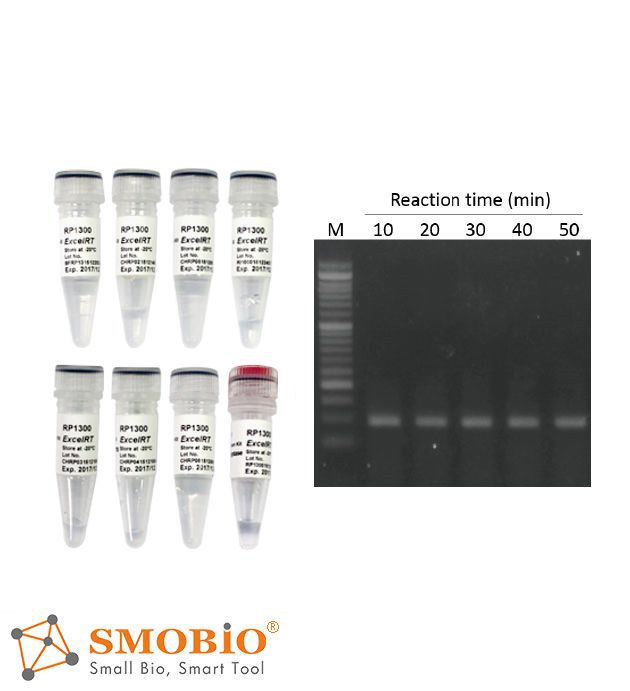
ExcelRT™ Reverse Transcription Kit is a complete, efficient and convenient kit to synthesize high quality first strand cDNA. This kit contains ExcelRT™ Reverse Transcriptase, which is able to synthesize the first strand cDNA at 37~50°C. The ExcelRT™ Reverse Transcriptase is a recombinant Moloney Murine Leukemia Virus (M-MLV) reverse transcriptase, which is designed to reduce RNase H activity and create better thermal stability. This kit also contains RNAok™ RNase Inhibitor, which is active against RNase A, RNase B, and RNase C. This product is supplied with oligo (dT)20 and random hexamers, which are used to synthesize cDNA from poly(A) tailed mRNA and total RNA, respectively.
Detail
Description
ExcelRT™ Reverse Transcription Kit is a complete, efficient and convenient kit to synthesize high quality first strand cDNA. This kit contains ExcelRT™ Reverse Transcriptase, which is able to synthesize the first strand cDNA at 37~50°C. The ExcelRT™ Reverse Transcriptase is a recombinant Moloney Murine Leukemia Virus (M-MLV) reverse transcriptase, which is designed to reduce RNase H activity and create better thermal stability. This kit also contains RNAok™ RNase Inhibitor, which is active against RNase A, RNase B, and RNase C. This product is supplied with oligo (dT)20 and random hexamers, which are used to synthesize cDNA from poly(A) tailed mRNA and total RNA, respectively.
Features
Contains all components for reverse transcription
High yield
Thermostable, up to 50°C, during first strand synthesis
High processivity, generating cDNA up to 8 kb
Reduced RNase H ribonuclease activity
Application
Generation of first strand cDNA from total RNA or mRNA.
Suitable for generating cDNA from RNA with strong secondary structure which can be reduced at temperature up to 50°C.
Storage
-20°C for 24 months
High yield
High sensitivity
Thermostable, up to 50°C, during first strand synthesis
Contents
ComponentVolume ExcelRT™ Reverse Transcriptase (200 U/μl) 100 μl RNase Inhibitor (20 U/μl)100 μl 5X RT Buffer (DTT)500 μl dNTPs Mix (10 mM each)200 μl Oligo (dT)20 (50 μM)100 μl Random Hexamers (100 μM)100 μl DEPC-Treated H2O 1 ml x 2
Storage Buffer
Reverse Transcriptase: 20 mM Tris-HCl (pH 7.5), 200 mM NaCl, 0.1 mM EDTA, 1 mM DTT, stabilizer and 50% (v/v) glycerol
RNase Inhibitor: 40 mM HEPES-KOH (pH 7.5), 100 mM KCl, 8 mM DTT, 0.1 mM EDTA, stabilizer and 50% (v/v) glycerol
5X RT buffer (DTT)
250 mM Tris-HCl (pH 8.3), 375 mM KCl, 15 mM MgCl2 and 50 mM DTT
GATA3 is a transcription factor important in cell proliferation, development, and differentiation. GATA3 is mostly observed in breast and urothelial carcinomas, and rarely present in other cancers such as endometrial endometrioid adenocarcinoma. Among the breast carcinomas, GATA3 has a lower expression in luminal B subtype breast carcinoma. Studies have found GATA3 expression to be associated with ER (estrogen receptor), PR (progesterone receptor), and Her2 in breast cancer cases. Urothelial carcinomas stain positively for GATA3 in invasive or high grade tumors, therefore Anti-GATA3 is useful for carcinoma diagnosis when breast and bladder are plausible.
Usages: For the differentiation of Gram-negative bacteria on the basis of citrate utilization.
Principle: Magnesium ions in various metabolic cofactors; ammonium dihydrogen phosphate to provide nitrogen; dipotassium hydrogen phosphate is the buffer; sodium citrate as a carbon source; agar as medium coagulant.
Formulation(per liter): Sodium chloride 5g Magnesium sulfate 0.2g Ammonium dihydrogen phosphate 0.2g Sodium ammonium phosphate 0.8g Sodium citrate 2g Agar 15g Bromothymol blue 0.08g Final pH 7.0 ± 0.2
How to use: 1.Suspend 23.3g in 1 L of distilled water , stirring heated to boiling until completely dissolved, dispensing flask, 121 autoclave for 15min. 2.Diluted and treated samples.
Storage: Keep container tightly closed, store in a cool, dry place, away from bright light. Storage period of 3 years.
HL-SAN efficiently removes nucleic acids from buffers typically used in protein purification. Due to its high salt tolerance, it is the obvious choice for host-cell DNA removal in settings where salt is added to reduce aggregation. Especially efficient for removing nucleic acids from proteins with high affinity for DNA and RNA. Proven performance during lysis and early stages of protein purification processes, as well as high-salt eluates. Cold-adapted enzyme with excellent performance also at ambient temperatures and during over-night digestion at 4°C.
Optimum activity at high salt concentration (0.5 M NaCl)
Active at low temperatures (20% at 6ºC)
Easily inactivated
Broad pH range
Temperature stable
Figures
Figure 1. Optimum activity in solutions with high salinity
HL-SAN has optimum activity at ∼0.5 M NaCl, but operates at a broad range of [NaCl] and [KCl]. The activity of HL-SAN was tested in a 25 mM Tris-HCl buffer, pH 8.5, 5 mM MgCl2 with varying [NaCl] or [KCl]. The maximum activity was set to 100%.
Figure 2. Temperature and activity
HL-SAN has optimum activity at ~35°C, but works over a broad temperature range (20% activity at 10°C and 50°C). The activity of HL-SAN was tested in a 25 mM Tris-HCl buffer, pH 8.5 containing 5 mM MgCl2 and 0.5 M NaCl.
Fig 3. The effect of MgCl2 and MnCl2 concentration on the HL-SAN activity.
The activity of HL-SAN was tested in a 25 mM Tris-HCl buffer, pH 8.5, 0.5 M NaCl and with varying concentrations of MgCl2 or MnCl2. The activity of the sample containing 5 mM MgCl2 was set to 100%.
Figure 4. HL-SAN activity vs pH/[NaCl]
The activity of HL-SAN was tested in a 25 mM Tris-HCl buffer with different pHs and different concentrations of NaCl. All buffers contained 5 mM MgCl2. The nature of the buffer was pH-dependent, but generally the NaCl-optimum was the same in all buffers/pHs. The exception was etanolaminbuffer at pH 9 and pH 9.5 in which the NaCl-optimum was shifted to the left (not shown).
Without NaCl, the specificity towards ssDNA and dsDNA is similar. At 0.5 M NaCl, the activity towards dsDNA increases, while the activity towards ssDNA is unaffected.
Figure 6. HL-SAN digests ssDNA to ~5-13 nt, and dsDNA to ~5-7 nt
The size of the end products from ssDNA varies from ~5-13 nt, while dsDNA is digested to around ~5-7 nt. The size of the end products seems to depend on the DNA sequence. Substrates 1 and 2 were ssDNA with different sequences and substrates 3 and 4 were dsDNA with similar sequences but with a FAM-label at different ends. Substrate 5 was dsDNA with the same sequence as substrate 3 and 4 but with a FAM-label at both ends.
Figure 7. HL-SAN activity decreases with increasing concentrations of glycerol
The activity of HL-SAN was tested in a 25 mM Tris-HCl buffer, pH 8.5, 5 mM MgCl2, 0.5 M NaCl and with increasing concentrations of glycerol. The activity of the control not containing glycerol was set to 100%.
Figure 8. The activity of HL-SAN at different concentrations of imidazole
The activity of HL-SAN was tested in a 25 mM Tris-HCl buffer, pH 8.5, 5 mM MgCl2, 0.5 M NaCl and with varying concentrations of imidazole. The activity of the control not containing imidazole was set to 100%.
Document
HL-SAN efficiently removes nucleic acids from buffers typically used in protein purification. Due to its high salt tolerance, it is the obvious choice for host-cell DNA removal in settings where salt is added to reduce aggregation. Especially efficient for removing nucleic acids from proteins with high affinity for DNA and RNA. Proven performance during lysis and early stages of protein purification processes, as well as high-salt eluates. Cold-adapted enzyme with excellent performance also at ambient temperatures and during over-night digestion at 4°C.