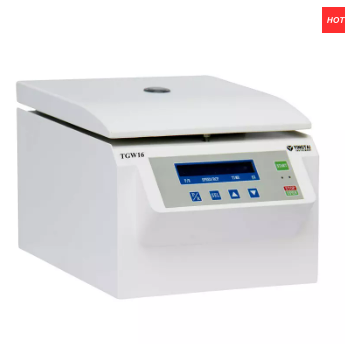
1. Brushless motor, no pollution, free-maintenane. 2. Microprocessor control, LCD display which indicates the speed, time, RCF in operation, 10 kinds of brake setting , operate simply. 3. Electric lid lock, super speed, imbalance protection. 4. The centrifuge body is made of high quality steel, stainless steel chamber, safe and reliable. 5. Rotor is connected to spindle by specialized taper sleeve, loading simple and quick, no direction. 6. 3 tiers protection steel cover and get the ideal centrifuation result.
Detail
TGW16 Technical Parameter:
Max. Speed
16000rpm
Max. RCF
19040×g
Max. Capacity
10×5ml
Time Range
0~99min59s
RPM/RCF Convert
Yes
Noise (dB)
≤ 55
Acc/Dec
10 Kinds
Speed Accuracy
±20r/min
Voltage(V/Hz)
AC 220V/110V 50HZ/60HZ
Size (W x D x Hmm)
355×270×205mm
Net Weight(Kg)
16KG
Certificates
CE,ISO & Calibration report are available
Matched Rotors for TGW16
Order No
Rotor
Max speed (rpm)
Max Volume(ml)
Max RCF (g)
W16-1
Angle rotor
16000
40×0.2ml
19040
W16-2
Angle Rotor
16000
24×0.5ml
18480
W16-3
Angle Rotor
16000
12×1.5/2ml
17940
W16-4
Angle Rotor
16000
10x5ml
17880
W16-5
Angle Rotor
14000
20×1.5/2ml
15580
W16-6
Angle Rotor
14000
4x8PCR
12070
Other Products
NGS Low Input DNA Library Prep Kit (illumina and MGI Platforms)
Product Info
Document
Product Info
The NGS Low Input DNA Library Prep Kit (illumina and MGI Platforms) was developed for construction of high quality NGS libraries with low input DNA amount from 1 ng to 400 ng. The kit allows scientist to study samples with limited DNA such as tumor samples, patient samples, and other specially collected samples (FACS sorting etc.). The kit has high library conversion efficiency with as little as 1 ng DNA input. The fast and simple 1.5-hour protocol makes libraries with even coverage and low GC-bias based our unique chemistry for DNA end-polishing and ligation.
The kit needs double strand DNA fragments (blunt and/or sticky) as input DNA for NGS library preparation, and is compatible with DNA fragments generated from both enzymatic approach (for example, BioDynami DNA fragmentation enzymes, Cat.# 40061 and Cat.# 40062) and mechanical approaches such as sonication and nebulization etc.
NGS Low Input DNA Library Prep Kit Workflow
Three index types are available for the NGS Low Input DNA Library Prep Kit of illumina platform:
Non-index (Cat.# 30022): Libraries do not have index.
Index (Cat.# 30024): Each of our index primers contains a unique barcode sequence with 6 bases that can be used to identify the low input DNA libraries. Library multiplexing up to 48 samples is possible. Index information can be downloaded here.
Unique dual index (Cat.# 30025): Library multiplexing up to 96 low input DNA libraries is possible with unique dual indexes with our Four-Base Difference Index System. The system allows us to make indexes for the libraries that have at least 4 bases different from each other in the 8-base barcode length. Our unique dual index primers can reduce sequencing errors such as de-multiplexing errors, amplification errors, mis-assignment of reads, index cross-contamination, and also index hopping. The kit includes 96 pre-mixed unique pairs of index primers. Index information can be downloaded here.
Indexes are available for the MGI platform kits (Cat.# 34024).
Kit advantages:
Fast protocol
The hands-on time is only 10 minutes
The total protocol time is around 1.5 hours
Simple procedure
Ready-to-use master mix makes it simple for reaction setup
Less reaction components
Less magnetic beads required for cleanup steps: Save the cost more than 50%
Low input DNA amount: Starts from 1 ng of DNA
Comparison of library conversion efficiency under the same NGS library preparation condition. Input DNA amounts are 1 ng and 10 ng, respectively. DNA was mechanical sheared with Covaris before library prep. BioDynami kit: NGS Low Input DNA Library Prep Kit (Cat. #30022).
Comparison of library yield under the same NGS library prep condition. Input DNA amounts are 1 ng, 10 ng, and 100 ng. DNA was mechanical sheared with Covaris before library prep. BioDynami kit (Cat. #30022). PCR cycle numbers were indicated.
Usages: Pancreatic digest of casein obtained with a process to maintain a high level of vitamins and growth factors, it is particularly recommended for a rapid growth and detection of microorganisms present in low concentrations.
Technical specification: Total nitrogen(TN)—————————≥11.5% Amino nitrogen(AN) ————————≥3.0% Sulphuri ash———————————–≤15.0% Loss on drying——————————–≤6.0% Chlorides—————————————≤2.0% PH(5% solution)——————————7.0±0.5 Solubility in 5% water ———————–complete Nitrites——————————————negative
Storage: Keep container tightly closed, store in a cool, dry place, away from bright light.
This product is suitable for extracting total RNA from 50-150mg conventional plantor fungal samples as well as samples rich in polyphenolic and polysaccharides. This kit is based on silica gel column purification technology, and the extraction process does not require the use of toxic phenol chloroform extraction. The entire extraction process only takes 20-30 minutes. This kit adopts DNA filtration technology, which can efficiently filter and remove DNA. The obtained RNA can be directly used for experiments such as RT-PCR, Northern Blot, poly A+ purification, nucleic acid protection, and in vitro translation.
Details
Kit Contents
Contents
R415002
D415003
Purification Times
50 Preps
250 Preps
HiPure RNA Mini Columns
50
250
gDNA Filter Columns
50
250
2ml Collection Tubes
100
500
TCEP (1M)
0.29 g
5 x 0.29 g
Buffer EP
1.0 ml
5.0 ml
Buffer PSL
50 ml
250 ml
Buffer RW1
50 ml
250 ml
Buffer RW2*
20 ml
2 x 50 ml
RNase Free Water
10 ml
30 ml
Storage and Stability
Except TCEP, the kit components can be stored dry at room temperature (15–25°C) and are stable for at least 18 months under these conditions. After receiving the product, it is recommended to store TCEP (dry powder) at -20-8°C. At low temperatures, Buffer PSL may form precipitates, dissolve it completely by 55°C water bath.
Purchase Guide
1. When dealing with woody or uncommon samples, R4150 is recommended first. R4150 contains two polysaccharide/polyphenol lysis buffer, which is the most universal product.
2. R4151 is recommended for handling common economic crop samples for the first time. Strong lysis solution can be used to process easy-extraction samples. The amount of corn or rice leaves samples can reach up to 300mg.
3. R4165 adopts CTAB/chloroform method, which can also handle a large number of difficult-to-extraction plants, but requires contact with chloroform substitutes, which is less safe than other kits. This kit uses DNase Ⅰ to remove DNA, which is also a good choice for extracting polysaccharide/polyphenol-rich plant samples.
4. R4014 is recommended for fruit/starch plant samples, which uses improved trizol pre-treatment, single column operation and is more economical.
Document
This product is suitable for extracting total RNA from 50-150mg conventional plantor fungal samples as well as samples rich in polyphenolic and polysaccharides. This kit is based on silica gel column purification technology, and the extraction process does not require the use of toxic phenol chloroform extraction. The entire extraction process only takes 20-30 minutes. This kit adopts DNA filtration technology, which can efficiently filter and remove DNA. The obtained RNA can be directly used for experiments such as RT-PCR, Northern Blot, poly A+ purification, nucleic acid protection, and in vitro translation.