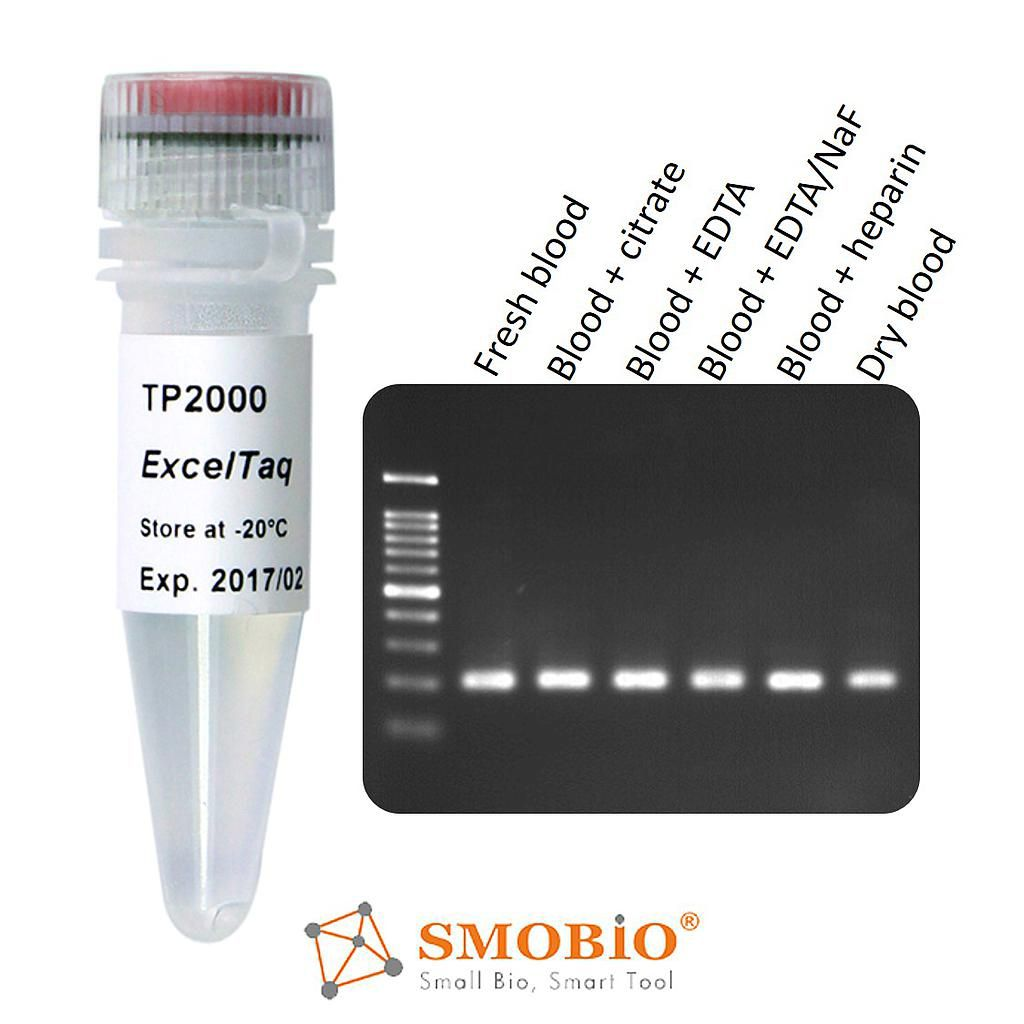
[TP2000] ExcelTaq™ Blood Direct DNA Polymerase, 5 U/μl, 500 U
Facebook
X
Pinterest
Email
The ExcelTaq™ Blood Direct DNA Polymerase is designed for amplifying targeted DNA directly from whole blood, eliminating the need for a lengthy DNA isolation process. ExcelTaq™ Blood Direct DNA Polymerase is highly tolerant in the presence of PCR interfering/ inhibiting substances in blood, such as IgG, hemoglobin, and lactoferrin. ExcelTaq™ Blood Direct DNA Polymerase is compatible with most anticoagulants, such as citrate, EDTA, and heparin (Fig. 1). The ExcelTaq™ Blood Direct DNA Polymerase includes a pair of Positive Control Primers (CCR5) that are compatible with primate blood samples.
Detail
Description
The ExcelTaq™ Blood Direct DNA Polymerase is designed for amplifying targeted DNA directly from whole blood, eliminating the need for a lengthy DNA isolation process. ExcelTaq™ Blood Direct DNA Polymerase is highly tolerant in the presence of PCR interfering/ inhibiting substances in blood, such as IgG, hemoglobin, and lactoferrin. ExcelTaq™ Blood Direct DNA Polymerase is compatible with most anticoagulants, such as citrate, EDTA, and heparin (Fig. 1). The ExcelTaq™ Blood Direct DNA Polymerase includes a pair of Positive Control Primers (CCR5) that are compatible with primate blood samples.
Features
5’→3′ DNA polymerase activity
No detectable 3’→5′ exonuclease (proofreading) activity
Generates PCR products with 3′-dA overhangs
Compatible with most anticoagulants
Applications
Direct amplification of DNA from blood samples
High throughput screening without DNA purification
Attogene’s Mercury Lateral Flow Kit can be used for the screening of Mercury in water samples at 10 ppb in the field.
Mercury contamination is a serious worldwide environmental problem. As it is difficult to detoxify by chemical or biological methods, gradual Mercury ion accumulation in the nervous and cardiovascular systems of the human body can subsequently cause serious diseases. Long-term health consequences of drinking Mercury-contaminated food and water include brain, heart, kidney, lungs and immune system problems for adults, and the physical and mental development delays in infants and children. Attogene’s Mercury Lateral Flow test gives results conforming of 10ppb or greater. Using the supplied pipette, simply fill the vial with your water sample, place the water into the sample port and wait 5 minutes.
Magen’s HiPure columns are prepared by high quality glass fiber filter membrane as raw materials through membrane cutting, membrane release, ring release, ring pressing, gland, weighing and other processes. HiPure nucleic acid adsorption columns have the characteristics of long-term stability and high binding capacity. Experiments show that the highest binding capacity and binding efficiency of HiPure nucleic acid adsorption columns are basically unchanged when stored at room temperature for 4 years.
The series of nucleic acid columns produced by Magen Biotech are based on carefully selected imported glass fiber membranes (GF/B, GF/D, GF/F). Columns production processes such as polypropylene injection molding materials, injection molding process, and downstream membrane packing and compression rings are strictly controlled. This is to ensure that the column has extremely high adsorption capacity and long-term stability. Compared with conventional products on the market, Magen’s columns are with varieties, and binding rate will not change when stored at room temperature for 4 years.
Details
Specifications
Features
Specifications
Recommended application
Small amounts of nucleic acid isolation, viral nucleicacid from cell free samples
Preservation conditions
Room temperature
Stability
Up to 4 years
Filter membrane
High quality glass fiber filter GF/F, 3 layers
Membrane aperture
0.7μm
Maximum binding yield of plasmid
30 μg
Maximum yield of alcohol mediated Binding
200 μg
Single liquid carrying capacity of column
800 μl
Minimum elution volume
30 μl
Withstand centrifugal force
16,000 x g
Centrifuge
Small high speed centrifuge (2ml)
Adsorption Mechanism
Based on the negatively charged DNA skeleton, it has a high affinity for positively charged glass fibers. In high salt and ethanol solutions, DNA/RNA binds to glass fiber and interacts with hydrophilic matrix on silica through hydrogen bond. DNA/RNA is tightly bound. All pollutants can be removed by washing solution. At high salt concentration, nucleic acids selectively bind to silicagel membrane, while other pollutants, mainly proteins, are removed by membrane washing.
Ordering information
CAT.No.
Product Name
Package
C13112
HiPure Viral Mini Column I (3 x GF/F)with 2ml Collection Tubes
1000/Bag
Purchase Guide
Item No.
Product Name
Membrane type/number of layers
Collection tubes
Plasmid DNA binding capacity (Physical adsorption)
Note: GF/B pore size is for 1.0μM glass fiber membrane; GF/F pore size is for 0.7μm glass fiber membrane.
Document
Magen’s HiPure columns are prepared by high quality glass fiber filter membrane as raw materials through membrane cutting, membrane release, ring release, ring pressing, gland, weighing and other processes. HiPure nucleic acid adsorption columns have the characteristics of long-term stability and high binding capacity. Experiments show that the highest binding capacity and binding efficiency of HiPure nucleic acid adsorption columns are basically unchanged when stored at room temperature for 4 years.
Alkyne-PEG2-iodide is a crosslinker containing a propargyl group and an iodine group. The propargyl group can form triazole linkage with azide-bearing compounds or biomolecules via copper catalyzed Click Chemistry reactions. Iodine (I) is a very good leaving group for nucleophilic substitution reactions. The hydrophilic PEG spacer increases solubility in aqueous media. Reagent grade, for research use only.
Document
Alkyne-PEG2-iodide is a crosslinker containing a propargyl group and an iodine group. The propargyl group can form triazole linkage with azide-bearing compounds or biomolecules via copper catalyzed Click Chemistry reactions. Iodine (I) is a very good leaving group for nucleophilic substitution reactions. The hydrophilic PEG spacer increases solubility in aqueous media. Reagent grade, for research use only.