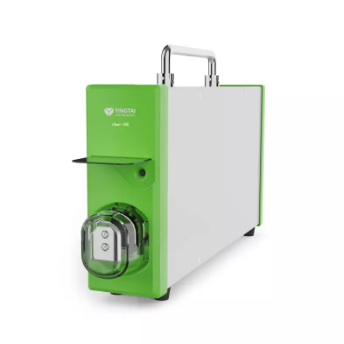
A device that uses the principle of high-frequency oscillation to generate heat through the friction of molecules in PVC hoses, thereby melting the PVC hose and achieving the sealing effect. This device is also referred to as a pipe sealing machine in some places.
Detail
Heat Sealing Time:
0.5~2s
Heat Sealing Tube Outer Diameter:
2~6mm
Indicator Light Colors:
Red/Blue
RF Frequency:
40.68MHz
Grounding Protection:
Class l
Spacing Adjustment
65,70,75,80,85,90,95,100mm
Power Consumption:
250W during operation,10Win standby
Power Supply:
100V~120V/220V~240V AC
Weight:
4.5kg
Dimensions:
336×65×173mm
Operating Temperature:
0~40℃
Storage Temperature:
-20~70℃
Other Products
Fungi/Yeast Genomic DNA Isolation Kits
Product Info
Document
Product Info
Overview
Rapid spin column purification of genomic DNA from viable yeast cells, fungal spores or mycelium, and bacteria including Gram-positive
Bead tubes (provided) allow for effective mechanical homogenization
Purified DNA is of high quality and integrity and compatible with any sensitive downstream applications such as PCR, qPCR, RFLP and more
These kits provide fast and reliable procedures for the purification of genomic DNA from viable yeast cells, fungal spores or mycelium, and bacteria including Gram-positive. Genomic DNA is efficiently extracted from the cells by a combination of heat treatment, detergents and Bead Tubes (provided). An optional lyticase treatment allows for improved DNA yields with certain fungal and yeast species. Recovered genomic DNA is of excellent yield and purity for any downstream application including PCR, qPCR, Restriction Fragment Length Polymorphism (RFLP), Amplified Fragment Length Polymorphism (AFLP), sequencing, SNP analysis and more.
Fungi/Yeast Genomic DNA Isolation Kit (Spin Column)
This kit provides rapid spin column purification of genomic DNA from viable yeast cells, fungal spores or mycelium, and bacteria including Gram-positive. Preparation time for a single sample is less then 30 minutes, and each kit contains sufficient materials for 50 preparations.
Fungi/Yeast Genomic DNA Isolation 96-Well Kit (HT)
Norgen’s Fungi/Yeast Genomic DNA Isolation 96-Well Kit provides a fast, reliable and simple procedure for high throughput isolation of DNA from viable yeast cells, fungal spores or mycelium and Gram-positive bacteria. The purification could be performed on either a vacuum manifold or using centrifugation. Complete 96 purifications in 40 minutes.
Maximum Amount of Starting Material: Fungi (Wet weight) Yeast or Gram-positive bacterial culture
50 mg 0.5 mL – 1 mL
Time to Complete 96 Purifications
40 minutes
Storage Conditions and Product Stability All solutions should be kept tightly sealed and stored at room temperature. These reagents should remain stable for at least 2 years in their unopened containers.
The Integrated Total Dietary Fiber test kit is suitable for the measurement and analysis of Integrated Total Dietary Fiber.
Updated to include resistant, branched maltodextrins as a component in dietary fiber.
K-INTDF – An Integrated Procedure (AOAC Method 2009.01 & 2011.25) for the measurement of Total Dietary Fiber (including resistant starch and non-digestible oligosaccharides). This method combines the key attributes of AOAC Official Methods of Analysis 2002.02, 985.29, 991.43, 2001.03.
Specific dietary fiber fractions are measured as follows:
2. Total High Molecular Weight Dietary Fiber (HMWDF) and SDFS determination (AOAC Method 2009.01)
The enzymes used in these methods are of very high purity; they are effectively devoid of contaminating enzymes active on β-glucan, pectin and arabinoxylan.
Data calculators are located in the Documents tab.