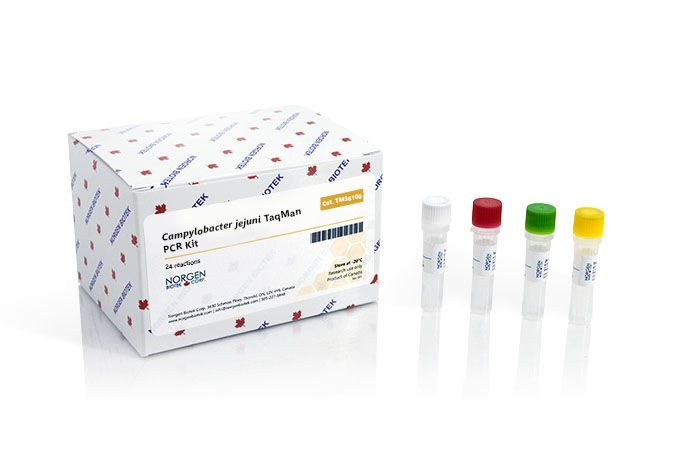
Campylobacter jejuni is a curved, rod-shaped and microaerophillic gram negative bacterium. It is one of the most common causal agents of gastroenteritis with diarrhea as the main symptom. While infection of C. jejuni is seldom life-threatening, it is considered one of the most common food-borne bacteria with over 2 million people infected per year in US alone. Infection of C. jejuni usually results from consumption of poorly prepared food including undercooked meat (particularly poultry), untreated water or raw unpasteurized milk. Traditional identification of C. jejuni involves culturing, however the microaerophilic characteristic of this bacterium make the enrichment process laborious and costly.
Storage Conditions and Product Stability All kit components can be stored for 2 years after the date of production without showing any reduction in performance.
All kit components should be stored at -20°C upon arrival. Repeated thawing and freezing (> 2 x) of the Master Mix and Positive Control should be avoided, as this may affect the performance of the assay. If the reagents are to be used only intermittently, they should be frozen in aliquots.
Component
Cat. TM36150 (100 preps)
Cat. TM36110 (100 preps)
MDx TaqMan 2X PCR Master Mix
2 x 700 μL
–
Campylobacter jejuni Primer & Probe Mix
280 μL
280 μL
Campylobacter jejuni Positive Control
150 μL
150 μL
Nuclease-Free Water (Negative Control)
1.25 mL
1.25 mL
Product Insert
1
1
Other Products
[RP1000] ExcelRT™ Reverse Transcriptase, 200 U/μl, 20000 U
Product Info
Document
Product Info
Description
The ExcelRT™ Reverse Transcriptase is a recombinant Moloney Murine Leukemia Virus (M-MLV) reverse transcriptase – an RNA dependent DNA polymerase capable of generating first strand cDNA using an RNA template. It is designed to reduce RNase H activity and create better thermal stability. The ExcelRT™ Reverse Transcriptase is able to routinely synthesize first strand cDNA >8 kb at 37~50°C.
Features
High yield
Thermostable, up to 50°C, during first strand synthesis
High processivity, generating cDNA up to 8 kb
Reduced RNase H ribonuclease activity
Application
Generation of first strand cDNA from total RNA or mRNA.
Suitable for generating cDNA from RNA with strong secondary structure which can be reduced at temperature up to 50°C.
Storage
-20°C for 24 months
High yield
Thermostable, up to 50°C, during first strand synthesis
20 mM Tris-HCl (pH 7.5), 200 mM NaCl, 0.1 mM EDTA, 1 mM DTT, stabilizer, 50% (v/v) glycerol
5X RT buffer
250 mM Tris-HCl (pH 8.3 at 25°C), 375 mM KCl and 15 mM MgCl2
Storage
-20°C for 24 months
Document
The ExcelRT™ Reverse Transcriptase is a recombinant Moloney Murine Leukemia Virus (M-MLV) reverse transcriptase – an RNA dependent DNA polymerase capable of generating first strand cDNA using an RNA template. It is designed to reduce RNase H activity and create better thermal stability. The ExcelRT™ Reverse Transcriptase is able to routinely synthesize first strand cDNA >8 kb at 37~50°C.
Hereby we (Changsha Yingtai Instrument Co.,Ltd) confirm that CDL7M centrifuge is recommended for Graphene Base Manufacturing Industries. This centrifuge type is widely used in Large Laboratory Systems, Graphene Base Manufacturing Industries, and also used in the field of blood stations, pharmaceutical factories, biochemistry, biological products, and so on
Features
1. Widely used in the field of blood bank, pharmaceutical factory and laboratory.
2. Brushless frequency motor, in great torque, free maintenance, no powder pollution, quick in speed up and down.
3. Digital display which indicates the program, speed, time,RCF, temperature.
4. Micro computer control, there are 10 kinds of program and 10 kinds of acceleration and deceleration for your choice.
5. There are 3 kinds of rotors for your choice.
6. Electric lid lock, compact design, super speed and imbalance protection.
7. The centrifuge body is made of high-quality steel, safe and reliable.
Collagen is a fundamental component of the extracellular matrix, and the predominant protein in animals, constituting around 30% of total protein mass. A glycoprotein, it is well known for its triple helical structure. This is formed from three polypeptide α-chains with Gly-X-Y repeating residues (Gly for Glycine, X for proline, and Y for hydroxyproline).
Types of Collagen
Over 28 types of collagens have been identified, with Type I collagen being the most abundant. It’s prevalent in ligaments, tendons, skin, and bone tissue. Its mature, insoluble form grants it remarkable strength, making it vital for the mobility of organisms. Collagen also has biochemical functions, influencing cell growth, proliferation, and differentiation.
This version of the kit is designed to detect and measure INSOLUBLE forms of collagen. Chose our Sircol 2.0 collagen kit if you need to analyse SOLUBLE collagen.
Applications of Collagen
Collagen, with its diverse properties, finds utility in various industries. It plays a role in medicine for wound healing and has an expanding role in tissue engineering and cell culture for biomedical purposes. It’s gaining popularity in the cosmetic industry for skin rejuvenation and is used in chemical formulations and the food industry as a functional food supplement and additive.
How does the Sircol assay detect collagen?
Sircol dye reagent contains Sirius Red – a linear anionic dye with sulphonic acid side chain groups. Under assay conditions the Sircol dye binds the basic groups of soluble collagen molecules. Maximal binding occurs in collagens possessing intact triple helix organisation as the highly ordered Gly-X-Yn helical structure of tropocollagen further contributes to dye binding. This results in a high degree of dye-collagen specificity. Affinity is progressively reduced during heat denaturation 4ºC due to the unwinding of the triple helix and formation of random chains.
Overview of the Sircol assay process:
Step 1. Samples being assayed for insoluble collagen must first undergo a 2-3 hour pre-treatment with Sircol Fragmentation reagent. This converts insoluble collagen into water-soluble gelatin can then be assayed.
Step 2. Addition of Sircol Dye Reagent to these pre-treated insoluble collagen samples results in the formation of a denatured collagen-dye complex. This complex then precipitates during the dye incubation period and is subsequently isolated by centrifugation, followed by washing to remove unbound dye. The Denatured collagen-bound dye is then eluted and measured spectrophotometrically.
Step 3. The insoluble collagen content of unknown samples is quantified by comparison against a calibration curve prepared using a the denatured collagen standard supplied with the kit.
Assay range
100 – 1000 µg/ml
Limit of Detection
100µg/ml
Detection Method
Colorimetric Detection (556nm) (Endpoint)
Measurements per kit
110 in total (allows a maximum of 46 samples to be run in duplicate alongside a standard curve).
Suitable Samples
The assay can be used to assess the rate of production of newly laid down collagen fibres during periods of rapid growth, development, tissue repair, remodeling and wound healing. Sources of material includes tissues, bone and calcified tissue.
*Insoluble collagens must be converted into soluble form prior to assay. Instructions and regents are provided with the kit., depending on sample this will require prior salt/acid/acid-pepsin extraction.
**non-mammalian collagens may result in a reduced limit of detection. We recommend use of an assay standard matched to the species under assay.
Many customers have found that the straightforward sample processing and analysis of Sircol make it a good alternative to conventional hydroxyproline analysis.
Precautions
This kit is designed for research use only. Not for use in diagnostic procedures. Kit requires access to a centrifuge, water bath / heated block, as well as a spectrophotometer/colorimeter capable of absorbance detection at 556nm. Specific sample preparation protocols may require customer to provide further reagents, consult assay manual for further information.
Sircol Insoluble Collagen kit contents:
1. Sircol Dye Reagent (1x110ml)
2. Denatured Collagen Reference Standard (1x5ml, 1.0mg/ml)
3. Acid-Salt Wash Reagent (1x20ml)
4. Fragmentation Reagent (1x110ml)
5. Alkali Reagent (1x110ml)
6. 2ml screw-cap tubes for preparation of samples.
7. Assay kit manual
NB: Additional reagents may be required for sample preparation prior to assay. Consult manual or contact us for further details.
Document
As collagens mature, they become increasingly crosslinked and insoluble – characteristics necessary for key biophysical role that collagen plays in living organisms. Biocolor’s Sircol™ INSOLUBLE Collagen Kit is a dye-binding assay designed for accurate quantification and measurement such collagens. It is ideal for analyzing crosslinked / insoluble collagens from sources such as tissues, bone, and calcified tissue.