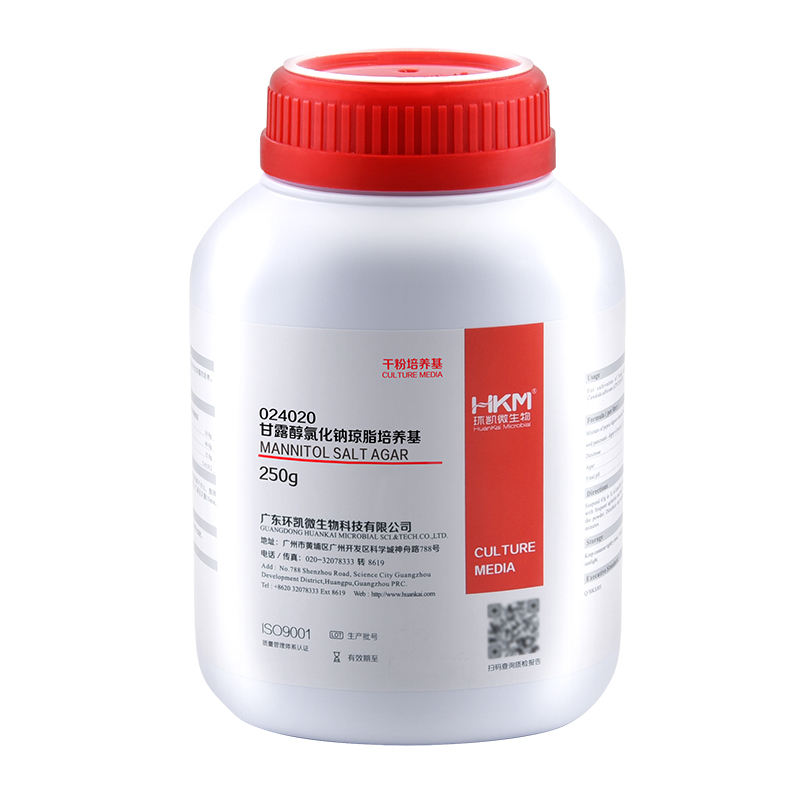
For selective isolation and culture of Staphylococcus aureus.
Principle:
Peptone and beef extract powder provides carbon, nitrogen, vitamins and minerals; D- mannitol to fermentable sugars; higher levels of sodium chloride to provide a higher osmotic pressure, suppress most non-staphylococcal microorganisms ; phenolsulfonphthalein as pH indicator; agar is medium coagulant. Typical pathogenic staphylococci (coagulase positive) D- mannitol produce acid fermentation and produce yellow colonies with a yellow halo, typically non-pathogenic Staphylococcus unfermented D- mannitol to form red colonies.
Formulation(per liter): Pancreatic digest of casein 5.0g Pancreatic digest of animal tissue 5.0g Beef Extract 1.0g Sodium Chloride 75.0g Mannitol 10.0g Phenol Red 0.025g Agar 15.0g Final PH 7.4±0.2
How to use: 1.Suspend 111g in 1L of distilled water , stirring heated to boiling to completely dissolve ,autoclave at 121℃ for 15 minutes. 2.Diluted and treated samples.
Quality control:
Item
The name and number of strain
Growth
Colony Color
1
Staphylococcus aureus CMCC (B) 26003
Good
Golden yellow
2
Staphylococcus epidermidis CMCC (B) 26069
Good
Red
3
Escherichia coli CMCC (B) 44102
Inhibition
—
Storage: Keep container tightly closed, store in a cool, dry place, away from bright light. Storage period of 3 years.
NGS Library Quantification Standards With PCR Primers
Product Info
Document
Product Info
The NGS Library Quantification Standards with PCR Primers (for illumina platform) were developed for quantification of the NGS library concentration for illumina sequencing platform. It is comprised of Library Standards (six 10-fold dilutions) and a primer mix.
Quantification of the NGS library of the amplifiable molecules is critical for the quality of the sequencing data. Adequate library concentration will maximize sequencing capacity. Poor library concentration results in either low or high cluster density on the flow cell, which can lead to low sequencing capacity.
It is not accurate to measure the concentration of NGS library with standard DNA quantification methods such as spectrophotometer or fluorometer. QPCR is the best way for library quantification with high consistency and reproducibility of library quantitation.
BioDynami Library Quantification Standards with PCR Primers (for illumina platform): Amplification curve of 6 standards.
Our reagent is a highly sensitive, Real time PCR-based quantification that specifically designed for NGS libraries using illumina sequencing platform. The amplification uses illumina adaptor sequences as primers, and only the fully adaptor-ligated libraries will be amplified. Therefore the reagent provides an accurate estimation of the library concentration based on true sequenceable illumina libraries. In addition, this kit can also be used for confirmation of ligation reaction after completion of library preparation.
Our library quantification standards is compatible with commercial SYBR Green based QPCR reagents. This makes it more flexible for scientists who want to use their real time PCR reagent. Quantification of library concentration is achieved by comparison with a standard curve generated from the Library Standards.
Document
The NGS Library Quantification Standards with PCR Primers (for illumina platform) were developed for quantification of the NGS library concentration for illumina sequencing platform. It is comprised of Library Standards (six 10-fold dilutions) and a primer mix.
Gel images of different ranges of library size selection. Sheared human genomic DNA was used as input.
.
Library size selection is an enrichment of a specific range of library sizes for NGS library preparations. The NGS library preparation is related to the quality of the sequencing data. Precise NGS library size selection can increase sequencing efficiency, improve data quality, and reduce costs.
There are two types of sequencing technologies: short-read sequencing and long-read sequencing. Short-read sequencing uses DNA libraries that contain small insert DNA fragments of similar sizes, usually several hundred base pairs. The sequencing efficiency can be improved if the DNA size selection is in the right range. Cat.# 20104S and 20104L are the best kits for NGS library size selection of illumina paired-end 100 (PE100) sequencing with 100-200 bp library inserts; Cat.# 20105S and 20105L are the best kits for NGS library size selection of illumina paired-end 150 (PE150) sequencing with 150-300 bp library inserts; and Cat.# 20106S and 20106L are the best kits for NGS library size selection of illumina paired-end 300 (PE300) sequencing with 300-600 bp library inserts.
Long-read sequencing uses a large DNA fragment as input and makes very long reads. Usually, library size selection is preferred to remove smaller fragments. Cat.# 20110S and 20110L are the best kits for long-read sequencing size selection with DNA sizes >5 kb, and Cat.# 20111S and 20111L are the best kits for long-read sequencing size selection with DNA sizes >10 kb.
The magnetic beads, or SPRI (Solid Phase Reversible Immobilization) beads, is well used for the purification of DNA due to their reversible DNA binding. The NGS library can be size-selected by the magnetic beads or SPRI beads. The properties of the magnetic beads can be changed for a specific range of DNA binding. The contaminants and other unwanted components in the libraries can also be removed during size selection.
Specific ranges of NGS libraries can be selected using magnetic beads with different buffer compositions. The first DNA-beads binding step, also called the right-side clean-up, removes large NGS library fragments. The large NGS library fragments that bind to the beads are discarded with the beads pellet. The desired NGS library fragments in the supernatant are transferred to a new well, and new beads are added to the supernatant for the second beads-DNA binding, also called the left-side clean-up. After the rinsing step, the NGS library fragments with the dual selection are eluted in water or an appropriate buffer. The magnetic beads method has great advantages over time-consuming column purification and tedious gel-based purification.
NGS library size selection with dual clean-ups.
.
Library size selection for long-read sequencing only requires a single clean-up. In this case, only the large library fragments are bound to the beads, while other small library fragments are discarded with the supernatant. The selected larger library fragments are eluted in water or an appropriate buffer after the rinsing step.
NGS library size selection with single clean-up for >5 kb and >10 kb libraries.