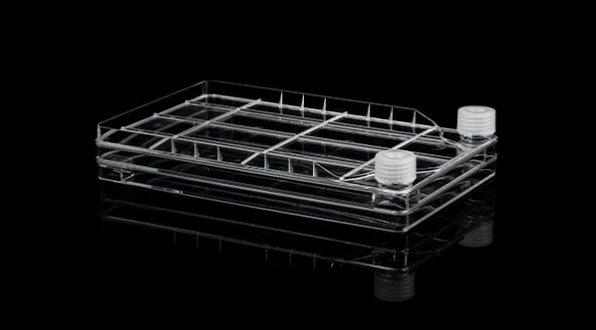
Huayi Cell Factory is a robust and easy-to-use cell culture platform for applications in the production of human and animal vaccines, therapeutic proteins, cell therapy, and gene therapy.
To address the needs of your workflow, We have three kinds of mouth, which is available on most cell culture products to ensure consistent performance from lot to lot and from format to format.
Huayi Cell Factory is a robust and easy-to-use cell culture platform for applications in the production of human and animal vaccines, therapeutic proteins, cell therapy, and gene therapy.
To address the needs of your workflow, We have three kinds of mouth, which is available on most cell culture products to ensure consistent performance from lot to lot and from format to format.
The product assembled with ultrasonic welded technology
Versatile port design facilitates both pouring and aseptic filling techniques
Gamma radiation sterilization
the cell culture surface area
of one 10-layer Cell Factory unit is equivalent to the area
of 36 T-175 flasks
Other Products
ProteoSpin™ Urine Protein Concentration Kits
Product Info
Document
Product Info
Overview
Simultaneous concentration, desalting and buffer exchange of total urinary proteins
No molecular weight cutoff allows for isolation of all sizes of proteins and peptides
Purification is based on spin column chromatography that uses Norgen’s resin separation matrix
These kits concentrate urine proteins while simultaneously removing salts, urea, and other urine contaminants. There is no molecular weight cut-off and therefore the columns capture total urinary proteins and peptides of all sizes making them ideal for biomarker discovery work, differential expression of proteins in various diseases, or other diagnostic research. The columns are convenient, rapid and easy to use and thus offer significant time savings over classic dialysis protocols. The resulting high-quality protein sample is concentrated and free from the original sample salts, thus preparing the sample conveniently for downstream proteomic applications including SDS-PAGE, 2D Gels, MALDI-TOF, LC/MS, LC/MS/MS, whole protein mass spectrometry, western blotting, protein microarrays, and more.
ProteoSpin™ Urine Protein Concentration Micro Kit
Each spin column is able to concentrate and desalt up to 200 μg of urine proteins. Twelve samples can be processed in 20 minutes.
ProteoSpin™ Urine Protein Concentration Midi Kit
The ProteoSpin™ Urine Protein Concentration Midi Kit provides a fast and simple procedure for concentrating dilute solutions of urine proteins from 1 to 5 mL inputs of urine. Each mini spin column is able to concentrate and desalt up to 3 mg of urine proteins in 30 minutes.
ProteoSpin™ Urine Protein Concentration Maxi Kit
The ProteoSpin™ Urine Protein Concentration Maxi Kit provides a fast and simple procedure for concentrating dilute solutions of urine proteins from 2 to 20 mL inputs of urine. Each maxi spin column is able to concentrate and desalt up to 4 mg of urine proteins in 45 minutes.
*Yield will depend on the health status of the donor.
Storage Conditions and Product Stability
All solutions should be kept tightly sealed and stored at room temperature. Once opened, the solution should be stored at 4°C. This kit is stable for 2 years after the date of shipment.
Component
Cat. 17400 (25 preps)
Cat. 52300 (10 preps)
Cat. 21600 (4 preps)
Wash Solution C
60 mL
60 mL
130 mL
Binding Buffer A
4 mL
4 mL
8 mL
Elution Buffer C
8 mL
30 mL
30 mL
Protein Neutralizer
4 mL
4 mL
4 mL
Micro Spin Columns
25
–
–
Midi Spin Columns (assembled with collection tubes)
–
10
–
Maxi Spin Columns (assembled with collection tubes)
Diazo Biotin-PEG3-alkyne is useful for introducing a biotin moiety to azide-containing biomolecules using Cu(I)-catalyzed Click Chemistry. The hydrophilic spacer arm provides better solubility to the labeled molecules in aqueous media. Diazo allows efficient release of captured biotinylated molecules from streptavidin using sodium dithionite (Na2S2O4). Reagent grade, for research purpose. Please contact us for GMP-grade inquiries.
Document
Diazo Biotin-PEG3-alkyne is useful for introducing a biotin moiety to azide-containing biomolecules using Cu(I)-catalyzed Click Chemistry. The hydrophilic spacer arm provides better solubility to the labeled molecules in aqueous media. Diazo allows efficient release of captured biotinylated molecules from streptavidin using sodium dithionite (Na2S2O4). Reagent grade, for research purpose. Please contact us for GMP-grade inquiries.
The CellG3 assay reagent for the measurement of endo-cellulase (endo-1,4-β-glucanase) contains two components; 1) 4,6-O-benzylidene-2-chloro-4-nitrophenyl-β-D-cellotrioside (BCNPG3) and 2) thermostable β-glucosidase. The benzylidene blocking group prevents any hydrolytic action by the β-glucosidase on BCNPG3. Incubation with an endo-cellulase generates a non-blocked colourimetric oligosaccharide that is rapidly hydrolysed by the ancillary β-glucosidase. The rate of formation of 2-chloro-4-nitrophenol is therefore directly related to the hydrolysis of BCNPG3 by the endo-cellulase. The reaction is terminated and the phenolate colour is developed on addition of Tris buffer solution (pH 9.0).
Please note that a new assay kit (K-CellG5) is now available for the measurement of endo-cellulase. The CellG5 reagent contains a cellopentaose core and exhibits vastly improved sensitivity for some cellulases. In addition, the exchange of the benzylidene blocking group in CellG3 for 3-keto-butylidene in CellG5 improves the substrate’s water solubility significantly, allowing for a reduction in the concentration of DMSO required in the assay. As DMSO is known to inhibit certain cellulases, this is another benefit in using CellG5. Megazyme now recommends the use of K-CellG5 for all assays for the measurement of endo-cellulase.
The CellG3 assay reagent for the measurement of endo-cellulase (endo-1,4-β-glucanase) contains two components; 1) 4,6-O-benzylidene-2-chloro-4-nitrophenyl-β-D-cellotrioside (BCNPG3) and 2) thermostable β-glucosidase. The benzylidene blocking group prevents any hydrolytic action by the β-glucosidase on BCNPG3. Incubation with an endo-cellulase generates a non-blocked colourimetric oligosaccharide that is rapidly hydrolysed by the ancillary β-glucosidase. The rate of formation of 2-chloro-4-nitrophenol is therefore directly related to the hydrolysis of BCNPG3 by the endo-cellulase. The reaction is terminated and the phenolate colour is developed on addition of Tris buffer solution (pH 9.0).