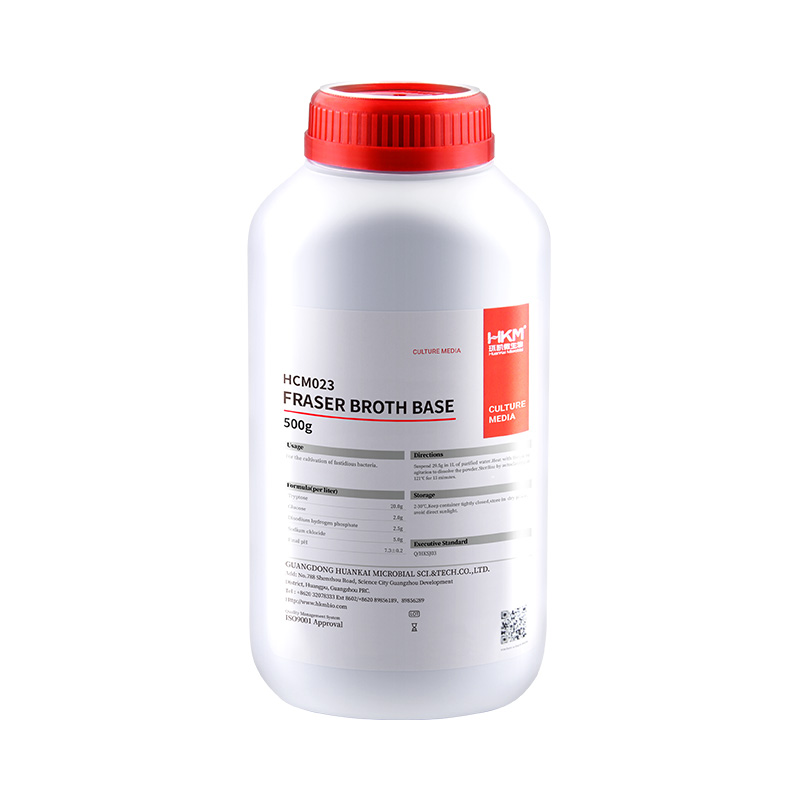
Intended Use For selective enrichment culture of Listeria monocytogenes in food. Principle and Interpretation Tryptone, proteose peptone, meat extract, yeast paste powder provide nitrogen ……
Detail
Introduction
Intended Use
For selective enrichment culture of Listeria monocytogenes in food.
Principle and Interpretation
Tryptone, proteose peptone, meat extract, yeast paste powder provide nitrogen sources, vitamins, amino acids, and growth factors; sodium chloride can maintain a balanced osmotic pressure; sodium dihydrogen phosphate and potassium dihydrogen phosphate as buffering agents; esculin are fermentable sugars; lithium chloride and other antibiotics can inhibit Gram negative bacteria and most Gram positive bacteria.
Formulation
Ingredients
/liter
Enzymatic digest of animal tissues ( Proteose peptone)
5.0g
Enzymatic digest of casein ( Tryptone)
5.0g
Meat extract
5.0g
Yeast extract
5.0g
Sodium chloride
20.0g
Disodium hydrogen phosphate dihydrate
12.0g
Potassium dihydrogen phosphate
1.35g
Aesculin
1.0g
Lithium chloride
3.0g
pH7.2±0.2 at 25°C
Preparation
Suspend 57.4g in 1 L of distilled or deionized water. Heat with frequent agitation and boil to completely dissolve the powder. Distribute into flasks. Autoclave at 121℃ for 15 minutes. Cool to 45-50℃,aseptically add the contents of 1 vial of Fraser Selective Supplement (SR0120) to each 225 mL of base to prepare FB1 solution; Add one reagent (SR0130) to each100 mL of FB2 culture medium to prepare FB2 enrichment solution.
Quality Control
Cultural characteristics observed after incubation at 35-37°C for 46~50 hours
2-30℃,Keep container tightly closed, avoid direct sunlight.
Use before expiry date on the label.
Precautions
1. When weighing the dehydrated medium, please wear masks to avoid causing respiratory system discomfort
2. Keep container tightly closed after using to prevent clumping.
Waste Disposal
Microbiological contamination was disposed by autoclaving at 121°C for 30 minutes.
Revision
On June 14, 2024
References
ISO 11290
Other Products
TL36 Biological Microscope
Product Info
Document
Product Info
* Optical system: equipped with infinite flat field optical system, the whole machine mildew prevention design and large field eyepiece, with beautiful appearance, clear imaging, broad vision, convenient operation and other characteristics, can be widely used in biology, medicine, industry, agriculture and other fields, is the ideal instrument for medical, teaching, scientific research and other units
* Observation head device: the cylinder can rotate 360 degrees, the displacement of the center of the mirror is 0.06mm; 30 tilt; the hinge type binocular observation (the magnification difference between left and right systems is 2.0%; the end position difference is 0.1mm at zero vision) and the third party connection port, the pupil distance adjustment range is 50-75mm, the fixed observation cylinder head is internal hexagon screw or select portable screw.
* Eyepiece configuration: random eyepiece WF10X / 22mm; the magnification accuracy of eyepiece shall not exceed ± 2%. There is a card slot on the eyepiece tube to lock the eyepiece to prevent falling. Binocular vision is adjustable, making binocular observation easier;
* Loading platform: triangular rail XY composite mechanical moving loading platform; 0.005 lateral to 5N horizontal force, corrosion resistance and wear resistance. Rectangular, size 190X140mm, stroke 6090mm, minimum read value 0.1 mm.
Parameter of microscope
Specification configuration
TL36A
Binocular observation head, 45° tilt, 360 degrees can be rotated, pupil distance can be adjusted, adjustment range 50-75mm
TL36B
Three-eye observation head, 45° tilt, 360 degrees can be rotated, pupil distance can be adjusted, adjustment range 50-75mm.
TL36M
Three-eye viewing head with 6.3 megapixel imaging system CMOS camera
TL36P
Three-eye viewing head, equipped with 10.1 inch integrated flat panel display
Eyepiece
Wide-angle eyepiece WF10X,field of view 22mm,optional WF16X,WF25X
Converter
Quadruple Revolving converter
0bjective
Flat field achromatic objective at infinite distance,4X,10X,40X,100X(oil)
Condenser
ABBE N.A.1.25Condenser with Iris Diaphragm &Filter
Stage
Double Layer Mechanical Stage, Size1190X140mm, Moving Range : 60mmx90mm
Focusing
0.02mmCrude motion, micromotion and coaxial focal adjustment system with a minimum focal range of 0.02mm Coarse and Fine Focusing
Light source
3W LED,with Rechargeable Battery,Type C USB cable
Attachments
Dust bag,Type C power cord
Document
TL 36 series biological microscopes are equipped with infinite distance flat field achromatic objective and large field eyepiece, with the characteristics of beautiful appearance, clear imaging, broad vision, convenient operation and so on, can be widely used in biology, medicine, industry, agriculture and other fields, is the ideal instrument for medical, teaching, scientific research and other units
Blood samples contain rich DNA, including mitochondrial DNA, genomic DNA, circulating DNA (mostly released into blood after tumor cell apoptosis) in white blood cells, as well as parasitic viral or microbial DNA. These DNA are important parameters in clinical testing or diagnosis, which are also valuable materials for medical research. There are three main issues with extracting DNA from blood samples:
1. The sample is highly infectious, posing great harm to operators and the environment.
2. The source of DNA is complex and aportion of the nucleic acid, such as viral DNA or free DNA, may be lost during the operation, leading to downstream detection failure;
3. Blood sample contains a large amount of impurities and inhibitory factors.
Currently there are many methods available for extracting DNA from whole blood samples, such as phenol chloroform extraction, salting out method, etc. However, these methods require pre-treatment of blood sample, which removes red blood cells and isolate white blood cells in the first step. Due to the requirement that it cannot inactivate or kill pathogens during the process of removing red blood cells, the waste liquid (red blood cell lysate) and consumables may be contaminated by pathogens and become infectious, posing a danger to the entire laboratory environment and operators. In addition, during the process of removing red blood cells, useful nucleic acid information such as viruses, microorganisms, or circulating DNA is also lost, leading to experiment or detection failures.
The HiPure Blood DNA Kits series provided by Magen Company uses silica gel column purification technology, which can directly lyse whole blood samples without the need for white blood cell separation. Whole blood samples are directly mixed with lysates and proteases, resulting in the inactivation of pathogens, greatly reducing the infectivity, environmental pollution, and the chance of operators being infected. Due to the direct lysis and digestion of samples, except lymphocyte DNA, other circulating DNA as well as DNA from viruses and microorganisms, can also be recovered.
This product provides fast and easy methods for purification of total DNA for reliable PCR and Southern blotting. Total DNA (e.g., genomic, viral, mitochondrial) can be purified from tissue, whole blood, plasma, serum, buffy coat, bone marrow, other body fluids, lymphocytes, cultured cells.
Details
Specifications
Features
Specifications
Main Functions
Isolation total DNA from blood, tissue, culture cells, swab, blood spots using 96 plate
Applications
PCR, southern bolt and virus detection, etc
Purification method
96 well plate
Purification technology
Silica technology
Process method
Manual (centrifugation or vacuum)
Sample type
Blood, serum, plasma, milk, saliva, and other liquid samples and cultured cells
Sample amount
Elution volume
Time per run
Liquid carrying volume per column
Binding yield of column
Principle
This product is based on silica column purification. The sample is lysed and digested with lysate and protease, DNA is released into the lysate. Transfer to an adsorption column. Nucleic acid is adsorbed on the membrane, while protein is not adsorbed and is removed with filtration. After washing proteins and other impurities, Nucleic acid was finally eluted with low-salt buffer (10mm Tris, pH9.0, 0.5mm EDTA).
Advantages
High quality DNA – meet a variety of downstream applications, including PCR, qPCR, enzyme digestion, hybridization, etc.
High throughput – 96 samples can be processed simultaneously
Kit Contents
Contents
D311701
D311702
Purification Times
1 x 96
4 x 96
HiPure gDNA Plate
1
4
96 well Plate (2.2ml)
1
4
1.6ml Collection Plate
1
4
0.5ml Collection Plate
1
4
Silicon Seal Tape
1
4
Seal Film
5
25
Buffer ATL
30 ml
100 ml
Buffer AL
30 ml
100 ml
Buffer DW1
60 ml
250 ml
Buffer GW2
50 ml
2 x 100 ml
Proteinase K
50 ml
200 ml
Protease Dissolve Buffer
5 ml
15 ml
Buffer AE
30 ml
120 ml
Storage and Stability
Proteinase K should be stored at 2-8°C upon arrival. However, short-term storage (up to 12 weeks) at room temperature (15-25°C) does not affect their performance. The remaining kit components can be stored at room temperature (15-25°C) and are stable for at least 18 months under these conditions.
Blood samples contain rich DNA, including mitochondrial DNA, genomic DNA, circulating DNA (mostly released into blood after tumor cell apoptosis) in white blood cells, as well as parasitic viral or microbial DNA. These DNA are important parameters in clinical testing or diagnosis, which are also valuable materials for medical research. There are three main issues with extracting DNA from blood samples:
Propargyl-PEG3-bromide comprises a propargyl group and a bromide group. The propargyl group reacts with azide-bearing compounds or biomolecules in Click Chemistry to yield a stable triazole linkage; copper will be needed as a catalyst. Reagent grade, for research purpose. Please contact us for GMP-grade inquiries.
Document
Propargyl-PEG3-bromide comprises a propargyl group and a bromide group. The propargyl group reacts with azide-bearing compounds or biomolecules in Click Chemistry to yield a stable triazole linkage; copper will be needed as a catalyst. Reagent grade, for research purpose. Please contact us for GMP-grade inquiries.