
Introduction
Discover our Modified Tryptone Soya Broth, designed for the enrichment and cultivation of a wide range of microorganisms, ensuring accurate and reliable microbiological testing.

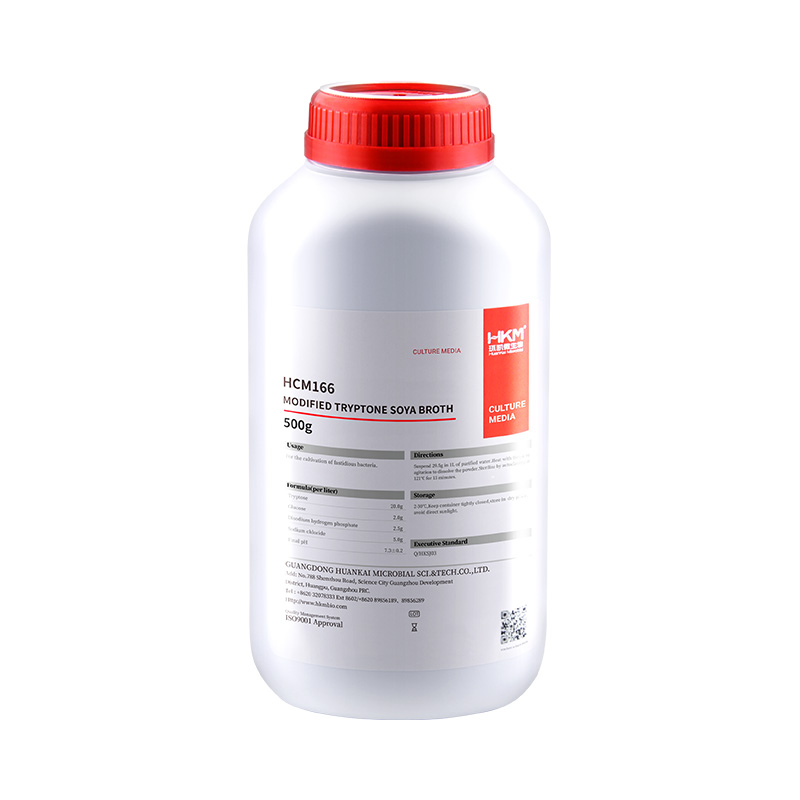
Discover our Modified Tryptone Soya Broth, designed for the enrichment and cultivation of a wide range of microorganisms, ensuring accurate and reliable microbiological testing.

Description
The PM5100 3-color Pre-Stained Protein Ladder High Range is a ready-to-use three-color protein standard with 14 pre-stained proteins covering a wide range of molecular weights from 10 to 245 kDa in Tris-Glycine Buffer (9 to 235 kDa in Bis-Tris (MOPS) buffer and 10 to 235 kDa in Bis-Tris (MES) buffer). Proteins are covalently coupled with different chromophores for easy identification of bands, with three reference proteins carrying enhanced intensity corresponding to a blue band at 20 kDa, green at 40 kDa, and red at 75 kDa, respectively, as separated on SDS-PAGE (Tris-Glycine buffer). The PM5100 3-color Pre-Stained Protein Ladder High Range is designed for monitoring protein separation during SDS-polyacrylamide gel electrophoresis, verification of Western transfer efficiency on membranes (PVDF, nylon, or nitrocellulose) and for approximating the size of proteins.
Features
Contents
Approximately 0.1~0.4 mg/ml of each protein in the buffer (20 mM Tris-phosphate (pH 7.5 at 25°C), 2% SDS, 0.2 mM DTT, 3.6 M urea, and 15% (v/v) glycerol).
Quality Control
Under suggested conditions, PM5100 ExcelBand™ 3-color Pre-Stained Protein Ladder High Range resolves 14 major bands in SDS-PAGE (Tris-Glycine, MOPS, and MES buffer) and after Western blotting to nitrocellulose membrane.
Storage
4°C for 3 months
-20°C for long term storage
The PM5100 3-color Pre-Stained Protein Ladder High Range is a ready-to-use three-color protein standard with 14 pre-stained proteins covering a wide range of molecular weights from 10 to 245 kDa in Tris-Glycine Buffer (9 to 235 kDa in Bis-Tris (MOPS) buffer and 10 to 235 kDa in Bis-Tris (MES) buffer). Proteins are covalently coupled with different chromophores for easy identification of bands, with three reference proteins carrying enhanced intensity corresponding to a blue band at 20 kDa, green at 40 kDa, and red at 75 kDa, respectively, as separated on SDS-PAGE (Tris-Glycine buffer). The PM5100 3-color Pre-Stained Protein Ladder High Range is designed for monitoring protein separation during SDS-polyacrylamide gel electrophoresis, verification of Western transfer efficiency on membranes (PVDF, nylon, or nitrocellulose) and for approximating the size of proteins.

General information
Champion™ Competent Cells are chemically competent cells, which were prepared by SMOBIO to make E. coli perform excellent transformation efficiency. Standard transformation protocol is recommended for large plasmids or non-ampicillin selection. Time-saving transformation protocol is recommended for simple and rapid transformation. Champion™ Competent Cells are one of the fastest and simplest ready-to-use competent cell products in the world.
Kit contents
Shipping condition
Throughout the shipping process, the temperature is maintained under -70°C.
Storage and expiration
Champion™ Competent Cells must be stored between -70°C to -80°C. Subsequent freeze-thaw cycles will reduce transformation efficiency. If high efficiency is required for the experiment, do not use aliquots that have gone through several freeze-thaw cycles. The efficiency of Champion™ Competent Cells lasts for 1 year with proper storage.
Champion™ Competent Cells are chemically competent cells, which were prepared by SMOBIO to make E. coli perform excellent transformation efficiency. Standard transformation protocol is recommended for large plasmids or non-ampicillin selection. Time-saving transformation protocol is recommended for simple and rapid transformation. Champion™ Competent Cells are one of the fastest and simplest ready-to-use competent cell products in the world.

Propargyl-PEG3-NHS ester is a Click Chemistry reagent with a propargyl group and an NHS ester group. The propargyl group can react with biomolecules containing azide group via copper catalyzed Click Chemistry reaction. The NHS ester is an amine reactive group which can be used for derivatizing peptides, antibodies, amine coated surfaces etc. Reagent grade, for research purpose. Please contact us for GMP-grade inquiries.

Propargyl-PEG3-NHS ester is a Click Chemistry reagent with a propargyl group and an NHS ester group. The propargyl group can react with biomolecules containing azide group via copper catalyzed Click Chemistry reaction. The NHS ester is an amine reactive group which can be used for derivatizing peptides, antibodies, amine coated surfaces etc. Reagent grade, for research purpose. Please contact us for GMP-grade inquiries.