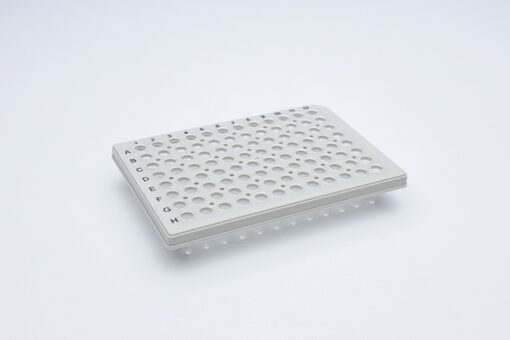
iST-601 Exo-Frame, Abi-Style PCR 96 Well Plate, Semi-Skirted SALE
Facebook
X
Pinterest
Email
Grey, standard profile semi-skirted PCR plate with a rigid two-component hardshell design which eliminates warping and distortion during PCR testing.
Detail
Overview
Grey, standard profile semi-skirted PCR plate with a rigid two-component hardshell design which eliminates warping and distortion during PCR testing.
Grey
Polycarbonate frame
standard-profile PCR plate
Semi-Skirted
Rigid two-component design eliminates warping and distortion during PCR
96W Clear Thin Walled PP Tubes
Packaged 10 plates per sleeve, 50 plates per box
Other Products
DBCO-PEG1-NHS ester
Product Info
Document
Product Info
DBCO-PEG1-NHS Ester is a PEG containing molecule containing an NHS ester moiety that can react specifically and efficiently with primary amines (e.g. the side chain of lysine residues or aminosilane-coated surfaces) at neutral or slightly basic condition to form a covalent bond. DBCO is commonly used for copper-free Click Chemistry reactions. Reagent grade, for research purpose. Please contact us for GMP-grade inquiries.
Document
DBCO-PEG1-NHS Ester is a PEG containing molecule containing an NHS ester moiety that can react specifically and efficiently with primary amines (e.g. the side chain of lysine residues or aminosilane-coated surfaces) at neutral or slightly basic condition to form a covalent bond. DBCO is commonly used for copper-free Click Chemistry reactions. Reagent grade, for research purpose. Please contact us for GMP-grade inquiries.
[CD1010] SMOChem™ Deoxynucleotide (dNTP) Mix, 10 mM each (40 mM total), 200 µl
Product Info
Document
Product Info
Description
The SMOChem™ Deoxynucleotide (dNTP) Mix is an aqueous solution that contains an equimolar solution of ultrapure dATP, dCTP, dGTP and dTTP, each at a concentration of 10 mM at pH 8.5. The dNTP Mix is designed for many different molecular biology applications that involved in DNA synthesis or labeling, such as PCR, real-time PCR, DNA sequencing, reverse transcription, primer extension, and etc. The dNTP Mix is free of exo-deoxyribonuclease and endo-deoxyribonuclease as well as ribonuclease activity. The dNTP Mix offers the possibility to reduce the number of pipetting steps and the risk of reaction set up errors.
Features
Ideal for PCR amplification and cDNA synthesis
Premixed solution
Nuclease and ribonuclease free
Applications
PCR amplification of DNA fragments
DNA fill-in reaction
DNA sequencing
Reverse transcription
One-step RT-PCR
Storage
-20°C for 36 months
Document
The SMOChem™ Deoxynucleotide (dNTP) Mix is an aqueous solution that contains an equimolar solution of ultrapure dATP, dCTP, dGTP and dTTP, each at a concentration of 10 mM at pH 8.5. The dNTP Mix is designed for many different molecular biology applications that involved in DNA synthesis or labeling, such as PCR, real-time PCR, DNA sequencing, reverse transcription, primer extension, and etc. The dNTP Mix is free of exo-deoxyribonuclease and endo-deoxyribonuclease as well as ribonuclease activity. The dNTP Mix offers the possibility to reduce the number of pipetting steps and the risk of reaction set up errors.
Tri(propargyl-PEG5-NHCO-ethyloxyethyl)amine is a click chemistry branched linker. The propargyl groups can react with azide-bearing molecules via copper catalyzed Click Chemistry.
Document
Tri(propargyl-PEG5-NHCO-ethyloxyethyl)amine is a click chemistry branched linker. The propargyl groups can react with azide-bearing molecules via copper catalyzed Click Chemistry.