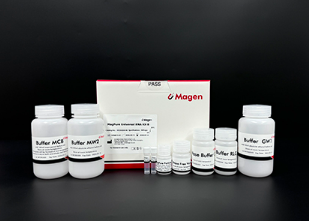
This product is suitable for rapid extraction of RNA from low RNA yield somples such as tissue (<10mg), cells, bone marrow, fresh blood, and other clinical samples. RNA can be used directly for RT-PCR, Real time PCR, NGS, Viral RNA detection and so on.
Detail
Introduction
This product is suitable for rapid extraction of RNA from low RNA yield somples such as tissue (<10mg), cells, bone marrow, fresh blood, and other clinical samples. RNA can be used directly for RT-PCR, Real time PCR, NGS, Viral RNA detection and so on.
Details
Specifications
Features
Specifications
Main Functions
Isolation total RNA from tissue, cell, whole blood
Applications
RT-PCR, cDNA synthesis, second generation sequencing
Purification method
Polydisperse magnetic beads
Purification technology
Magnetic beads technology
Process method
Manual or automatic
Adaptive instrument
Nucleic acid extractor, pipetting workstation
Sample type
Tissues, cells, lymphocytes and other clinical sample
Sample amount
Cells grown in suspension: ≤3 x 10⁶Animal tissue: ≤10mgPlant tissue: ≤30mgWhole blood: 0.5~1.0 ml fresh blood or bone marrow and fresh blood mixture
Kit Contents
Contents
IVD3020B-96
IVD3020B
Purification Times
96 Preps
200 Preps
MagPure Particles N
2.5 ml
5 ml
DNase I
2 x 600 µl
4 x 600 µl
DNase Buffer C
60 ml
120 ml
Buffer RLC
60 ml
120 ml
Buffer MCB*
60 ml
150 ml
Buffer GW1*
44 ml
110 ml
Buffer MW2*
50 ml
100 ml
RNase Free Water
20 ml
60 ml
Storage and Stability
DNase I should be shipped with ice pack and stored at -20°C after arrival. MagPure Particles N should be stored at 2–8°C for long time storage. The remaining kit components can be stored at room temperature(15–25°C) for up to18 months under these conditions.
Gel images of different ranges of library size selection. Sheared human genomic DNA was used as input.
.
Library size selection is an enrichment of a specific range of library sizes for NGS library preparations. The NGS library preparation is related to the quality of the sequencing data. Precise NGS library size selection can increase sequencing efficiency, improve data quality, and reduce costs.
There are two types of sequencing technologies: short-read sequencing and long-read sequencing. Short-read sequencing uses DNA libraries that contain small insert DNA fragments of similar sizes, usually several hundred base pairs. The sequencing efficiency can be improved if the DNA size selection is in the right range. Cat.# 20104S and 20104L are the best kits for NGS library size selection of illumina paired-end 100 (PE100) sequencing with 100-200 bp library inserts; Cat.# 20105S and 20105L are the best kits for NGS library size selection of illumina paired-end 150 (PE150) sequencing with 150-300 bp library inserts; and Cat.# 20106S and 20106L are the best kits for NGS library size selection of illumina paired-end 300 (PE300) sequencing with 300-600 bp library inserts.
Long-read sequencing uses a large DNA fragment as input and makes very long reads. Usually, library size selection is preferred to remove smaller fragments. Cat.# 20110S and 20110L are the best kits for long-read sequencing size selection with DNA sizes >5 kb, and Cat.# 20111S and 20111L are the best kits for long-read sequencing size selection with DNA sizes >10 kb.
The magnetic beads, or SPRI (Solid Phase Reversible Immobilization) beads, is well used for the purification of DNA due to their reversible DNA binding. The NGS library can be size-selected by the magnetic beads or SPRI beads. The properties of the magnetic beads can be changed for a specific range of DNA binding. The contaminants and other unwanted components in the libraries can also be removed during size selection.
Specific ranges of NGS libraries can be selected using magnetic beads with different buffer compositions. The first DNA-beads binding step, also called the right-side clean-up, removes large NGS library fragments. The large NGS library fragments that bind to the beads are discarded with the beads pellet. The desired NGS library fragments in the supernatant are transferred to a new well, and new beads are added to the supernatant for the second beads-DNA binding, also called the left-side clean-up. After the rinsing step, the NGS library fragments with the dual selection are eluted in water or an appropriate buffer. The magnetic beads method has great advantages over time-consuming column purification and tedious gel-based purification.
NGS library size selection with dual clean-ups.
.
Library size selection for long-read sequencing only requires a single clean-up. In this case, only the large library fragments are bound to the beads, while other small library fragments are discarded with the supernatant. The selected larger library fragments are eluted in water or an appropriate buffer after the rinsing step.
NGS library size selection with single clean-up for >5 kb and >10 kb libraries.
Nucleic acid testing (NAT) is the method of choice for detection and quantification of a wide range of micro organisms. Primerdesign manufactures and supplies high quality quantitative real-time PCR kits for the detection and simultaneous quantification of numerous significant pathogens . A copy number standard curve is provided for quantification and an the internal extraction template (DNA or RNA), controls for the quality of the nucleic acid extraction and eliminates false negative results.
The kit is designed with the broadest possible detection profile to ensure that all clinically relevant strains and subtypes are detected*. Target sequences are selected by working with data from key opinion leaders in the field. Multiple sequence alignments and unprecedented real-time PCR expertise in design and validation ensure the best possible kit.
Details of the target and priming specificity are included in the individual handbooks above.
Packaged, optimised and ready to use. Expect Better Data.
Document
Exceptional value for money Rapid detection of all clinically relevant subtypes Positive copy number standard curve for quantification Highly specific detection profile High priming efficiency Broad dynamic detection range (>6 logs) Sensitive to < 100 copies of target
Accurate controls to confirm findings
[PM1700] ExcelBand™ All Blue Broad Range Protein Marker (9-240 kDa), 250 μl x 2
Product Info
Document
Product Info
Description
The PM1700 ExcelBand™ All Blue Broad Range Protein Marker is a blue protein standard with 12 pre-stained proteins covering a wide range of molecular weights from 10 to 240 kDa in Tris-Glycine buffer (9 to 235 kDa in Bis-Tris (MOPS) buffer and Bis-Tris (MES) buffer). Proteins are covalently coupled with a blue chromophore, and two reference bands (at 25 kDa and 72 kDa, respectively) are enhanced in intensity when separated on SDS-PAGE (Tris-Glycine buffer).
The PM1700 ExcelBand™ All Blue Broad Range Protein Marker is designed for monitoring protein separation during SDS-polyacrylamide gel electrophoresis, verification of Western transfer efficiency on membranes (PVDF, nylon, or nitrocellulose) and for approximating the size of proteins.
Features
Ready-to-use — Premixed with a loading buffer for direct loading, no need to boil.
Two enhanced bands — 72 kDa and 25 kDa
Contents
Approximately 0.1~0.5 mg/ml of each protein in the buffer (20 mM Tris-phosphate (pH 7.5 at 25°C), 2% SDS, 0.2 mM DTT, 3.6 M urea, and 15% (v/v) glycerol).
Quality Control
Under suggested conditions, PM1700 ExcelBand™ All Blue Broad Range Protein Marker resolves 12 major bands in SDS-PAGE (Tris-Glycine buffer, MOPS, and MES buffer) and after Western blotting to nitrocellulose membrane.