Simultaneously clean-up and normalize PCR products
Fast (less than 20 minutes), high-throughput and easy processing using centrifugation
Sufficient elution volume (100 µL) for repeat or future assays
Non-magnetic bead purification
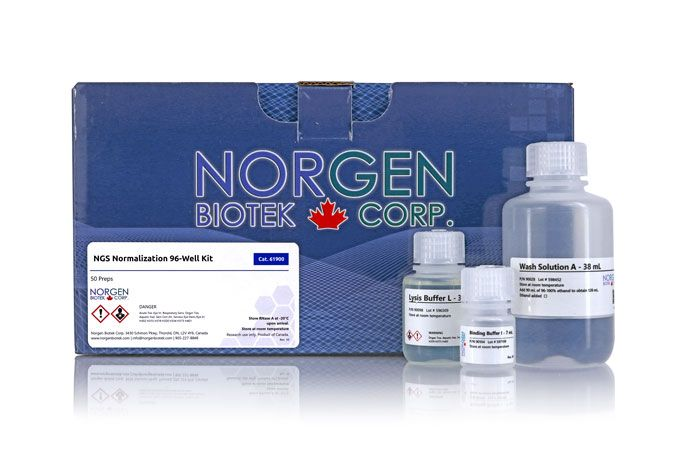
Norgen’s NGS Normalization 96-Well Kit allows for high-throughput NGS library PCR amplicon clean-up and normalization of NGS library PCR product concentration. The clean-up removes all PCR by-products including primers, dimers, enzymes and unincorporated nucleotides during the library prep PCR step. Purification is based on 96-well column chromatography using Norgen’s proprietary resin as the separation matrix. The amount of Norgen’s matrix in each 96 well is optimized to have a limited binding capacity, thus each well can elute an equal concentration of PCR product. The process involves first adding 3 volumes of Buffer SK to the PCR product, and the mixture is then loaded onto the 96-Well Normalization Plate. The bound PCR amplicon is then washed with the provided Wash Solution A in order to remove any remaining impurities, and the purified PCR amplicon is eluted with Elution Buffer B. The purified and normalized library PCR amplicon can then be used in NGS workflows and other sequencing applications.
Storage Conditions All solutions should be kept tightly sealed and stored at room temperature. This kit is stable for 2 years after the date of shipment.
Component
Cat. 61900 (192 preps)
Buffer SK
30 mL
Wash Solution A
2 x 38 mL
Elution Buffer B
30 mL
96-Well Normalization Plate
2
96-Well Collection Plate
2
96-Well Elution Plate
2
Adhesive Tape
1
Product Insert
1
Other Products
Fastin™ – Elastin assay kit
Product Info
Document
Product Info
Introducing the Fastin Assay Kit: Your Straightforward Solution for Elastin Quantification! Our user-friendly kit utilizes a dye-based method to measure elastin from in-vivo and in-vitro sources. It can be used to quantify various elastin forms, spanning from immature tropoelastin to mature, ‘insoluble’ elastin fibers.
Colorimetric Detection (513nm) (Endpoint)
Understanding Elastin: The Key to Tissue Flexibility
Tissues like lungs and arteries must maintain the ability to stretch and recoil repeatedly throughout an organism’s life. Elastin, a mature protein, is responsible for this elasticity and is usually present as insoluble fibers within the ECM. During development, these fibers are initially formed from a soluble precursor called tropoelastin.
What is the Fastin Assay?
The Biocolor Fastin assay is a user-friendly, dye-based means of quantifying elastins derived from both in-vivo and in-vitro sources. A variety of elastin forms can be assayed, from immature tropoelastin to mature ‘insoluble’ elastin fibres.
Further information on how the assay works can be found on the ‘Mode of Action‘ tab.
A list of suggested sample types can be found under the ‘Assay Specification‘ tab.
How does the Fastin assay detect Elastin?
The Fastin Dye Reagent contains an elastin-binding synthetic porphyrin, TPPS (5,10,15,20-tetraphenyl- 21H,23H-porphine). This affinity of TPPS for elastin was first observed when used as a ‘vital stain’ on live animals. Most tissues took up the dye initially but only elastin retained the TPPS molecules over time. [Winkelman, J. (1962), Cancer Res. 22, 589-596; Winkelman, J & Spicer, S. (1962), Stain Technol. 37, 303-305].
It has been proposed that the elastin binding of TPPS may be due to the retention of the acidic dye (which contains four charged sulfate groups) by the basic amino acid side chain residues of elastin.
How does the Fastin assay work?
Step 1. Incubation of samples containing soluble elastin with the Fastin Dye Reagent causes an elastin-dye complex to form. This insoluble complex then precipiates.
Step 2. Dye-labelled elastin is then isolated by centrifugation and the unbound dye removed. Elastin-bound dye is then eluted and measured spectrophotometrically.
Step 3. The elastin content of unknown samples can be calculated by comparison against a calibration curve prepared using a standard comprising water-soluble elastin (supplied with the kit).
Assay range
50 – 500µg/ml
Limit of Detection
50µg/ml
Detection Method
Colorimetric Detection (513nm) (Endpoint)
Measurements per kit
110 in total (allows a maximum of 48 samples to be run in duplicate alongside a standard curve).
Suitable Samples
In-vivo: tissues and fluids. Insoluble elastin will first require conversion to water soluble α-elastin using the oxalic acid reagents and extraction protocol supplied with the kit.
In-vitro: Elastin produced by cells during 2D/3D cell culture. NB elastin in conditioned cell media is typically below the detection limit of the kit.
Precautions
This kit is designed for research use only. Not for use in diagnostic procedures. Kit requires access to a centrifuge, heated water bath or block, as well as a spectrophotometer or colorimeter capable of absorbance detection at 513nm. Specific sample preparation protocols may require customer to provide further reagents, consult assay manual for further information.
Fastin elastin kit contents:
1. Dye Reagent (1x110ml)
2. α-elastin Reference Standard (1x5ml, 1.0 mg/ml soluble Bovine elastin)
6. 1.5ml micro-centrifuge tubes for dye-labelling reaction.
7. Assay kit manual
NB: Additional reagents may be required for sample preparation prior to assay. Consult manual or contact us for further details.
Document
Introducing the Fastin Assay Kit: Your Straightforward Solution for Elastin Quantification! Our user-friendly kit utilizes a dye-based method to measure elastin from in-vivo and in-vitro sources. It can be used to quantify various elastin forms, spanning from immature tropoelastin to mature, ‘insoluble’ elastin fibers. Colorimetric Detection (513nm) (Endpoint)
DBCO-PEG2-acid is an analog of DBCO-Acid with PEG linker and a DBCO group. The DBCO groups is commonly used for copper-free Click Chemistry reactions due to its strain promoted high energy. The hydrophilic PEG chain allows for increased water solubility. The terminal carboxylic acid can react with primary amine groups in the presence of activators (e.g. EDC, or HATU) to form a stable amide bond. Reagent grade, for research purpose. Please contact us for GMP-grade inquiries.
Document
DBCO-PEG2-acid is an analog of DBCO-Acid with PEG linker and a DBCO group. The DBCO groups is commonly used for copper-free Click Chemistry reactions due to its strain promoted high energy. The hydrophilic PEG chain allows for increased water solubility. The terminal carboxylic acid can react with primary amine groups in the presence of activators (e.g. EDC, or HATU) to form a stable amide bond. Reagent grade, for research purpose. Please contact us for GMP-grade inquiries.
Norgen’s Legionella sp. TaqMan PCR Kit is designed for the detection of Legionella sp. specific DNA in a real-time PCR based on the use of TaqMan technology. This kit is designed for research use only and not for use in diagnostic procedures. The detection of Legionella sp. specific DNA is based on TaqMan PCR providing a simple, reliable and rapid result for the detection of Legionella sp. infection. Norgen’s Legionella sp. TaqMan PCR Kit includes a PCR control to monitor for PCR inhibition, and to validate the quality of the sample and the detection result. The Legionella sp. TaqMan PCR Kit comprises Master Mix for the target and PCR control detection, Primer & Probe Mix, as well as a positive control and a negative control (nuclease-free water) to confirm the integrity of the kit reagents.
Legionella sp. TaqMan PCR Kit, 100 reactions
Ready to use format, including Master Mix for the target and PCR control to monitor for PCR inhibition and validate the quality
Specific Primer and Probe mix for the pathogen/virus/viroid of interest
Primer and Probe mix
Positive and negative control to confirm the integrity of the kit reagents
Legionella sp. TaqMan PCR Probe/Primer Set and Controls, 100 reactions
Specific Primer/Probe mix and Positive Control for the pathogen/virus/viroid of interest
Nuclease-free water
Can be used together with Norgen’s PCR Master Mix (#28007) or customer supplied master mix
For research use only and NOT intended for in vitro diagnostics.
Storage Conditions and Product Stability All kit components can be stored for 2 years after the date of production without showing any reduction in performance.
All kit components should be stored at -20°C upon arrival.