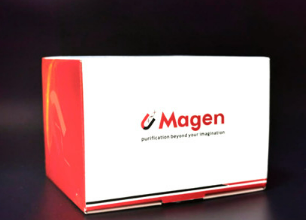
The Kit provides a high throughput of high-quality RNA from 96 samples of cells, tissues, and yeast using silica-membrane spin column plate with a binding capacity of 100ug RNA. RNA purified using the HiPure Total RNA System is ready for applications such as RT-PCR, Northern blotting, poly A+ RNA (mRNA) purification, nuclease protection, and in vitro translation.
Detail
Introduction
The Kit provides a high throughput of high-quality RNA from 96 samples of cells, tissues, and yeast using silica-membrane spin column plate with a binding capacity of 100ug RNA. RNA purified using the HiPure Total RNA System is ready for applications such as RT-PCR, Northern blotting, poly A+ RNA (mRNA) purification, nuclease protection, and in vitro translation.
Details
Principle
HiPure RNA technology simplifies total RNA isolation. Samples are first lysed and then homogenized. Ethanol is added to the lysate to provide ideal binding conditions. The lysate is then loaded onto the HiPure silica membrane and RNA binds to the silica membrane, and all contaminants are efficiently washed away. For certain RNA applications that are sensitive to very small amounts of DNA, the residual amounts of DNA remaining can be removed using a convenient on-column DNase treatment. Pure, concentrated RNA is eluted in water.
Kit Contents
Contents
R401601
R401602
Purification Times
1 x 96
4 x 96
HiPure RNA Plate
1
4
1.5ml Collection Plate
1
4
0.5ml Collection Plate
1
4
RTL Lysis Buffer
100 ml
400 ml
RNA Binding Buffer*
30 ml
120 ml
Buffer RW1
100 ml
400 ml
Buffer RW2*
50 ml
2 x 100 ml
RNase Free Water
20 ml
80 ml
Storage and Stability
The Kit can be stored dry at room temperature (15-25°C) and are stable for at least 18 months under these conditions.
Other Products
DBCO-PEG12-amine
Product Info
Document
Product Info
DBCO-PEG12-amine is a PEG linker which contains DBCO and amine moieties. The DBCO group is commonly used in copper-free Click Chemistry reactions. The amine group is reactive with carboxylic acids, activated NHS esters, carbonyls (ketone, aldehyde), etc. The hydrophilic PEG spacer increases the water solubility of the compound. Reagent grade, for research purpose.
Document
DBCO-PEG12-amine is a PEG linker which contains DBCO and amine moieties. The DBCO group is commonly used in copper-free Click Chemistry reactions. The amine group is reactive with carboxylic acids, activated NHS esters, carbonyls (ketone, aldehyde), etc. The hydrophilic PEG spacer increases the water solubility of the compound. Reagent grade, for research purpose.
NGS FFPE DNA Library Prep Kit (illumina and MGI Platforms)
Product Info
Document
Product Info
The NGS FFPE DNA Library Prep Kit (illumina and MGI Platforms) was developed for the construction of high quality FFPE DNA libraries using 10 ng to 400 ng of input DNA isolated from formalin-fixed, paraffin-embedded (FFPE) samples. The DNA damage caused by fixation makes it difficult to construct high quality libraries. Our kit has been optimized to repair damaged DNA in the reactions. Multiplexing of the NGS FFPE DNA Library is possible.
NGS FFPE DNA Library Prep Kit Workflow
FFPE samples are a great resource for biomedical research. However, the methods for fixation and condition of storage significantly damage the DNA in the samples. Thus, the extraction of high quality DNA from FFPE samples is often a challenge. Low yield and low quality of FFPE DNA usually are common because of the limited tissue material and the DNA degradation.
As a result, it is usually difficult to construct high quality NGS libraries from low amount and low quality of FFPE DNA. In order to address this issue, we have developed the NGS FFPE DNA Library Prep Kit to make high quality libraries from the low input of FFPE DNA samples.
Three index types are available for the NGS FFPE DNA Library Prep Kit of the illumina platform:
Non-index (Cat.# 30035): Libraries do not have index.
Index (Cat.# 30037): Each of our index primers contains a unique barcode DNA (6 bases long) that can be used to identify individual library. Multiplexing of libraries is up to 48 samples. Index information can be downloaded here.
Unique dual index (Cat.# 30039): FFPE DNA library multiplexing is possible with 96 samples based on the unique dual indexing system. Our unique Four–Base Difference Index System allows us to make indexes that have at least 4 bases different from each other in the 8-base index sequence. Our unique dual indexing primers can effectively remove NGS errors including index hopping, de-multiplexing errors, index cross-contamination, mis-assignments etc. The unique dual index primer set includes 96 pre-mixed unique pairs of i5 and i7 index primers. Index information can be downloaded here.
Indexes are available for the MGI platform kits (Cat.# 34037).
Kit advantages:
Fast and simple protocol
Making libraries in just 1.5 hours
10 minutes of hands-on time
Easy procedure
Ready-to-use master mix to reduce the tedious mixing
Less reaction components to simplify the reaction setup
Less magnetic beads needed for the purification steps: saving more than 50% of the expensive beads
Low input FFPE DNA: From 10 ng to 400 ng
Comparison of library conversion efficiency under the same condition. Input DNA amount is 25 ng.
Comparison of library yield under the same condition. Input DNA amount is 25 ng.
Document
The NGS FFPE DNA Library Prep Kit (illumina and MGI Platforms) was developed for the construction of high quality FFPE DNA libraries using 10 ng to 400 ng of input DNA isolated from formalin-fixed, paraffin-embedded (FFPE) samples. The DNA damage caused by fixation makes it difficult to construct high quality libraries. Our kit has been optimized to repair damaged DNA in the reactions. Multiplexing of the NGS FFPE DNA Library is possible.
Propargyl-PEG3-alcohol consists of a hydroxyl group and a propargyl group. The propargyl group reacts with azide compounds in copper catalyzed azide-alkyne Click Chemistry to form a triazole linkage. Reagent grade, for research purpose. Please contact us for GMP-grade inquiries.
Document
Propargyl-PEG3-alcohol consists of a hydroxyl group and a propargyl group. The propargyl group reacts with azide compounds in copper catalyzed azide-alkyne Click Chemistry to form a triazole linkage. Reagent grade, for research purpose. Please contact us for GMP-grade inquiries.