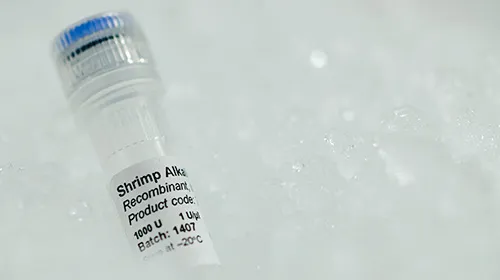
ArcticZymes’ Shrimp Alkaline Phosphatase (SAP), including its recombinant version (rSAP), is the gold standard and the first heat-labile, all-purpose alkaline phosphatase on the market.
Detail
OverView
ArcticZymes’ Shrimp Alkaline Phosphatase (SAP), including its recombinant version (rSAP), is the gold standard and the first heat-labile, all-purpose alkaline phosphatase on the market.
Originally isolated from Pandalus borealis (Arctic shrimp), it has been purified from a recombinant source since 2010. Unlike other alkaline phosphatases, rSAP can be fully inactivated by a short heat treatment of 15 minutes at 65°C.
This added convenience through complete heat inactivation has made SAP one of the most sold DNA modifying enzymes.
For added flexibility, especially when lyophilisation may be desired, rSAP is also available in a Glycerol FREE format. First launched in 1993, SAP’s unique features continue to make it a valuable tool in various applications.
Key Features
Gold standard heat labile, all-purpose alkaline phosphatase.
Completely inactivated after 5 min at 65°C or 1 min at 75°C.
Robust: Active in most restriction enzyme buffers, no need for supplemental zinc or other additives for activity.
Simple, hassle-free dephosphorylation of DNA, RNA, dNTPs and proteins for subsequent use in cloning or end-labelling of probes.
No vector purification necessary.
Easy inactivation of unincorporated dNTPs in PCR products prior to DNA sequencing or SNP analysis.
Ideal for MALDI-TOF, cloning, HLA typing, genotyping and sequencing.
Preparing substrate in protein kinase studies.
Figures
Properties
Other Products
PreviousNext[DM3260] FluoroBand™ 1 KB Plus (0.1-10 kb) Fluorescent DNA Ladder, 500 μlPreviousNext
Product Info
Document
Product Info
Description
The DM3260 FluoroBand™ 1 KB Plus (0.1-10 kb) Fluorescent DNA Ladder is a ready-to-use DNA ladder, which is pre-mixed with high sensitivity DNA binding fluorescent dye and loading dye for direct gel loading. The DNA Ladder DM3260 is composed of 19 individual DNA fragments: 10k, 8k, 6k, 5k, 4k, 3k, 2.5k, 2k, 1.5k, 1k, 900, 800, 700, 600, 500, 400, 300, 200, and 100 base pairs derived from a mixture of PCR products and specifically digested plasmid DNA; these bands can be visualized when illuminated with 470 nm blue light or UV light. This product contains three enhanced bands (3 kb, 1.5 kb and 500 bp) for easier reference. In addition, three tracking dyes, Xylene cyanol FF, Bromophenol blue and Orange G which mimic the migration of 4,000 bp, 500 bp and 50 bp dsDNA during electrophoresis are also added for real time monitoring. Real time observation of the electrophoresis is also possible if compatible light source is fitted to the electrophoresis tank.
Features
Sharp bands
Quick reference— enhanced bands
Ready-to-use— premixed with loading dye for direct loading
Stable— room temperature storage over 6 months
Directly observed by UV or blue light— premixed with high sensitive DNA fluorescent dye
Source
Phenol extracted PCR products and dsDNA digested with specific restriction enzymes, equilibrated in 10 mM Tris-HCl (pH 8.0) and 10 mM EDTA.
Range
100 ~ 10,000 bp
Concentration
87 µg/ 500 µl
Recommended loading volume
5 µl/ well
Storage
Protected from light Room temperature for 6 months 4°C for 12 months -20°C for 24 months
Document
The DM3260 FluoroBand™ 1 KB Plus (0.1-10 kb) Fluorescent DNA Ladder is a ready-to-use DNA ladder, which is pre-mixed with high sensitivity DNA binding fluorescent dye and loading dye for direct gel loading. The DNA Ladder DM3260 is composed of 19 individual DNA fragments: 10k, 8k, 6k, 5k, 4k, 3k, 2.5k, 2k, 1.5k, 1k, 900, 800, 700, 600, 500, 400, 300, 200, and 100 base pairs derived from a mixture of PCR products and specifically digested plasmid DNA; these bands can be visualized when illuminated with 470 nm blue light or UV light. This product contains three enhanced bands (3 kb, 1.5 kb and 500 bp) for easier reference. In addition, three tracking dyes, Xylene cyanol FF, Bromophenol blue and Orange G which mimic the migration of 4,000 bp, 500 bp and 50 bp dsDNA during electrophoresis are also added for real time monitoring. Real time observation of the electrophoresis is also possible if compatible light source is fitted to the electrophoresis tank.
Propargyl-PEG4-NHS ester is an amine reactive PEG linker with an alkyne group. Under the copper catalyzation, alkyne group can react with azide-bearing biomolecules to form a stable triazole linkage. The hydrophilic PEG spacer increases solubility in aqueous media. Reagent grade, for research purpose. Please contact us for GMP-grade inquiries.
Document
Propargyl-PEG4-NHS ester is an amine reactive PEG linker with an alkyne group. Under the copper catalyzation, alkyne group can react with azide-bearing biomolecules to form a stable triazole linkage. The hydrophilic PEG spacer increases solubility in aqueous media. Reagent grade, for research purpose. Please contact us for GMP-grade inquiries.
Isolate all sizes of circulating and exosomal RNA, including microRNA
Versatile plasma/serum input ranges
No phenol extractions
No carrier RNA
Bind and elute all RNA irrespective of size or GC content, without bias
Concentrate circulating RNA and exosomal RNA into a flexible elution volume
High quality, purified RNA is suitable for a variety of downstream applications, including Small RNA Sequencing. Find out more information on Norgen’s NGS services
Compatible with Streck Cell-Free RNA BCT® Tubes
Purification is based on spin column chromatography that uses Norgen’s proprietary resin separation matrix
These kits provide a fast, reliable and convenient method to purify and concentrate high quality, high purity and inhibitor-free cell-free circulating and exosomal RNA using a convenient spin column method. These kits can purify RNA from fresh or frozen serum or plasma samples prepared from blood collected on either EDTA or Citrate. Plasma samples prepared from blood collected on heparin should not be used, as heparin can significantly interfere with many downstream applications such as RT-PCR. The purified plasma/serum RNA is fully compatible with all downstream applications including PCR, qPCR, methylation-sensitive reverse transcription qPCR, reverse transcription PCR, Northern blotting, RNase protection and primer extension, expression array assays, and NGS.
Background
Plasma/Serum cell-free circulating RNA or exosomal RNA has the potential to provide biomarkers for certain cancers and disease states. Exosomes are 40 – 150 nm membrane vesicles, which are secreted by most cell types. Exosomes can be found in saliva, blood, urine, amniotic fluid and malignant ascitic fluids, among other biological fluids. Evidence has been accumulating recently that these vesicles act as cellular messengers, conveying information to distant cells and tissues within the body. These exosomes may play a functional role in mediating adaptive immune responses to infectious agents and tumours, tissue repair, neural communication and transfer of pathogenic proteins. For this reason exosomal RNAs may serve as biomarkers for various diseases including cancer. As the RNA molecules encapsulated within exosomes are protected from degradation by RNAses they can be efficiently recovered from biological fluids, such as plasma or serum.
Plasma/Serum RNA Purification Mini Kit
This kit can purify RNA from fresh or frozen serum or plasma samples prepared from blood collected on either EDTA or Citrate, from volumes ranging from 50 µL to 200 µL. The purified plasma/serum RNA is eluted in a flexible final volume of 10 µL to 25 µL.
Plasma/Serum RNA Purification Midi Kit
This utilizes a two column method, and can purify RNA from fresh or frozen serum or plasma samples prepared from blood collected on either EDTA or Citrate, from volumes ranging from 250 µL to 1.5 mL. The first column will handle the large volume input of bodily fluids that is followed by a concentration on a mini column for a final elution of 50 µL to 100 µL.
Plasma/Serum RNA Purification Maxi Kit
This kit can purify RNA from fresh or frozen serum or plasma samples prepared from blood collected on either EDTA or Citrate, from volumes ranging from 2 mL to 5 mL. The first column will handle the large volume input of bodily fluids that is followed by a concentration on a mini column for a final elution of 50 µL to 100 µL.
All sizes, including miRNA and small RNA (<200 nt)
Elution Volume
50-100 μL
Time to Complete 10 Purifications
35-40 minutes
Average Yields*
Variable depending on specimen
*Please check page 7 of the Product Insert for Average Plasma/Serum Yields and Common RNA Quantification Methods.
This kit is suitable for the isolation of RNA from fresh or frozen serum or plasma prepared from blood collected on either EDTA or Citrate. Plasma samples prepared from blood collected on heparin should not be used as heparin can significantly interfere with many downstream applications such as RT-PCR.
Storage Conditions and Product Stability All solutions should be kept tightly sealed and stored at room temperature. This kit is stable for 2 years after the date of shipment. It is recommended to warm Lysis Buffer A for 20 minutes at 60°C if any salt precipitation is observed.