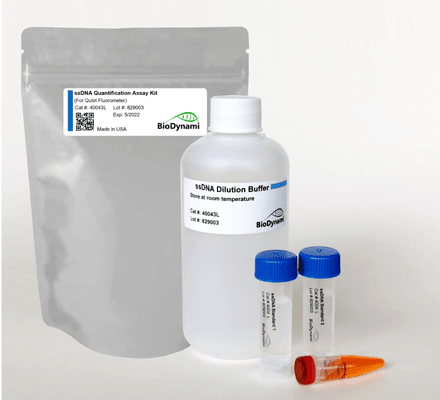
The ssDNA Quantification Kit is developed for single stranded DNA quantification. The kit includes ssDNA Dye, ssDNA Dilution Buffer, and two ssDNA Standards. Simply dilute the ssDNA Dye with the ssDNA Dilution Buffer, add DNA sample (volume from 1-20 μL), then read the concentration using the Qubit® Fluorometer. The assay is accurate for DNA concentrations from 50 pg/µL to 200 ng/µL based on the line corresponding of the data to standards.
Detail
ssDNA Quantification Kit
The ssDNA Quantification Kit is developed for single stranded DNA quantification. The kit includes ssDNA Dye, ssDNA Dilution Buffer, and two ssDNA Standards. Simply dilute the ssDNA Dye with the ssDNA Dilution Buffer, add DNA sample (volume from 1-20 μL), then read the concentration using the Qubit® Fluorometer. The assay is accurate for DNA concentrations from 50 pg/µL to 200 ng/µL based on the line corresponding of the data to standards.
Our kit detects ssDNA by using fluorescent dye that enables sensitive single stranded DNA quantification , including ssDNA viruses, synthetic ssDNA, first-strand cDNA synthesis, denatured DNA, and bisulfate-converted DNA etc. ssDNA quantification is essential for the study of the biological process involves ssDNA.
Features
Optimized for use with the Qubit® Fluorometer
Uses the Qubit® ssDNA assay setting
Linear range: 1-200 ng ssDNA
Cost saving by more than 50%
A series of input ssDNA (200, 400, 600, 800, 1000, and 1200 ng) was used.
The performance of the BioDynami ssDNA Quantification Kit is nearly identical to that of Thermo Fisher’s Qubit ssDNA kit (figure below).
Comparison of BioDynami ssDNA Quantification Kit with Thermo Fisher kit.
Common contaminants such as salts, solvents, or detergents are well tolerated in the assay (Table 1).
Contaminants has been tested in BioDynami ssDNA Kit.
Other Products
Total Dietary Fiber Controls
Product Info
Document
Product Info
K-TDFC
SKU: 700004345
Contains 6 Controls: Use with K-TDFR, K-INTDF or K-RINTDF
Content:
Contains 6 Controls: Use with K-TDFR, K-INTDF or K-RINTDF
Shipping Temperature:
Ambient
Storage Temperature:
Short term stability: Ambient, Long term stability: See individual component labels
Stability:
> 2 years under recommended storage conditions
Analyte:
Dietary Fiber
For use with the Total Dietary Fiber Assay Kit. Contains barley β-glucan, high amylose maize starch, wheat starch, casein, pectin and larch galactan. Wheat arabinoxylan is available on request.
Methyltetrazine-PEG1-DBCO is a TCO reactive reagent with a DBCO group and water-soluble PEG spacer. This reagent can be used to convert azido-containing peptides or proteins into tetrazine-modified peptides or protein without catalyst or axillary reagents. DBCO is commonly used for copper-free Click Chemistry reactions. Reagent grade, for research purpose. Please contact us for GMP-grade inquiries.
Document
Methyltetrazine-PEG1-DBCO is a TCO reactive reagent with a DBCO group and water-soluble PEG spacer. This reagent can be used to convert azido-containing peptides or proteins into tetrazine-modified peptides or protein without catalyst or axillary reagents. DBCO is commonly used for copper-free Click Chemistry reactions. Reagent grade, for research purpose. Please contact us for GMP-grade inquiries.
NGS DNA Library Prep Kit (illumina and MGI Platforms)
Product Info
Document
Product Info
The kit was developed for construction of high quality libraries for next generation sequencing (illumina and MGI Platforms). The kit needs double strand DNA fragments (blunt and/or sticky) as input DNA for NGS library preparation, and is compatible with DNA fragments generated from both enzymatic methods and physical methods (sonication, nebulization etc.). Library multiplexing is possible with different types of indexes.
The kit was optimized for next generation sequencing (NGS) library preparation with different types of samples. Most of DNA library preparation requires the ligation of sheared DNA fragments to library adaptors and the DNA library preparation is closely related to the quality of NGS data. With BioDynami’s unique DNA library preparation technologies, the fast and simple kit allows high quality NGS library preparation to be completed in 1.5 hours with only 10 minutes of hands-on time.
Some genomic regions are very difficult to be covered evenly and usually result in very low coverage rate or gap in these regions.
Typical difficult regions are: • with high GC contents • have secondary structures: mainly due to repeat sequences • the worst cases: have both high GC contents and repeated sequences.
Example: human TERT gene is one of the most difficult regions as shown above. NGS data showed that BioDynami kit has the best performance to cover the extremely difficult human TERT gene region.
Three index types are available for the illumina platform kits:
Non-index (illumina Cat.# 30009): Libraries do not have index.
Index (illumina Cat.# 30021): A unique barcode sequence with 6 bases has been included in each of the index primers. RNA Sequencing library multiplexing is possible with up to 48 samples. Index information can be downloaded here.
Unique dual index (illumina Cat.# 30023): RNA Sequencing library multiplexing up to 96 samples is possible with the unique dual indexes. We have developed a 4-Base Difference Index System. The system can generate indexes with at least 4 bases different from others in the 8-base indexing region. the unique dual indexing primers identify sequencing errors such as index hopping, mis-assignment, and de-multiplexing errors. Index information can be downloaded here.
Indexes are available for the MGI platform kits (Cat.# 34021).
Document
The kit was developed for construction of high quality libraries for next generation sequencing (illumina and MGI Platforms). The kit needs double strand DNA fragments (blunt and/or sticky) as input DNA for NGS library preparation, and is compatible with DNA fragments generated from both enzymatic methods and physical methods (sonication, nebulization etc.). Library multiplexing is possible with different types of indexes.