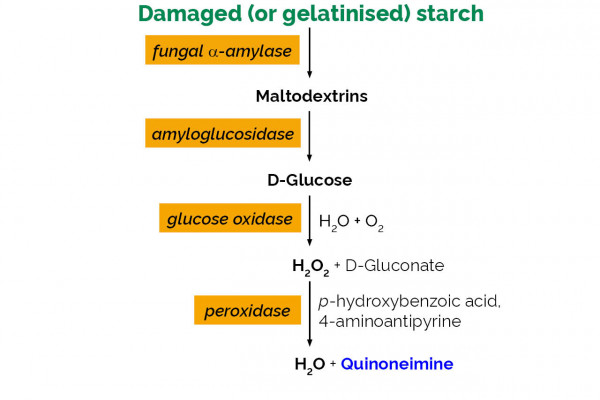
The Starch Damage Test Kit is suitable for the determination of starch damage in wheat flour / cereal flours.
Detail
K-SDAM
SKU: 700004338
200 assays per kit
Content:
200 assays per kit
Shipping Temperature:
Ambient
Storage Temperature:
Short term stability: 2-8oC, Long term stability: See individual component labels
Stability:
> 1 year under recommended storage conditions
Analyte:
Starch Damage
Assay Format:
Spectrophotometer
Detection Method:
Absorbance
Wavelength (nm):
510
Signal Response:
Increase
Limit of Detection:
0.5 g/100 g
Total Assay Time:
~ 40 min
Application examples:
Cereal flours and other materials.
Method recognition:
AACC Method 76-31.01, ICC Standard No. 164 and RACI Standard Method
The Starch Damage Test Kit is suitable for the determination of starch damage in wheat flour / cereal flours.
The milling of wheat causes physical damage to a proportion of the starch granules of the flour. The level of starch damage directly affects water absorption and dough mixing properties of the flour and is thus of technological significance.
Q-PAGE™ TGN (Tris-Glycine Novel) Precast Gels are ready-to-use acrylamide gels for SDS-PAGE running in Tris-Glycine buffer system. With unique formula, Q-PAGE™ TGN Precast Gels perform enhanced speed, better separation, and longer shelf life as compared with conventional Laemmli Tris-HCl gels. The protein migration patterns in Q-PAGE™ TGN series, however, are similar with typical Laemmli Tris-HCl gels, and thus Q-PAGE™ TGN Precast Gels are compatible to traditional SDS-PAGE and subsequent analyses.
Q-PAGE™ TGN Precast Gels are available in gradient (4 to 15%) and fixed (10%) concentrations of polyacrylamide in 12- and 15-well formats. Two available cassette sizes, Mini (10 x 8.3 cm) and Midi (10 x 10 cm), are compatible with most popular protein electrophoresis systems. Q-PAGE™ Mini (QP4XXX) Gels are suitable for Bio-Rad® and other systems. Q-PAGE™ Midi (QP5XXX) Gels are suitable for Invitrogen® XCell SureLock® Mini-Cell, Invitrogen® Mini Gel Tank, Hoefer SE260, and other systems.
Key Features
User-friendly gel cassette:
Numbered and framed wells for sample loading
Labeled warning sign and green tape as reminder
Enhanced gel performance:
Enhanced gel electrophoresis speed
Better band separation, equivalent to commercially 4-20% TG gels
Stable for shipping at ambient temperature
Easy compatibility:
Available as homogeneous and adjusted gradient gels for a wide range of protein separation.
Compatible with most popular protein electrophoresis systems
Storage and stability
Store Q-PAGE™ Precast Gels at 4°C for periods up to 12 months.
Do not freeze Q-PAGE™ Precast Gels. Remove tape and comb before electrophoresis.
Keep Q-PAGE™ Precast Gels flat during storage.
Document
Q-PAGE™ TGN (Tris-Glycine Novel) Precast Gels are ready-to-use acrylamide gels for SDS-PAGE running in Tris-Glycine buffer system. With unique formula, Q-PAGE™ TGN Precast Gels perform enhanced speed, better separation, and longer shelf life as compared with conventional Laemmli Tris-HCl gels. The protein migration patterns in Q-PAGE™ TGN series, however, are similar with typical Laemmli Tris-HCl gels, and thus Q-PAGE™ TGN Precast Gels are compatible to traditional SDS-PAGE and subsequent analyses.
Q-PAGE™ TGN Precast Gels are available in gradient (4 to 15%) and fixed (10%) concentrations of polyacrylamide in 12- and 15-well formats. Two available cassette sizes, Mini (10 x 8.3 cm) and Midi (10 x 10 cm), are compatible with most popular protein electrophoresis systems. Q-PAGE™ Mini (QP4XXX) Gels are suitable for Bio-Rad® and other systems. Q-PAGE™ Midi (QP5XXX) Gels are suitable for Invitrogen® XCell SureLock® Mini-Cell, Invitrogen® Mini Gel Tank, Hoefer SE260, and other systems.
1X MOPS-SDS Running Buffer Powder is used for electrophoresis on Q-PAGE™ Bis-Tris Precast Gel or polyacrylamide gels in Bis-Tris buffer system. It is convenient and universal for electrophoresis in Bis-Tris buffer system.
Features
Reliable: Rigorous quality control for reproducible separation of protein electrophoresis.
Convenient: Premeasured pouches make 1 liter of 1X buffer solution; No pH adjustment is necessary.
Fast: Dissolving in minutes and then ready to use.
Stable: Powder packaging suitable for long-term storage.
Contents
50mM Tris Base, 50mM MOPS, 0.1% SDS, 1mM EDTA
Applications
Running buffer for sodium dodecyl sulfate-polyacryamide gel electrophoresis (SDS-PAGE) in Bis-Tris buffer system
Storage
Room temperature for 24 months
Document
1X MOPS-SDS Running Buffer Powder is used for electrophoresis on Q-PAGE™ Bis-Tris Precast Gel or polyacrylamide gels in Bis-Tris buffer system. It is convenient and universal for electrophoresis in Bis-Tris buffer system.
Short term stability: 2-8oC, Long term stability: See individual component labels
Stability:
> 2 years under recommended storage conditions
Analyte:
D-3-Hydroxybutyric Acid
Assay Format:
Spectrophotometer, Microplate, Auto-analyser
Detection Method:
Absorbance
Wavelength (nm):
492
Signal Response:
Increase
Linear Range:
0.4 to 12 µg of D-3-hydroxybutyric acid per assay
Limit of Detection:
0.074 mg/L
Reaction Time (min):
~ 6 min
Application examples:
Egg, egg products (e.g. egg powder) and other materials (e.g. biological cultures, samples, etc.).
Method recognition:
Methods based on this principle have been accepted by EEC
The D-3-Hydroxybutyric Acid (β-Hydroxybutyrate) Assay Kit is suitable for the specific measurement and analysis of D-hydroxybutyric acid in eggs and egg products and other foods and beverages.
Note for Content: The number of manual tests per kit can be doubled if all volumes are halved. This can be readily accommodated using the MegaQuantTM Wave Spectrophotometer (D-MQWAVE).
All reagents stable for > 2 years after preparation
Very rapid reaction (~ 3 min)
No wasted diaphorase solution (stable suspension supplied)
Mega-Calc™ software tool is available from our website for hassle-free raw data processing
Standard included
Suitable for manual, microplate and auto-analyser formats
Document
The D-3-Hydroxybutyric Acid (β-Hydroxybutyrate) Assay Kit is suitable for the specific measurement and analysis of D-hydroxybutyric acid in eggs and egg products and other foods and beverages.