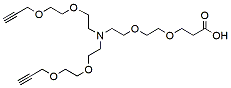
N-(Acid-PEG2)-N-bis(PEG2-propargyl) is reactive with azide-bearing compounds or biomolecules via copper catalyzed azide-alkyne Click Chemistry to yield a stable triazole linkage. The terminal carboxylic acid can react with primary amino groups in the presence of activators (e.g. EDC, or HATU) to form a stable amide bond. Reagent grade, for research purpose. Please contact us for GMP-grade inquiries.
Detail
N-(Acid-PEG2)-N-bis(PEG2-propargyl) is reactive with azide-bearing compounds or biomolecules via copper catalyzed azide-alkyne Click Chemistry to yield a stable triazole linkage. The terminal carboxylic acid can react with primary amino groups in the presence of activators (e.g. EDC, or HATU) to form a stable amide bond. Reagent grade, for research purpose. Please contact us for GMP-grade inquiries.
Other Products
R4171 HiPure Viral RNA Kit
Product Info
Document
Product Info
Introduction
Hipure viral RNA kit is suitable for purifying viral RNA from samples such as cell-free body fluid or culture medium. The kit is based on silica gel column purification technology. It requires no toxic phenol chloroform extraction and time-consuming alcohol precipitation in the extraction. The whole extraction process takes only 25 minutes. The kit is suitable for extracting viral RNA from 1-140µl cell-free fluid samples such as serum, plasma, cell-free body fluid or culture medium. The product has successfully extracted hepatitis B A/C, hepatitis C RNA, SARS and HIV. The obtained RNA can be directly used for RT-PCR, Northern hybridization and virus detection.
Details
Specifications
Features
Specifications
Main Functions
Extract viral RNA from 140μl cell-free samples
Applications
RT-PCR, Northern hybridization, and various virus detection
Purification method
Mini spin column
Purification technology
Silica technology
Process method
Manual (centrifugation or vacuum)
Sample type
Cell-free body fluid or culture medium
Sample amount
140μl
Elution volume
≥15μ
Time per run
≤25 minutes
Liquid carrying volume per column
800μl
Binding yield of column
100μg
Principle
Hipure silica gel column is based on glass fiber filter membrane with high binding force. Under the condition of high concentration of ionizing agent (such as guanidine hydrochloride or guanidine isothiocyanate), the filter membrane can adsorb nucleic acid through hydrogen bond and electrostatic, while protein and other impurities are not adsorbed and removed. The filter membrane adsorbed with nucleic acid is washed to remove the residual protein and salt. Finally, the nucleic acid adsorbed on the filter membrane can be washed out with low salt buffer (such as buffer TE) or water. The obtained nucleic acid has high purity and can be directly used in various downstream experiments.
The sample is homogenized and lysed in the lysate, and RNA is released into the lysate. The high concentration of guanidine isothiocyanate contained in the lysate denatured and inactivated endogenous or exogenous RNase, while RNA is protected from degradation. The lysate is centrifuged to remove insoluble impurities. After adding ethanol to adjust the binding conditions, it is transferred to the column for filtration. RNA is adsorbed on the membrane of the column, while protein is removed without adsorption. The column is washed with buffer VHB to remove protein and other impurities, washed with buffer RW2 to remove salt. Finally the RNA is eluted by RNase free water. The eluted RNA can be directly used in RT-PCR, Northern blot, poly-A purification, in vitro translation, etc.
Advantages
Fast – several samples can be extracted in 20 minutes by column method
High quality – high purity total RNA can be directly used in various sensitive downstream applications
Safe – no phenol chloroform extraction required
Sensitive – RNA can be recovered at the level of PG
High yield – carrier RNA contained in the product maximize the recovery of trace nucleic acid
Kit Contents
Contents
R417102
R417103
Purification Times
50 Preps
250 Preps
HiPure Viral Micro Columns
50
250
2ml Collection Tubes
100
500
Buffer VRL
50 ml
200 ml
Carrier RNA
310 µg
3 x 310 µg
Buffer VHB*
13 ml
110 ml
Buffer RW2*
20 ml
2 x 50 ml
Nuclease Free Water
10 ml
30 ml
Storage and Stability
Carrier RNA should be stored at 2–8°C upon arrival. However, short-term storage (up to 12 weeks) at room temperature (15–25°C) does not affect their performance. The remaining kit components can be stored at room temperature (15–25°C) and are stable for at least 18 months under theseconditions
Document
Hipure viral RNA kit is suitable for purifying viral RNA from samples such as cell-free body fluid or culture medium. The kit is based on silica gel column purification technology. It requires no toxic phenol chloroform extraction and time-consuming alcohol precipitation in the extraction. The whole extraction process takes only 25 minutes. The kit is suitable for extracting viral RNA from 1-140µl cell-free fluid samples such as serum, plasma, cell-free body fluid or culture medium. The product has successfully extracted hepatitis B A/C, hepatitis C RNA, SARS and HIV. The obtained RNA can be directly used for RT-PCR, Northern hybridization and virus detection.
The PCR Decontamination Kit can remove contaminating DNA in PCR master mixes, without reduction of PCR sensitivity.
The double-strand specific property of the dsDNase allows decontamination with primers and probe present.
Efficient for end-point PCR, probe-based qPCR, and some SYBR based qPCR mixes.
Contaminating bacterial DNA can be reduced to levels below the detection limit.
Fast and easy protocol.
Flat NTCs (No Template Controls).
Decontamination of master mixes without reduction of sensitivity has always been a challenge. Especially when minor amounts of DNA are targeted, contaminating DNA is a major problem. Any loss of sensitivity in the qPCR assay caused by the decontamination protocol is unacceptable.
In Figure 1, it is demonstrated that the PCR decontamination kit can remove contaminating DNA from a qPCR mix to non-detectable levels (flat NTC), without affecting the sensitivity of the qPCR.
Kit Contents
DTT (Inactivation Aid)
dsDNase
Document
The PCR Decontamination Kit can remove contaminating DNA in PCR master mixes, without reduction of PCR sensitivity.